
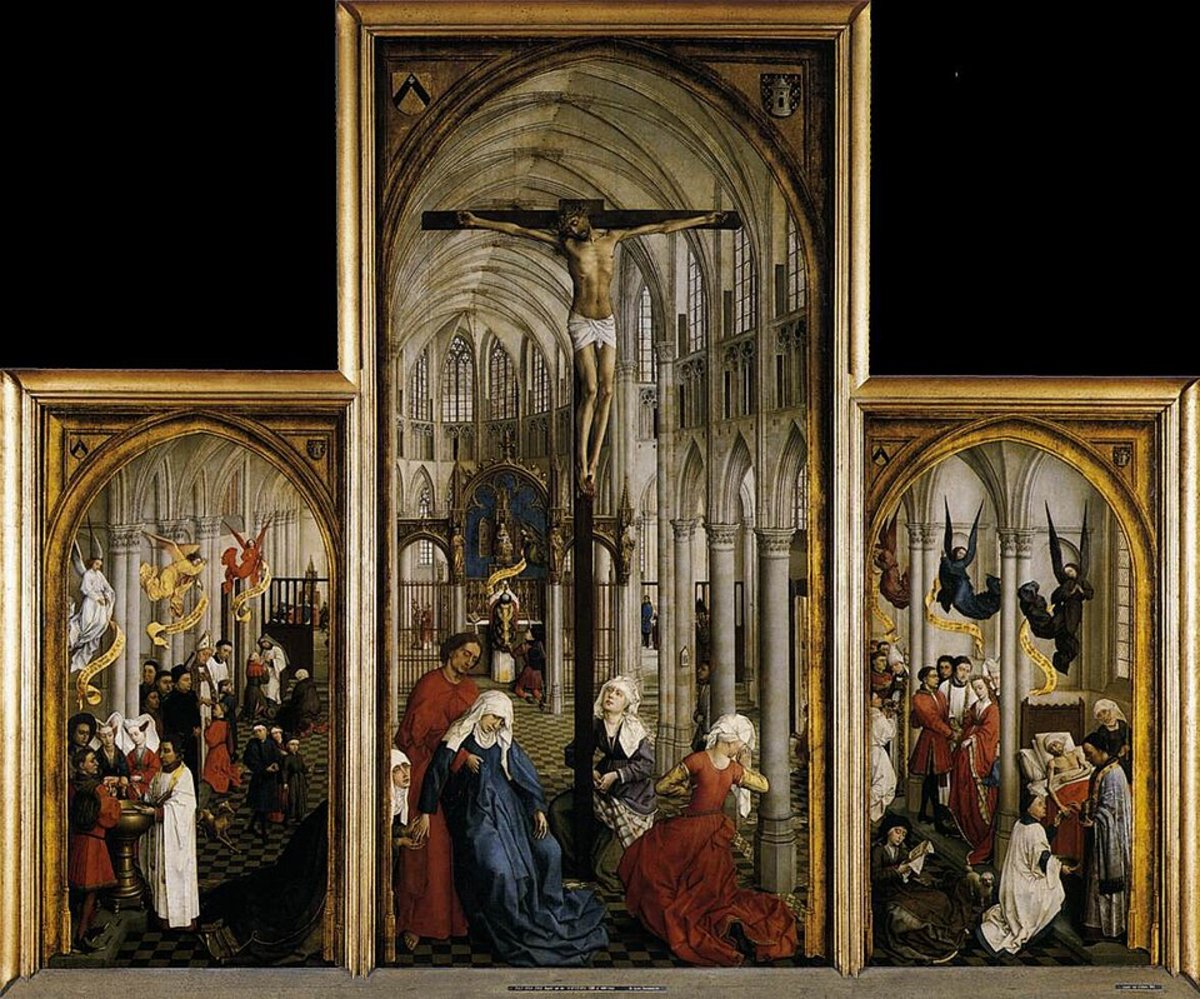
The Seven Sacraments Altarpiece
Seven Sacraments Altarpiece — Rogier, c.1445-1450, KMSKA Antwerp
Rogier van der Weyden, Public domain, via Wikimedia Commons
Rogier van der Weyden's Seven Sacraments Altarpiece is a triptych that uses a single unified architectural space (the interior of a Gothic church) to show all seven sacraments of the Roman Catholic Church taking place simultaneously. In the central nave, a large Crucifixion scene is shown; in the aisles to the left and right, and in the side chapels, six additional sacraments are enacted: Baptism, Confirmation, Penance (Confession), the Eucharist (Mass), Extreme Unction, and Holy Orders — with the Crucifixion at the centre representing the seventh sacrament (the Eucharist as the central mystery). The unified architectural space allows Rogier to show the whole sacramental life of the Church as a single continuous drama centred on the death of Christ.
The painting was commissioned by Jean Chevrot, Bishop of Tournai, for his private chapel, around 1445-1450. The seven sacraments — the specific rites through which the Catholic Church understood divine grace to be conferred — were a major theological topic in the 15th century (the Council of Trent would later define them precisely). Rogier's painting is the most complete visual survey of all seven sacraments in a single work and became a standard reference for later representations of the subject.
The central Crucifixion in the nave is flanked by the three angels who serve as identifying labels for each sacrament in the side aisles — the angels are inscribed with the name and meaning of each sacrament they identify. The church interior is a unified space of extraordinary architectural clarity; each sacramental scene takes place in a different part of the church, creating a spatial panorama of the entire sacramental life. The figures throughout are Rogier at his most psychologically precise.
When standing before this work, look carefully: Seven Sacraments Altarpiece — Rogier, c.1445-1450, KMSKA Antwerp. Give it time — what seems decorative often carries the central meaning.
When standing before this work, look carefully: Central nave Crucifixion — the sacramental centre. Give it time — what seems decorative often carries the central meaning.
When standing before this work, look carefully: Left wing — three sacraments in the aisle. Give it time — what seems decorative often carries the central meaning.
When standing before this work, look carefully: Right wing — three sacraments in the aisle. Give it time — what seems decorative often carries the central meaning.
Royal Museum of Fine Arts Antwerp (KMSKA), Leopold de Waelplaats 1-9, 2000 Antwerp. Open Tuesday-Sunday 10:00-17:00. Admission fee applies.