
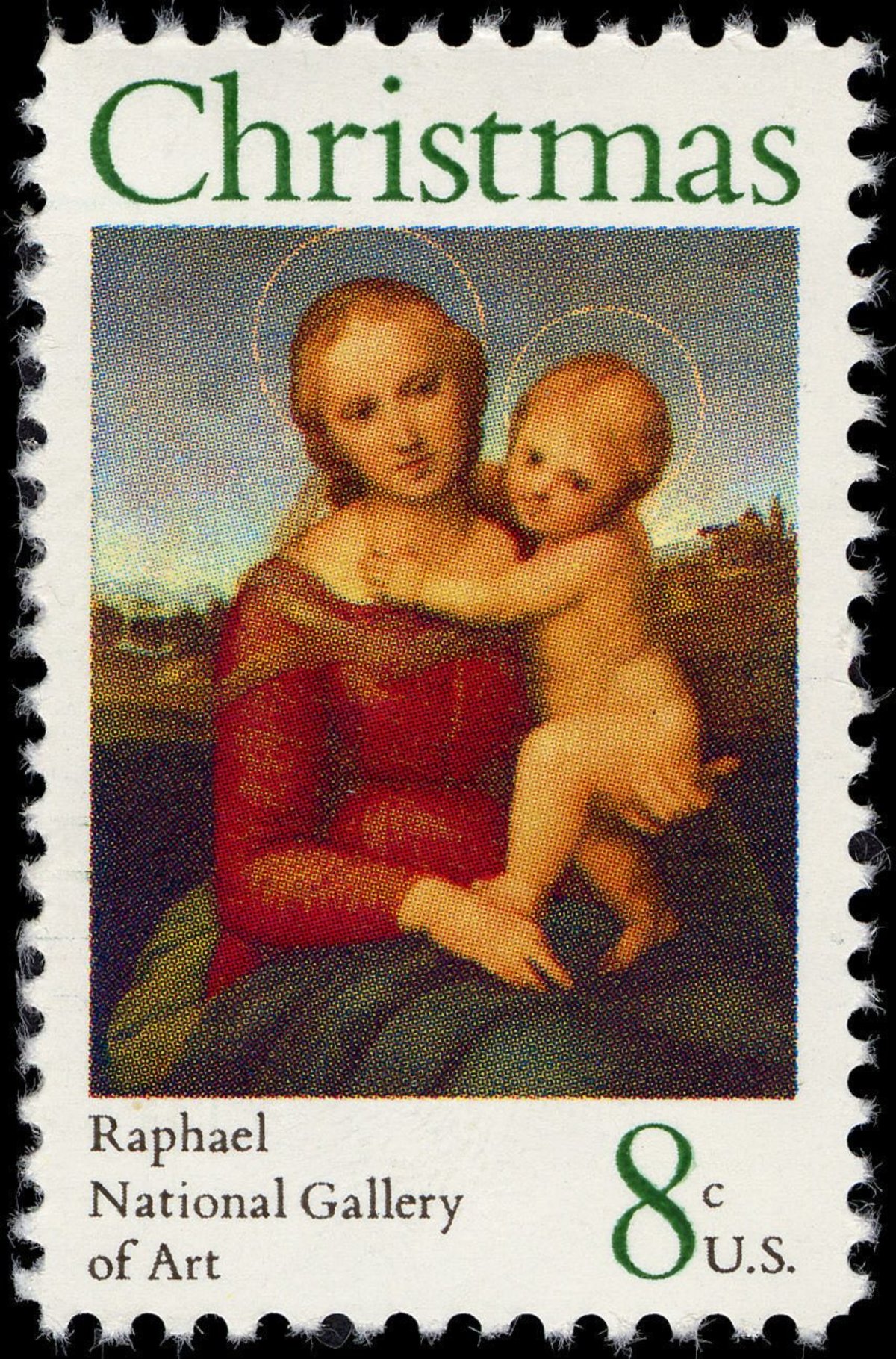
The Small Cowper Madonna
Small Cowper Madonna — Raphael, c.1505
Raphael, Public domain, via Wikimedia Commons
The Small Cowper Madonna is a small panel painting (approximately 59.5 by 44 cm) by Raphael, made around 1505 in Florence — one of a series of small-format Madonna and Child compositions from his Florentine period (1504-1508), characterised by the 'pyramid' compositional structure he developed under the influence of Leonardo da Vinci. The Virgin is shown three-quarter length in a Florentine landscape; the Christ Child reaches up to touch her chin in the Byzantine 'Glykophilousa' gesture adapted to a completely naturalistic setting.
The quality of the paint surface — the skin tones modelled with the sfumato influence of Leonardo, the blue of the Virgin's robe, the specific landscape with a Florentine church in the background — demonstrates Raphael at his most intimate and refined. The painting is called the 'Small Cowper Madonna' to distinguish it from a larger Cowper Madonna (also in the NGA, c.1508).
The Florentine period (1504-1508) was the transformative phase of Raphael's career: arriving in Florence as a skilled but provincial Umbrian painter trained by Perugino, he encountered the work of Leonardo and Michelangelo and in four years synthesised their innovations into his own supreme style. The Small Cowper Madonna is from the beginning of this period — the Leonardo influence (sfumato, pyramid composition, psychological intimacy) is already absorbed, but the Perugino clarity and sweetness are still present. Both Cowper Madonnas passed through the collection of the 2nd and 3rd Earls Cowper before entering American collections and eventually the NGA.
The church visible in the landscape background is identifiable as San Bernardino degli Zoccolanti near Urbino — a church Raphael knew from his years in Urbino. The specific detail of a recognisable building in the background of a Madonna composition is characteristic of Raphael's Florentine period: the Virgin and Child exist in a real landscape, not an abstract golden space. The Christ Child's gesture of touching the Virgin's chin (borrowed from the Byzantine Glykophilousa type) is naturalised — it looks like an infant reaching for his mother's face.
When standing before this work, look carefully: Small Cowper Madonna — Raphael, c.1505. Give it time — what seems decorative often carries the central meaning.
When standing before this work, look carefully: The Virgin's face — sfumato and Perugino sweetness combined. Give it time — what seems decorative often carries the central meaning.
When standing before this work, look carefully: The Christ Child touching the Virgin's chin. Give it time — what seems decorative often carries the central meaning.
When standing before this work, look carefully: The Florentine landscape background with San Bernardino. Give it time — what seems decorative often carries the central meaning.
National Gallery of Art, West Building, Washington DC.