
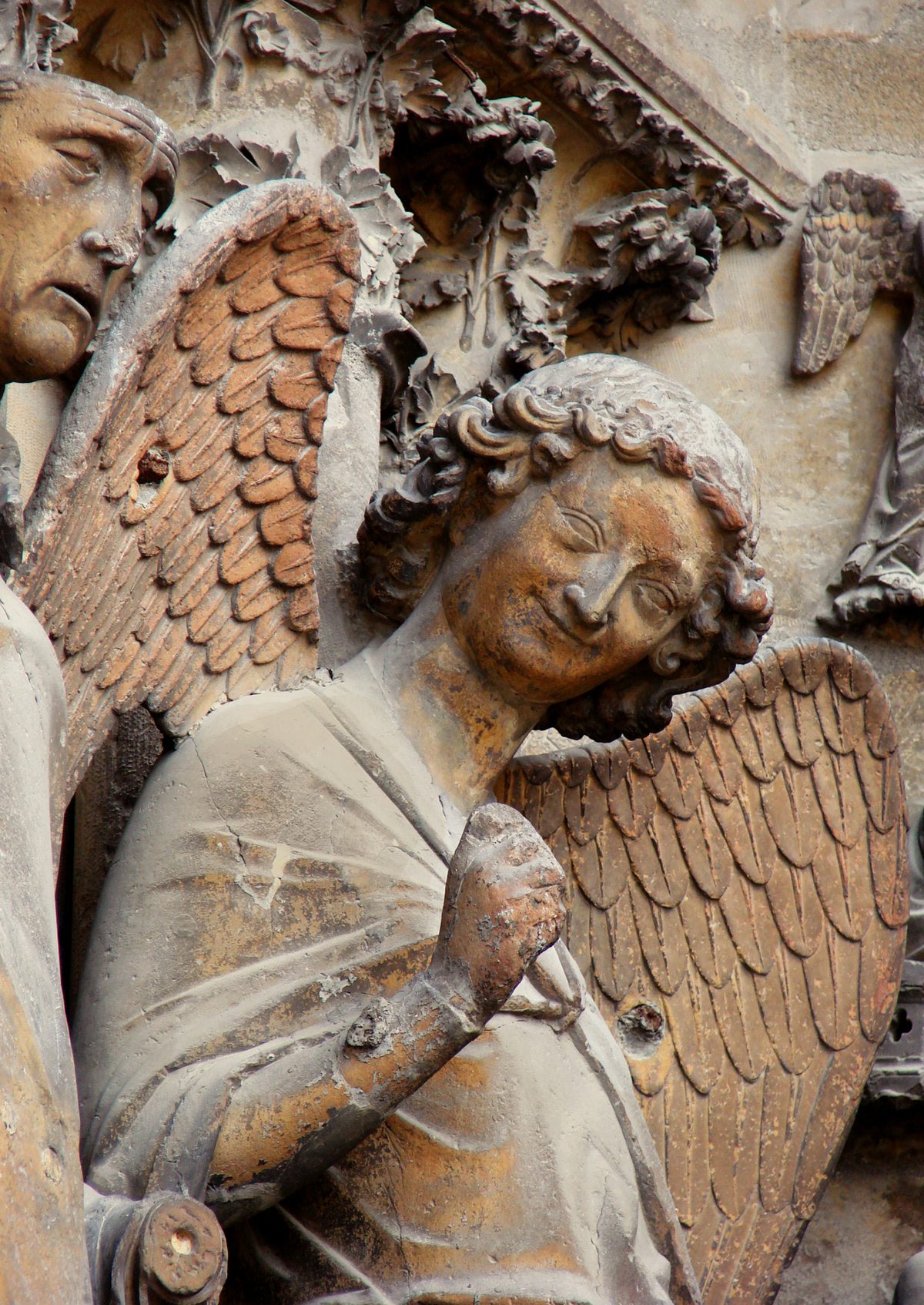
The Smiling Angel and Royal Portal
The Smiling Angel — Reims Cathedral, c.1236-1245
Public domain, via Wikimedia Commons
Reims Cathedral is the coronation church of the kings of France and the greatest ensemble of 13th-century Gothic sculpture in the world — with over 2,300 surviving carved figures distributed across the three western portals, the gallery above, and the nave and choir interior. The most famous single figure is the Smiling Angel (l'ange au sourire) on the central jamb of the left portal of the western facade: an angel of approximately 1.5 metres, made c.1236-1245, who turns toward the viewer with a smile of extraordinary psychological complexity — neither obviously joyful nor serene, the smile is knowing, slightly ironic, the most specific human expression in all of medieval sculpture.
The Angel of the Annunciation beside him is similarly celebrated. The programme of the western portals covers the Last Judgment (central), the Coronation of the Virgin (left), and the Life of John the Baptist (right).
Reims Cathedral was begun in 1211 after a fire destroyed the earlier building. The coronation of French kings took place here from the coronation of Louis VIII (1223) through Charles X (1825) — twenty-five coronations in total.
The sculpting of the western facade occupied approximately sixty years and involved multiple workshops of different stylistic character: the earliest workshops (active c.1211-1230) produced the most Romanesque-influenced figures; the later workshops (c.1236-1245, the period of the Smiling Angel) developed a fully Gothic style of high technical refinement. The Angel was damaged in World War I artillery fire (the Smiling Angel's head fell to the cathedral floor); it was restored in 1926 using a photograph and the original fragments.
The Smiling Angel's face rewards sustained attention. From a distance, the smile appears to be a simple formal quality; up close, it reads as an expression of specific psychological content — as if the angel knows something the viewer does not, and finds it gently amusing.
The slight inclination of the head, the quality of the curling hair, the formal drapery of the body below — all are in the fully developed Gothic style of Reims's greatest workshop period. Compare the Angel with the figures immediately beside him (St Nicasius, the Virgin in the Annunciation group) to see the range of the workshop's expressive vocabulary. The interior of Reims also contains extraordinary 13th-century windows and the famous rose window.
When standing before this work, look carefully: The Smiling Angel — Reims Cathedral, c.1236-1245. Give it time — what seems decorative often carries the central meaning.
When standing before this work, look carefully: The western facade of Reims Cathedral. Give it time — what seems decorative often carries the central meaning.
When standing before this work, look carefully: The central portal — the Last Judgment tympanum. Give it time — what seems decorative often carries the central meaning.
When standing before this work, look carefully: The nave of Reims Cathedral. Give it time — what seems decorative often carries the central meaning.
Reims Cathedral (Notre-Dame de Reims), Place du Cardinal-Luçon, Reims. Approximately 150 km from Paris by TGV (45 minutes).
The cathedral is open every day; admission to the cathedral is free. Reims's champagne country (Pommery, Taittinger, Veuve Clicquot) makes the visit additionally rewarding.