
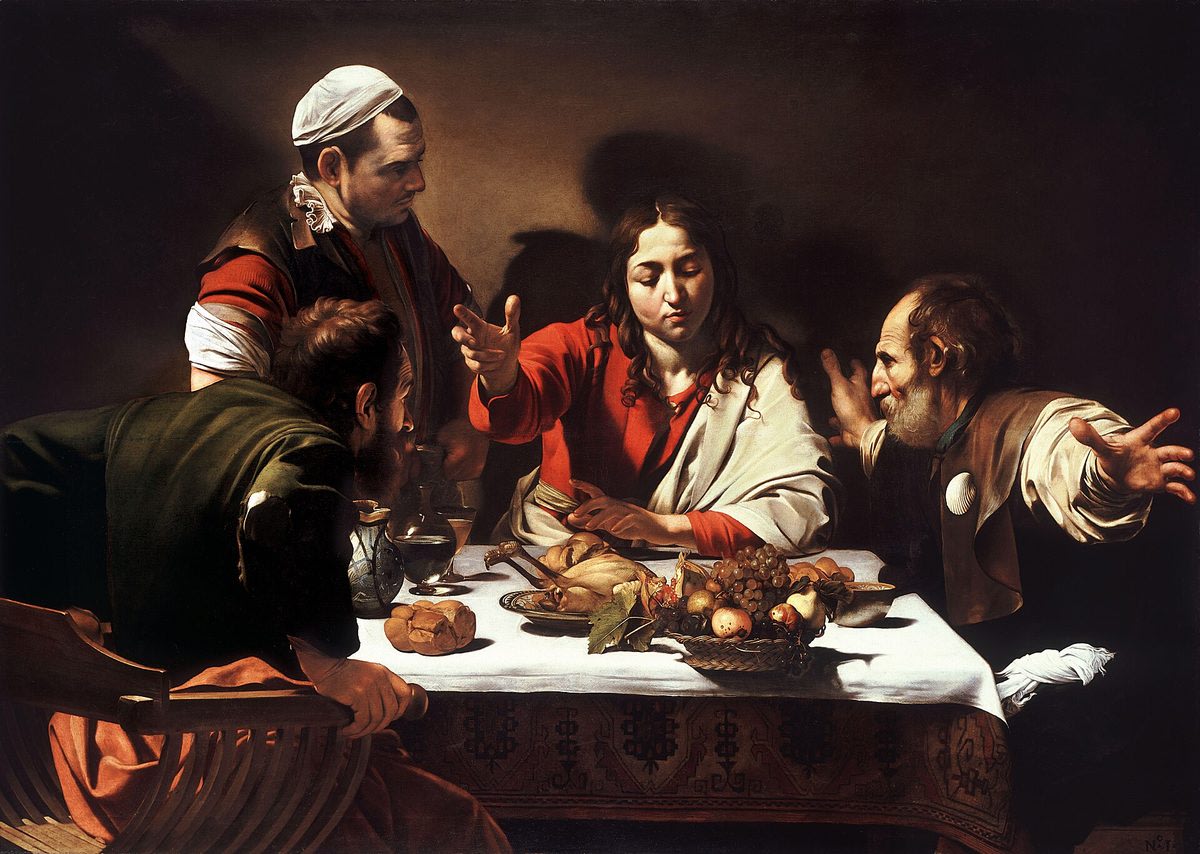
The Supper at Emmaus (National Gallery version)
Supper at Emmaus — National Gallery version, Caravaggio
Caravaggio, Public domain, via Wikimedia Commons
The National Gallery's Supper at Emmaus is the earlier of Caravaggio's two treatments of this subject (the later version is in the Brera, Milan — entry 62). Painted around 1601 and possibly the same work as the Brera entry (there is scholarly debate on the dating of both), it shares the theatrical subject: Christ breaking bread at Emmaus, the disciples recognising him, the outflung arms.
The National Gallery version is generally accepted as the same work sold by the Marchese Ciriaco Mattei and then passing through French collections before entering the National Gallery in 1839. The composition is very close to the Brera version but the two works differ in quality of light, specificity of the still life, and the treatment of the innkeeper.
Caravaggio's two treatments of Emmaus are the most revealing comparison he offers: both painted within a few years of each other, both dealing with the same subject, both demonstrating his approach to religious narrative — yet different in atmosphere, lighting, and emotional temperature. This National Gallery painting (assuming it is distinct from the Brera version) is slightly earlier in style: the chiaroscuro is not quite as extreme, the still life is similarly elaborate (the overhanging fruit basket, the bread, the roast chicken), and the figures' reactions are equally theatrical. The subject gave Caravaggio the opportunity to stage the most dramatic moment possible: the instant of recognition that transforms ordinary supper into the Eucharist.
Note: scholars disagree on whether this is the same painting as the Brera Emmaus or a slightly different work. The National Gallery catalogues it as a separate work from the Brera canvas.
If visiting both London and Milan, comparison of the two canvases in person would allow direct observation of any differences in quality, scale, and condition. Both works are authentic Caravaggio paintings of the highest quality and both are essential viewing for understanding his approach to the Eucharistic subject.
When standing before this work, look carefully: Supper at Emmaus — National Gallery version, Caravaggio. Give it time — what seems decorative often carries the central meaning.
When standing before this work, look carefully: The overhanging fruit basket — trompe-l'oeil still life. Give it time — what seems decorative often carries the central meaning.
When standing before this work, look carefully: Christ blessing the bread — the moment of recognition. Give it time — what seems decorative often carries the central meaning.
When standing before this work, look carefully: The disciple's outstretched arms. Give it time — what seems decorative often carries the central meaning.
National Gallery, Room 32, London. Free admission. The National Gallery's Caravaggio collection is one of the finest in the world — it also contains the Boy Bitten by a Lizard (private loan) and the Salome with the Head of John the Baptist.