
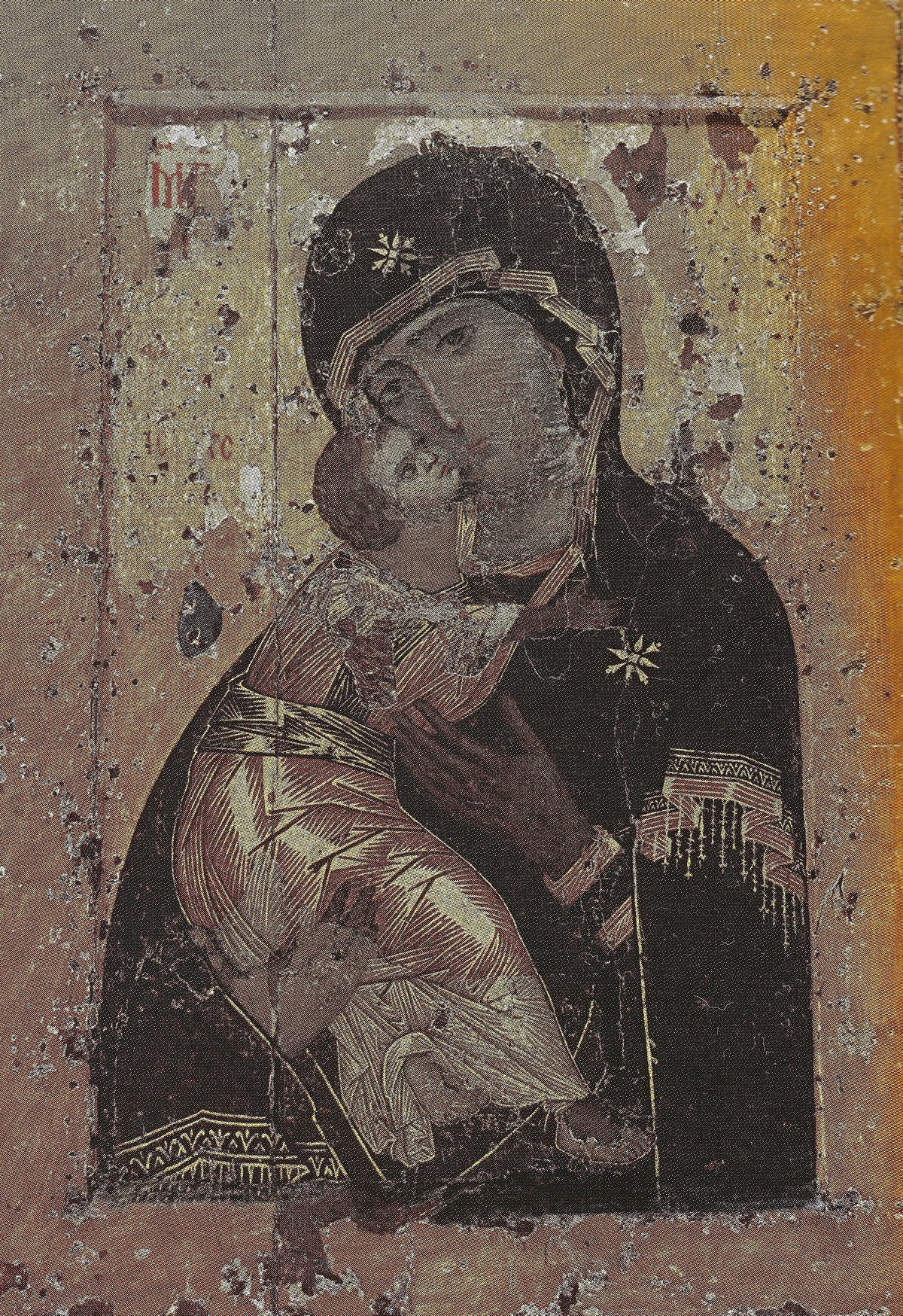
The Theotokos of Vladimir (Our Lady of Vladimir)
The Theotokos of Vladimir — Byzantine, c.1131
Byzantine, Public domain, via Wikimedia Commons
The Theotokos of Vladimir is the most sacred icon in Russia — a Byzantine panel icon of the Virgin and Child (Eleusa, 'tenderness' type: the Child's cheek pressed against the Virgin's cheek) brought from Constantinople to Russia around 1131. The original panel is approximately 104 by 69 cm; the Virgin and Child's faces and hands are original Byzantine work; the rest of the surface has been repainted over centuries.
The icon is associated with miraculous interventions in Russian history: it was credited with saving Moscow from the invasion of Timur (Tamerlane) in 1395 (when the icon was carried in procession around the city), from the Tatars in 1408, and from Khan Akhmat in 1480. It served as the primary icon of the Russian state for over 500 years, present at the coronation of tsars and the election of metropolitans. The Dormition Cathedral in the Moscow Kremlin was built specifically to house it.
The Vladimir icon represents the Eleusa type — the Virgin with her cheek pressed against the Christ Child's — which originated in Constantinople in the 11th century and became the dominant type of Russian Marian devotion. The specific quality of the original Byzantine faces (the Virgin's are particularly fine) is visible through the later repaints: the modelling is subtle, the colour warm, the expression of love and grief simultaneous — the Virgin holds the Child in an embrace that already anticipates the Pieta, the Child already leaning from her toward his destiny. The icon was examined and partially cleaned in the 1918-1919 restoration; the original Byzantine areas can be identified by art historians.
The Tretyakov Gallery displays the Vladimir icon in a specially designed chamber with its own microclimate and security. The original Byzantine faces — the Virgin's and the Christ Child's — are visible in their full quality in the cleaned state.
Notice the Virgin's expression: she knows what is coming. The Child's gesture of embracing her neck with his arm has the urgency of a child seeking comfort; her gesture of holding him has the gravity of one holding the fragile future. The icon's surface shows the pentimento of centuries of repaints and restorations — the gold background has been gilded and re-gilded; only the faces are certainly original.
When standing before this work, look carefully: The Theotokos of Vladimir — Byzantine, c.1131. Give it time — what seems decorative often carries the central meaning.
When standing before this work, look carefully: The original Byzantine faces — Virgin and Child. Give it time — what seems decorative often carries the central meaning.
When standing before this work, look carefully: The Child's embrace — anticipating the Pieta. Give it time — what seems decorative often carries the central meaning.
When standing before this work, look carefully: The icon in its chapel in the Tretyakov Gallery. Give it time — what seems decorative often carries the central meaning.
State Tretyakov Gallery, Moscow. The Vladimir icon is in the Church of St Nicholas in Tolmachi, attached to the gallery building — a functioning church within the museum.