
Masaccio, Public domain, via Wikimedia Commons
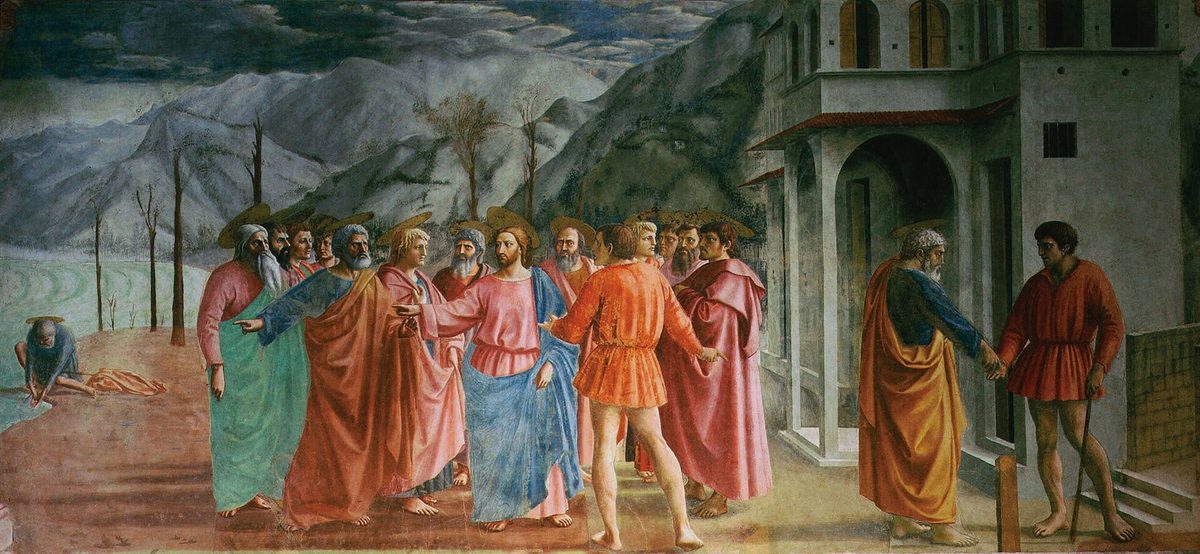
Masaccio's Tribute Money in the Brancacci Chapel is among the most revolutionary paintings in the history of art — the scene that definitively established the spatial, psychological, and narrative conventions of the Renaissance. It depicts the episode from Matthew 17 in which a tax collector demands the Temple tax of Christ and the disciples; Christ instructs Peter to find a coin in the mouth of a fish at the lake shore; Peter pays the tax.
In a continuous narrative device, three moments are shown in a single frame: Christ and the tax collector in the centre (the demand); Peter fishing at the lake shore on the left (finding the coin); Peter paying the tax collector on the right. The figures stand in a real landscape with real shadows, their conversations implied by posture and gesture, their individuality expressed through specific physiognomy and specific clothing.
Masaccio (1401-1428) painted the Brancacci Chapel (jointly with his older collaborator Masolino) over approximately two years, before dying in Rome in 1428 at the age of 26 or 27. The Tribute Money is the largest and most complex single scene in the chapel.
Its influence was immediate: Florentine painters studied it for the next hundred years. Michelangelo drew copies of Masaccio's figures in the Brancacci Chapel as a student exercise (the drawings survive); Leonardo, Raphael, and Fra Bartolommeo all recorded their responses to the chapel in their notebooks or early works. The atmospheric landscape and the monumental figure grouping were both unprecedented in Italian painting.
The figure of Christ in the centre group is the painting's moral and compositional axis: he stands with his arm extended toward the lake, commanding Peter, while the tax collector faces him from the right. The disciples form a ring around this exchange, each face individualized, each posture communicating a specific response (confusion, attention, concern).
Peter's figure is the most active: shown in three different positions (commanding figure in centre, crouching to fish on left, paying the tax on right), his energy and physicality are Masaccio's great contribution. Look at the landscape — the receding trees, the atmospheric haze on the distant hills — and the shadows on the ground: all figures cast shadows in the same direction, from a single light source, for the first time in Italian painting.
When standing before this work, look carefully: The Tribute Money — Masaccio, c.1424-1425. Give it time — what seems decorative often carries the central meaning.
When standing before this work, look carefully: Christ and the disciples — the central confrontation. Give it time — what seems decorative often carries the central meaning.
When standing before this work, look carefully: Peter finding the coin in the fish's mouth. Give it time — what seems decorative often carries the central meaning.
When standing before this work, look carefully: The Brancacci Chapel — full fresco cycle. Give it time — what seems decorative often carries the central meaning.
Brancacci Chapel, Santa Maria del Carmine, Piazza del Carmine, Florence. Visits must be booked in advance (maximum 30 visitors at a time for 30-minute slots). One of the most important small spaces in art history.