
The Tribute Money
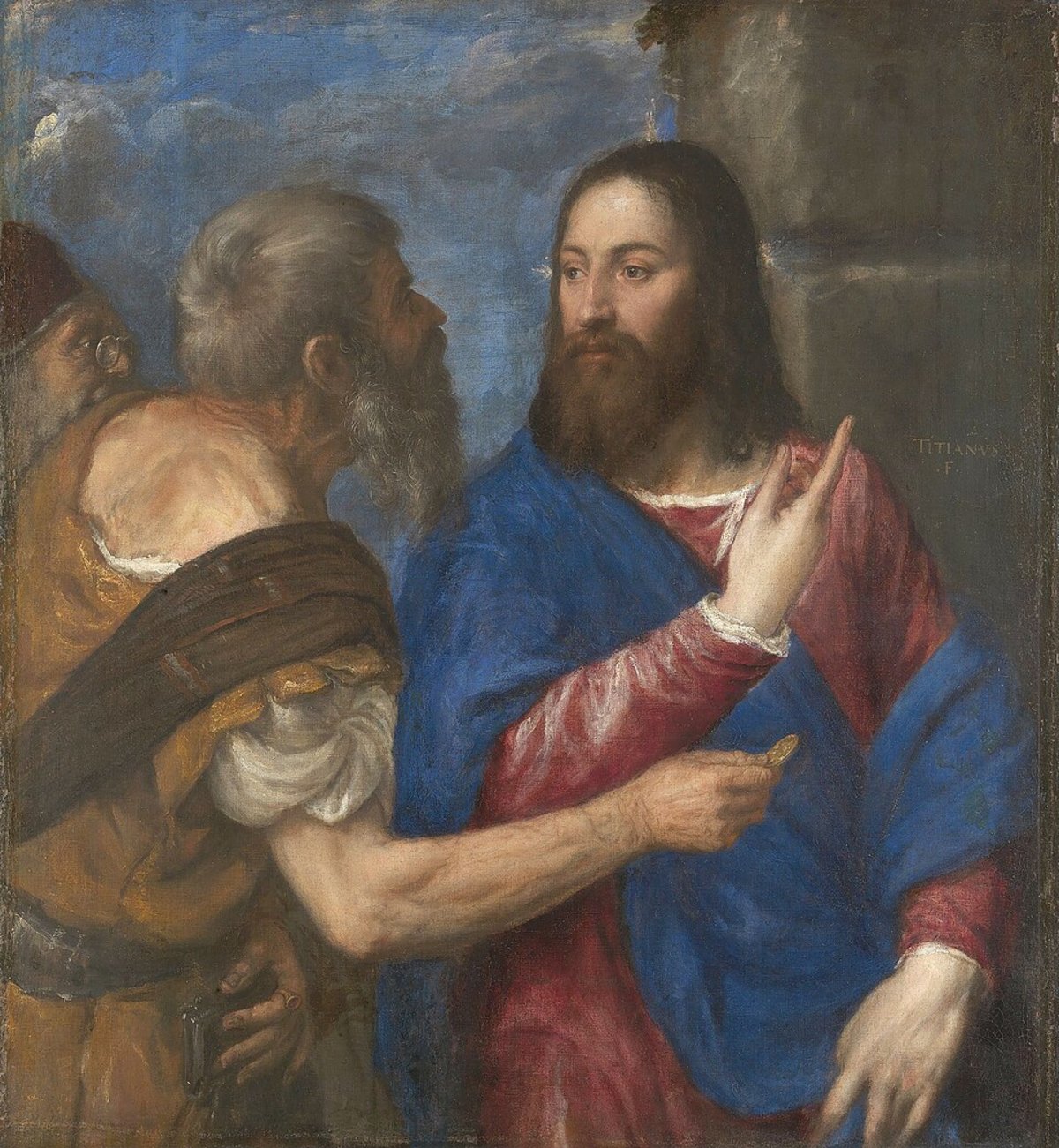
The Tribute Money — Titian, c.1516, Dresden
Titian, Public domain, via Wikimedia Commons
Titian's Tribute Money is a close-up composition showing Christ and a Pharisee at the moment of the famous exchange: 'Render unto Caesar the things that are Caesar's, and unto God the things that are God's' (Matthew 22:21). The Pharisee presents a coin (the tribute denarius) and Christ gestures toward it — his right hand pointing to the coin while his gaze and expression communicate the double meaning of his answer.
This is one of Titian's earliest surviving works (c.1516) and demonstrates his already fully developed ability to combine physical presence with psychological and theological depth. The painting's very long format (approximately 75 by 56 cm) fills the composition with the two faces and hands, creating maximum psychological intensity.
Titian (c.1488/1490-1576) was the dominant painter of Venice for seven decades — longer than any other major Renaissance artist. His career spans from his early works (c.1510-1516) through the great mythological and religious commissions of the middle period (the Assumption of the Virgin, the Pesaro Madonna) to the late style of his final decades, in which the handling of paint becomes maximally free.
The Tribute Money belongs to the earliest period — when Titian was demonstrating, for the first time, the full capacity of his art. It entered the Dresden collection through the 18th-century acquisitions of the Electors of Saxony.
The contrast between the two faces is the painting's central statement: the Pharisee's face is worldly, specific, almost caricatured in its expression of cunning; Christ's face is idealised, serene, and communicates a quality of spiritual authority that transcends the situation. The coin (visible in the Pharisee's fingers) is the object of the dispute — small, material, and ultimately irrelevant to the deeper question Christ's answer raises.
When standing before this work, look carefully: The Tribute Money — Titian, c.1516, Dresden. Give it time — what seems decorative often carries the central meaning.
When standing before this work, look carefully: Christ's face — spiritual authority. Give it time — what seems decorative often carries the central meaning.
When standing before this work, look carefully: The Pharisee — worldly cunning. Give it time — what seems decorative often carries the central meaning.
When standing before this work, look carefully: The denarius — the material object of dispute. Give it time — what seems decorative often carries the central meaning.
Gemäldegalerie Alte Meister, Theaterplatz 1, 01067 Dresden. Open Tuesday-Sunday 10:00-18:00.
Admission fee applies. The painting is in the Italian Renaissance rooms.