
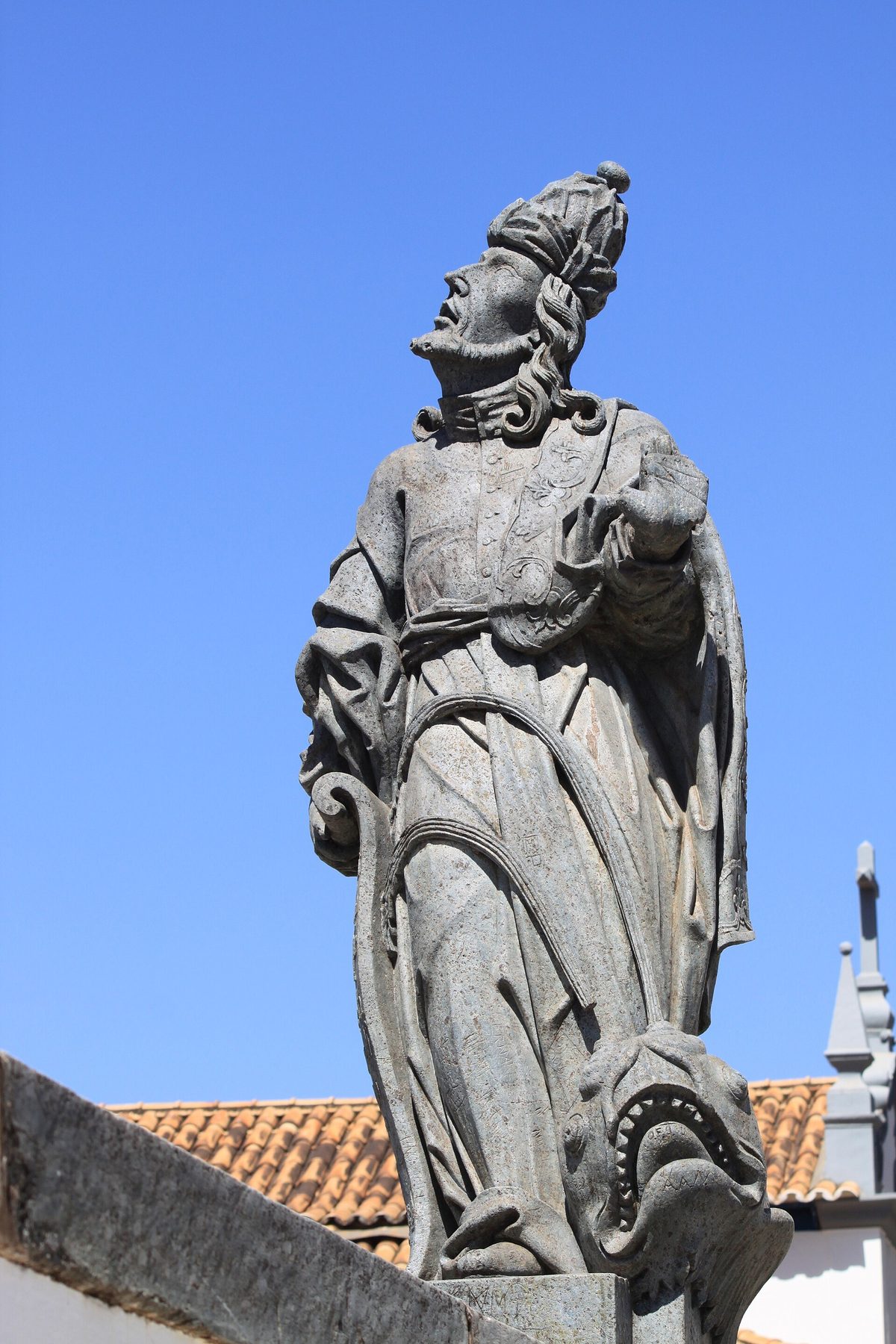
The Twelve Prophets (Profetas)
The Twelve Prophets — Aleijadinho, 1800-1805
Public domain, via Wikimedia Commons
The Twelve Prophets of Congonhas are twelve monumental soapstone sculptures of the Hebrew prophets — approximately life-size — arranged on the grand stairway and terraces of the Sanctuary of Bom Jesus de Matosinhos, executed between 1800 and 1805 by Aleijadinho (Antonio Francisco Lisboa, c.1738-1814). The prophets include Hosea, Joel, Amos, Obadiah, Jonah, Micah, Nahum, Habakkuk, Zephaniah, Haggai, Zechariah, and Malachi; each holds a scroll bearing a prophetic text (in Latin and Portuguese) related to the life of Christ.
The sculptures are considered the supreme achievements of Brazilian Baroque and some of the greatest sculptures in the Americas. They were executed when Aleijadinho was in the advanced stages of a disfiguring disease (probably leprosy or syphilis) that had removed his fingers and toes — he reportedly worked with chisels strapped to his wrists. The prophets are depicted with extraordinary energy and psychological force: each has an individual personality, a specific gesture, and a drapery treatment of Baroque dynamism.
Aleijadinho (Antonio Francisco Lisboa, c.1738-1814) was the son of a Portuguese architect-builder and an enslaved Black African woman — born into slavery but freed and apprenticed to his father's trade. He became the dominant architect and sculptor of 18th-century Brazil, working entirely in the Minas Gerais region.
The name 'Aleijadinho' (Little Cripple) is the nickname given to him because of his disability. His works include the churches of São Francisco de Assis in Ouro Preto and São João del-Rei, as well as the Congonhas sanctuary sculptures. The Congonhas prophets were his final major commission and represent the culmination of his career.
Walk up the stairway slowly, examining each prophet in turn. The arrangement is designed to be experienced as a procession: the twelve prophets flank the approach to the sanctuary, turning toward the pilgrim or away, gesturing with their scrolls, their draperies billowing in carved soapstone.
The quality of the individual faces — especially the more deeply modelled ones — is remarkable. The prophets Nahum (seated, powerful), Habakkuk (standing, reaching forward), and Jonah (with a fish) are frequently cited as the finest individual pieces. Bring binoculars to examine the inscriptions on the scrolls.
When standing before this work, look carefully: The Twelve Prophets — Aleijadinho, 1800-1805. Give it time — what seems decorative often carries the central meaning.
When standing before this work, look carefully: Prophet Isaiah — soapstone sculpture detail. Give it time — what seems decorative often carries the central meaning.
When standing before this work, look carefully: The grand stairway with prophets. Give it time — what seems decorative often carries the central meaning.
When standing before this work, look carefully: The Sanctuary of Bom Jesus de Matosinhos. Give it time — what seems decorative often carries the central meaning.
Sanctuary of Bom Jesus de Matosinhos, Congonhas, Minas Gerais, Brazil. Congonhas is approximately 75 km south of Belo Horizonte.
The sanctuary and prophets are a UNESCO World Heritage Site. Open daily; small admission fee.