
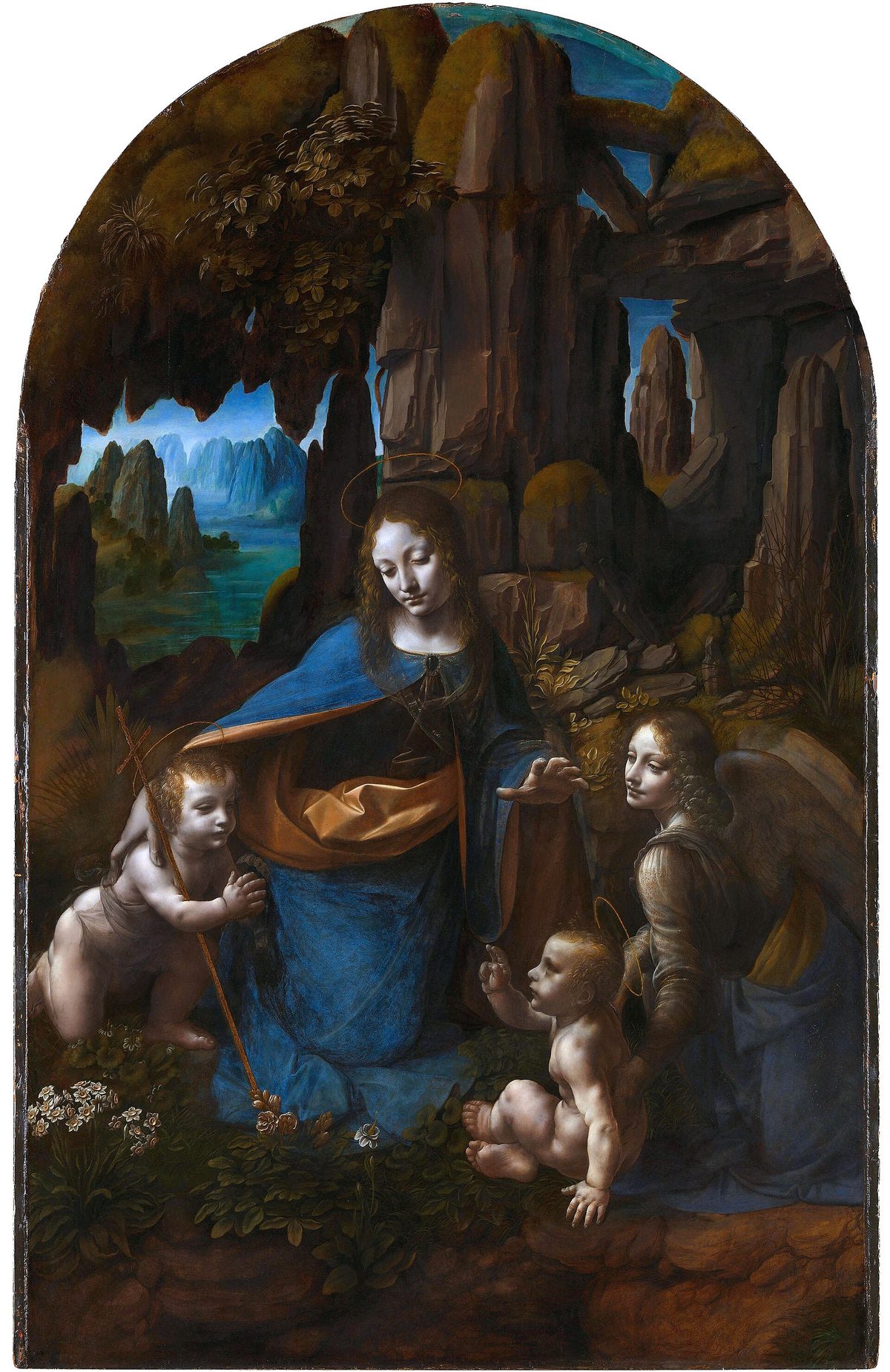
The Virgin of the Rocks (London version)
Virgin of the Rocks — London version, Leonardo, c.1491-1508
Leonardo da Vinci, Public domain, via Wikimedia Commons
The National Gallery's Virgin of the Rocks is the second version of Leonardo's composition — begun around 1491-95 and revised until approximately 1508. The Louvre version (entry 10) is earlier (c.1483-1486) and generally considered superior in conception; the London version differs in several respects: the angel points with his finger in the London version (the Louvre angel's pointing gesture was apparently painted over at some point, leaving a non-pointing angel — though recent analysis suggests the Louvre angel originally pointed); the children are slightly older in the London version; the halos (absent in the Louvre version) are present in the London version as translucent golden rings. The London panel was probably made to fulfil the original commission from the Confraternity of the Immaculate Conception in Milan, which had been in legal dispute over the Louvre version for years.
The commission for the Virgin of the Rocks came in 1483 from the Confraternity of the Immaculate Conception of San Francesco Grande in Milan. The contract specified a complex altarpiece programme; what Leonardo delivered (the Louvre version) apparently did not match the specification in some respects, leading to a decade of legal dispute.
By 1491-1495, Leonardo had begun the London version — this time, apparently, following the contract more closely (hence the halos, the pointing gesture, and the slightly different compositional details). The London panel was completed around 1508 and installed in the Milan altarpiece. In terms of quality, scholars debate which version represents Leonardo's finest achievement; the Louvre version is more dramatically lit and more atmospherically unified, while the London version is technically more refined in some areas.
Compare the two versions by standing before the London panel and consulting a reproduction of the Louvre version. Key differences: the angel in the London version looks directly at the viewer and points toward the infant John; the infant Christ and infant John are slightly older (less vulnerable); the halos are thin golden rings, not the conventional solid discs; the rock formations are slightly different in their configuration.
The painting quality is high: the faces of the Virgin and the Christ child are among Leonardo's finest, and the sfumato atmospheric technique is fully employed in the rock surfaces and the distant landscape. The National Gallery's recent conservation and technical examination has revealed much about the painting's complex history.
When standing before this work, look carefully: Virgin of the Rocks — London version, Leonardo, c.1491-1508. Give it time — what seems decorative often carries the central meaning.
When standing before this work, look carefully: The angel pointing — difference from the Louvre version. Give it time — what seems decorative often carries the central meaning.
When standing before this work, look carefully: The golden halos — added in the London version. Give it time — what seems decorative often carries the central meaning.
When standing before this work, look carefully: Side-by-side comparison of Louvre and London versions. Give it time — what seems decorative often carries the central meaning.
National Gallery, Room 66, London. The National Gallery holds the London panel in its Italian Renaissance rooms. The contrast with the Louvre version can be studied in the National Gallery's detailed online comparison.