
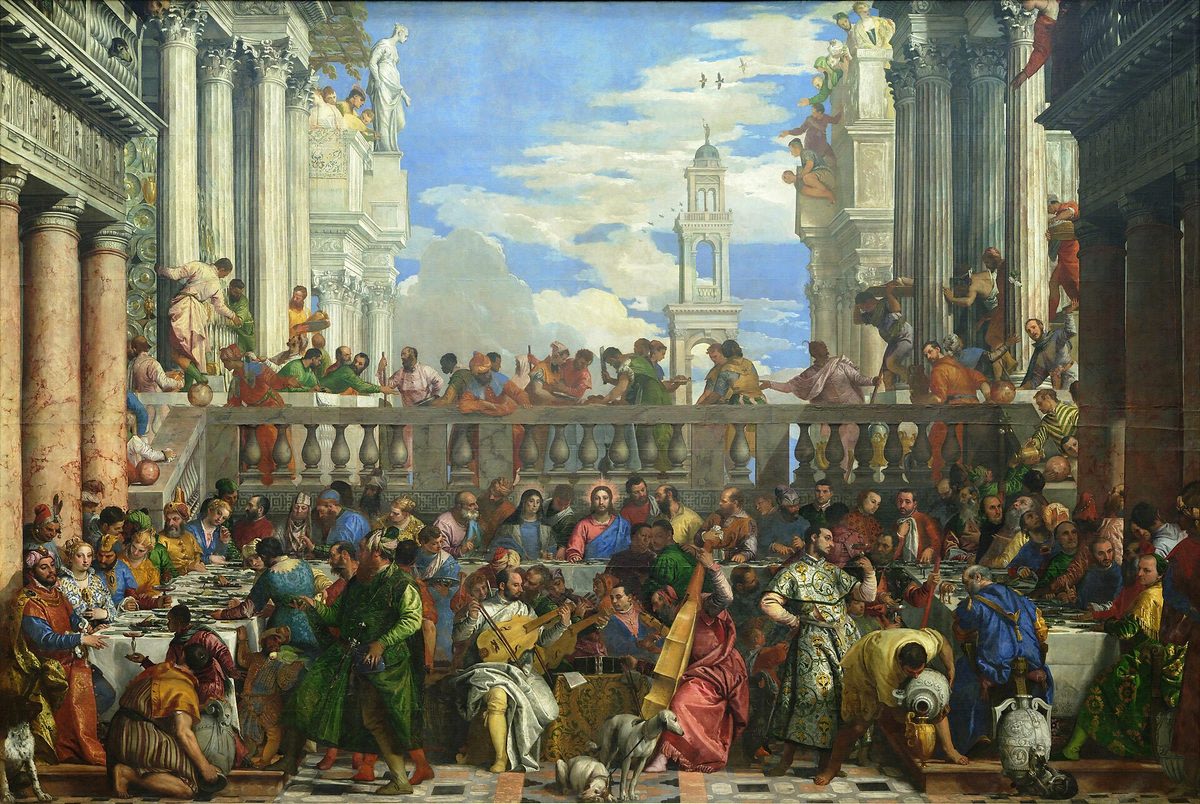
The Wedding Feast at Cana
Wedding Feast at Cana — Veronese, 1562-1563
Paolo Veronese, Public domain, via Wikimedia Commons
Paolo Veronese's Wedding Feast at Cana is the largest painting in the Louvre — a canvas approximately 9.9 by 6.6 metres, painted for the refectory of the Benedictine monastery of San Giorgio Maggiore in Venice and looted by Napoleon in 1797. It depicts the first miracle of Christ (John 2:1-11), the transformation of water into wine at the wedding at Cana — but in Veronese's treatment, the scene is a sumptuous contemporary Venetian banquet with over 130 figures, including a music ensemble playing in the centre foreground (whose members are traditionally identified as portraits of Titian, Veronese himself, Tintoretto, and Jacopo Bassano, playing viols and lute), and a crowd of Venetian nobles, servants, and guests. Christ sits at the centre of the long table, marked only by the halo around his head; the miracle is invisible.
Paolo Veronese (c.1528-1588) was the great orchestrator of Venetian festive painting — his canvases are temples of pleasure, colour, and pageantry, their biblical subjects the occasion for Venetian social spectacle rather than spiritual meditation. The Wedding Feast was his largest commission and required eighteen months to complete.
The architectural setting — a classical colonnade on both sides, an open sky above, a balcony with more guests looking down — was designed by Palladio, who built the refectory of San Giorgio Maggiore for which the painting was made. The combination of Palladian architecture and Veronese's exuberant crowd scene is the fullest expression of the Venetian approach to monumental religious painting.
The painting's organisation is a triumph of crowd management at enormous scale. Christ at the centre of the table is calm and radiantly lit; the guests around him are in various stages of festive attention (some eating, some in conversation, some looking at the wine jugs being filled).
The musicians in the foreground centre are the painting's most discussed detail: the four musicians identified as Venetian masters playing together is a compliment to Venetian painting culture and a piece of documentary social history. Look at the depth of the architectural setting — the colonnade recedes convincingly behind the table, and figures on the balcony above are painted at a different scale, correctly diminished by distance. Servants carry the water jugs; the miracle is already accomplished.
When standing before this work, look carefully: Wedding Feast at Cana — Veronese, 1562-1563. Give it time — what seems decorative often carries the central meaning.
When standing before this work, look carefully: The musicians — Titian, Veronese, Tintoretto, Bassano. Give it time — what seems decorative often carries the central meaning.
When standing before this work, look carefully: Christ at the centre — calm amid the feast. Give it time — what seems decorative often carries the central meaning.
When standing before this work, look carefully: The full painting in the Louvre — 10 metres wide. Give it time — what seems decorative often carries the central meaning.
Musée du Louvre, Salle des États (the same room as the Mona Lisa), Paris. The scale of the painting makes the room feel narrow — it is approximately 10 metres wide and the canvas is nearly as wide. The painting hangs opposite the Mona Lisa, a juxtaposition that emphasises the difference in scale and intention between the two works.