
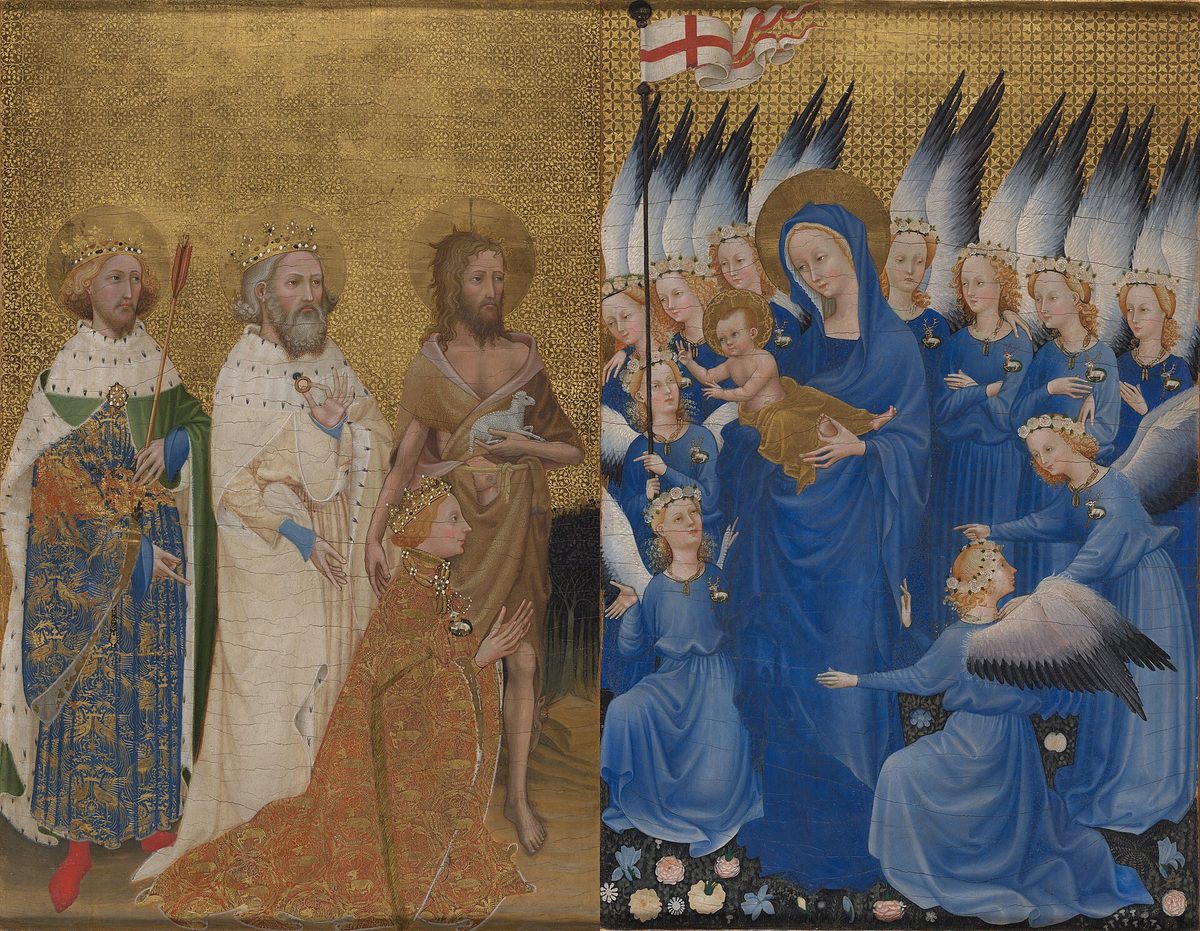
The Wilton Diptych
The Wilton Diptych — c.1395-1399
English or French school, Public domain, via Wikimedia Commons
The Wilton Diptych is the most beautiful small-scale painting to survive from medieval England and one of the supreme works of the International Gothic style. It is a portable devotional diptych — two hinged panels, each approximately 53 by 37 cm — showing on the left Richard II of England kneeling with his three patron saints (John the Baptist, Edward the Confessor, and St Edmund) and on the right the Virgin and Child surrounded by eleven angels, all in a field of deep lapis-lazuli blue.
The angels wear Richard's livery collar (with the white hart badge) and one holds the banner of St George and England — signifying the Virgin's intercession for Richard's kingship. The miniaturist quality of the painting — every feather on the angels' wings is painted individually, every gem in the crowns is depicted — makes it comparable to contemporary manuscript illumination at the highest level.
The diptych was made for Richard II's private devotion — almost certainly between 1395 and 1399, during the final years of his reign. The attribution remains contested: no document identifies the artist, who may be English, French, or Bohemian (Richard's queen Anne of Bohemia brought Bohemian court artists to England).
The lapis-lazuli blue — the most expensive pigment available — covers virtually the entire right panel; the cost of the materials alone was extraordinary. The painting was presumably in the English royal collection until the 17th century; it was at Wilton House (the seat of the Earls of Pembroke) by the 18th century and entered the National Gallery in 1929.
The right panel of the diptych is among the most beautiful surfaces in medieval painting: the deep blue of the angels' gowns and the sky is punctuated by the delicate gold of the crown of angels, the banner, and the Child's gestures. The eleven angels around the Virgin all gaze toward Richard, creating a sense of the heavenly court attending to the kneeling king.
Richard is depicted with a specific feature: he is young (the portrait corresponds to descriptions of Richard in his mid-twenties), he wears a robe embroidered with his personal device (the white hart and broom pods), and his expression is of intense devotional concentration. The back of the diptych is also decorated: a white hart lying in a flower meadow (Richard's personal badge) on the left, and the arms of England on the right.
When standing before this work, look carefully: The Wilton Diptych — c.1395-1399. Give it time — what seems decorative often carries the central meaning.
When standing before this work, look carefully: The Virgin and angels panel — lapis-lazuli blue. Give it time — what seems decorative often carries the central meaning.
When standing before this work, look carefully: Richard II with his patron saints. Give it time — what seems decorative often carries the central meaning.
When standing before this work, look carefully: The back — the white hart in a flower meadow. Give it time — what seems decorative often carries the central meaning.
National Gallery, Room 53, Trafalgar Square, London. Free admission. The National Gallery's collection of medieval and early Renaissance paintings is one of the best in the world; the Wilton Diptych room is usually quiet and allows close study.