
Tornabuoni Chapel Frescoes
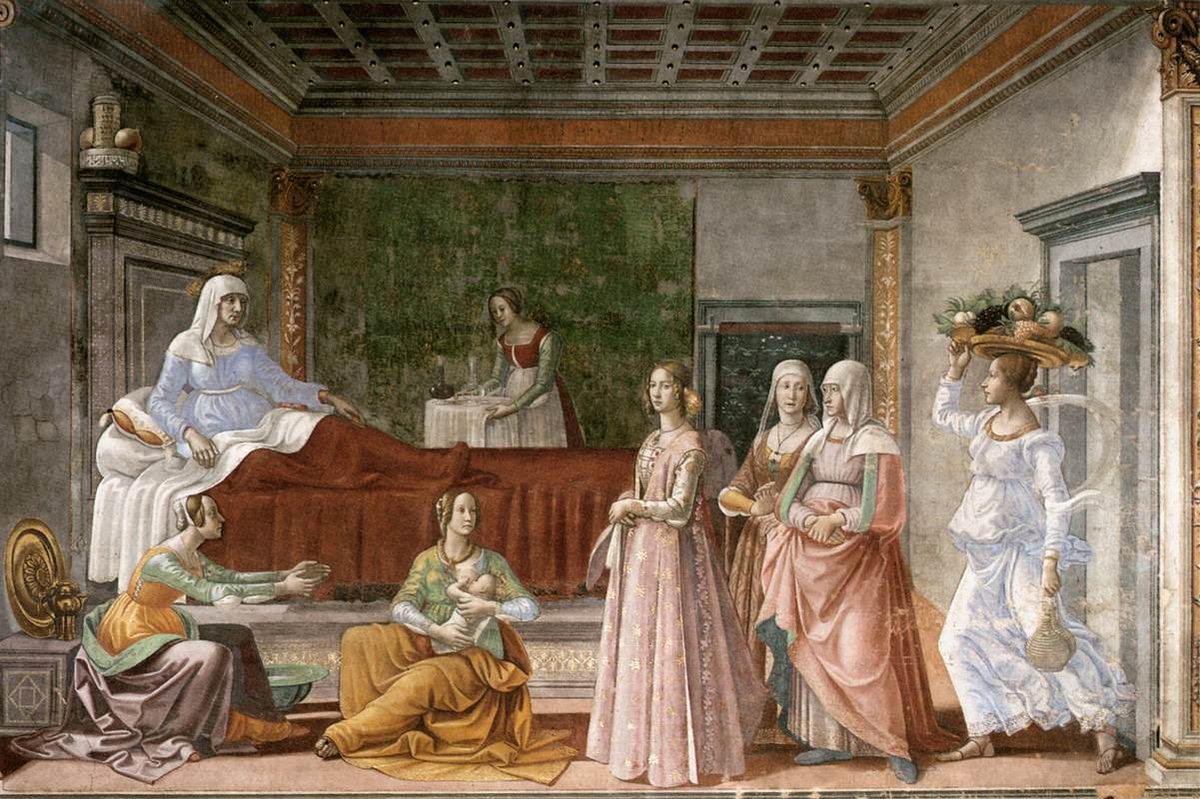
Birth of John the Baptist — Ghirlandaio, Tornabuoni Chapel
Domenico Ghirlandaio, Public domain, via Wikimedia Commons
Ghirlandaio's frescoes in the Tornabuoni Chapel at Santa Maria Novella are the supreme example of 15th-century Florentine narrative fresco — a programme of fourteen scenes from the life of the Virgin (north wall) and John the Baptist (south wall) commissioned by Giovanni Tornabuoni, a wealthy Florentine banker and uncle of Lorenzo de' Medici. The frescoes are famous for two things: their extraordinary quality of narrative painting (the scenes have a documentary clarity, psychological depth, and sense of actual space that goes beyond any predecessor) and their systematic inclusion of contemporary Florentine portraits — members of the Tornabuoni family, Florentine aristocrats, and probably several members of the Medici circle appear in biblical scenes, dressed in contemporary fashion. The young Michelangelo was a workshop assistant during the final stages of the project.
Domenico Ghirlandaio (1449-1494) was the leading narrative fresco painter in Florence in the 1480s. The Tornabuoni commission gave him the opportunity to display the full range of his abilities: architectural perspective, portrait characterization, landscape, ceremonial pageantry, and emotional narrative.
The influence of the Portinari Altarpiece (Hugo van der Goes) — which arrived in Florence in 1483, just before the Tornabuoni work began — is evident in the physiognomic naturalism of some figures. Ghirlandaio's workshop was one of the most productive in Florence; Michelangelo entered it as an apprentice around 1488, approximately when the Tornabuoni frescoes were nearing completion. The Tornabuoni commission was renewed and expanded in 1485.
The Birth of the Virgin (north wall) is the most reproduced scene: a formal Florentine bedchamber with attendants and a procession of aristocratic ladies entering to congratulate St Anne — Florentine social documentary under a biblical caption. The Birth of John the Baptist (south wall) is similarly organised around a contemporary domestic scene.
The scenes of the Visitation and the Baptism of Christ in the Jordan are more conventionally devotional. Look at the architectural backgrounds — the detailed perspectival interiors and the classical-Florentine exterior settings give the scenes a spatial credibility that Masaccio had initiated sixty years before and Ghirlandaio brought to its highest decorative polish.
When standing before this work, look carefully: Birth of John the Baptist — Ghirlandaio, Tornabuoni Chapel. Give it time — what seems decorative often carries the central meaning.
When standing before this work, look carefully: Birth of the Virgin — contemporary Florentine portraits. Give it time — what seems decorative often carries the central meaning.
When standing before this work, look carefully: The Tornabuoni Chapel — full fresco programme. Give it time — what seems decorative often carries the central meaning.
When standing before this work, look carefully: Portrait of Florentine ladies in the Birth of the Virgin. Give it time — what seems decorative often carries the central meaning.
Santa Maria Novella, Piazza Santa Maria Novella, Florence. The Tornabuoni Chapel is in the choir of the church — behind the high altar. There is a separate admission charge for the museum section (which includes the cloister and chapter house); the Tornabuoni Chapel itself requires the church entrance fee.