
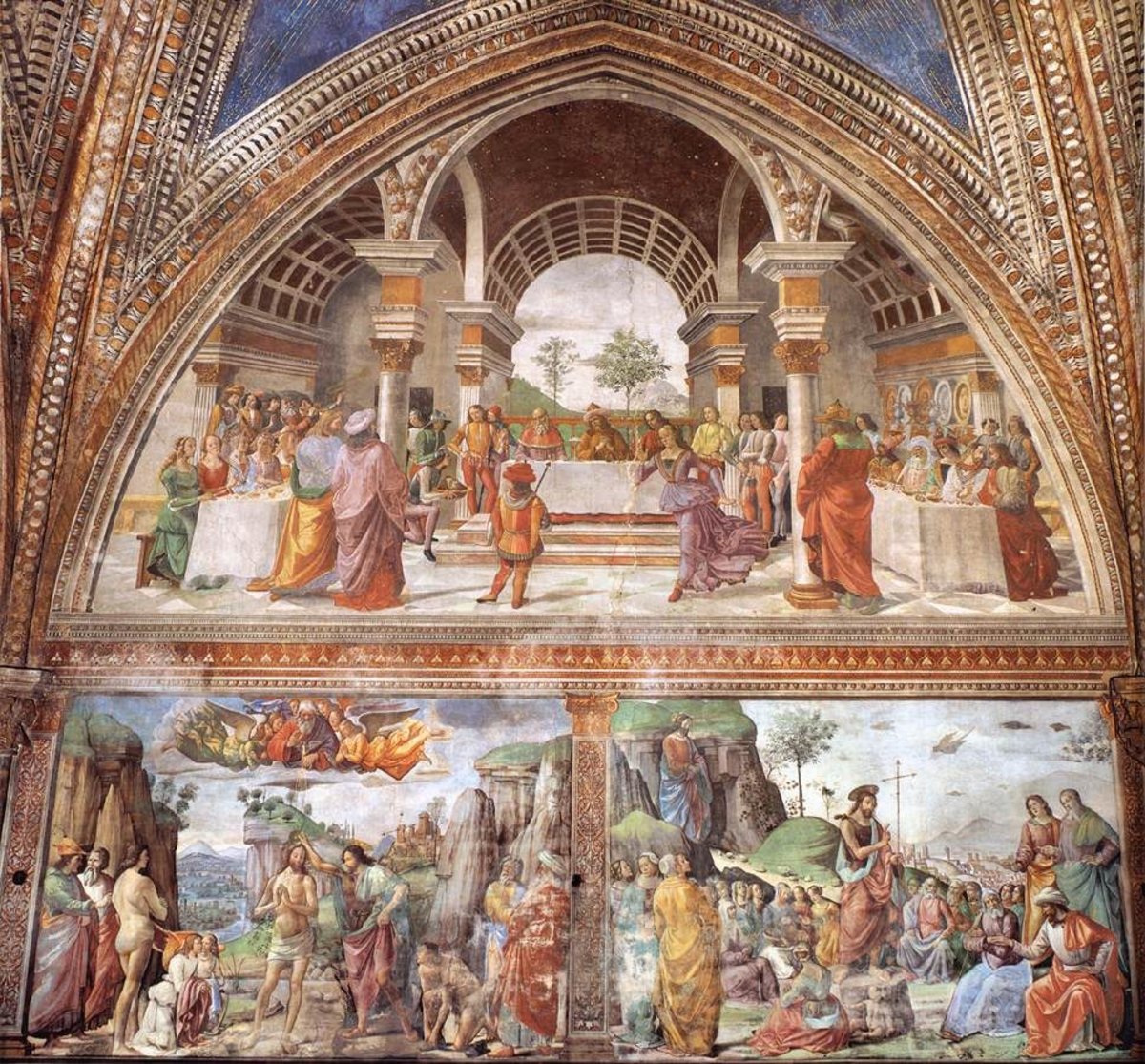
Tornabuoni Chapel Frescoes
Tornabuoni Chapel overview — Ghirlandaio, 1485-1490
Domenico Ghirlandaio, Public domain, via Wikimedia Commons
The Tornabuoni Chapel frescoes in Santa Maria Novella are Domenico Ghirlandaio's masterpiece — a complete fresco programme of the lives of the Virgin and St John the Baptist covering all four walls of the choir chapel, commissioned by Giovanni Tornabuoni (a Medici banker) and completed between 1485 and 1490. The scenes combine the sacred narratives (the Annunciation, the Visitation, the Nativity, the Birth of the Baptist, the Baptism of Christ) with contemporary Florentine settings and portrait figures: the Florentine merchant class, dressed in the fashion of the 1480s, appears as witnesses to and participants in the sacred events.
Ghirlandaio's documentary instinct — his ability to make the Annunciation happen in a contemporary Florentine loggia, with contemporary Florentines watching — gives the programme its social and historical significance alongside its religious meaning. The young Michelangelo worked in Ghirlandaio's workshop during the execution of these frescoes (c.1487-1488), the period of his initial training.
Domenico Ghirlandaio (1449-1494) was the dominant painter of late Quattrocento Florence — the master of the large-scale narrative fresco programme, the great portraitist of the Florentine merchant class, and the teacher from whose workshop Michelangelo emerged. His approach to sacred narrative was fundamentally theatrical: the biblical events are staged in contemporary settings, attended by portrait figures, and treated as opportunities for elegant figure composition and social documentation. The Tornabuoni programme is the fullest expression of this approach: approximately 20 scenes covering approximately 800 square metres of wall surface, with hundreds of individual portrait figures.
The Tornabuoni Chapel is at the east end of the church, behind the high altar. The programme begins on the right wall with scenes from the life of the Virgin and continues on the left wall with scenes from the life of the Baptist.
The Visitation scene (right wall, second register) is particularly famous for its portraits of contemporary Florentine women attending Mary's visit to Elizabeth. The Birth of St John (left wall, second register) shows a Renaissance domestic interior in precise perspective, with fashionably dressed women attending the birth. Look also at the stained glass windows of the chapel, which are also designed by Ghirlandaio and form part of the unified decorative programme.
When standing before this work, look carefully: Tornabuoni Chapel overview — Ghirlandaio, 1485-1490. Give it time — what seems decorative often carries the central meaning.
When standing before this work, look carefully: The Visitation — contemporary Florentine portraits. Give it time — what seems decorative often carries the central meaning.
When standing before this work, look carefully: Birth of St John the Baptist — Renaissance interior. Give it time — what seems decorative often carries the central meaning.
When standing before this work, look carefully: The Annunciation — Ghirlandaio's elegant staging. Give it time — what seems decorative often carries the central meaning.
Santa Maria Novella, Piazza Santa Maria Novella, Florence. Admission fee. The Tornabuoni Chapel (choir) requires a ticket to the church museum; entry is controlled to protect the frescoes.