
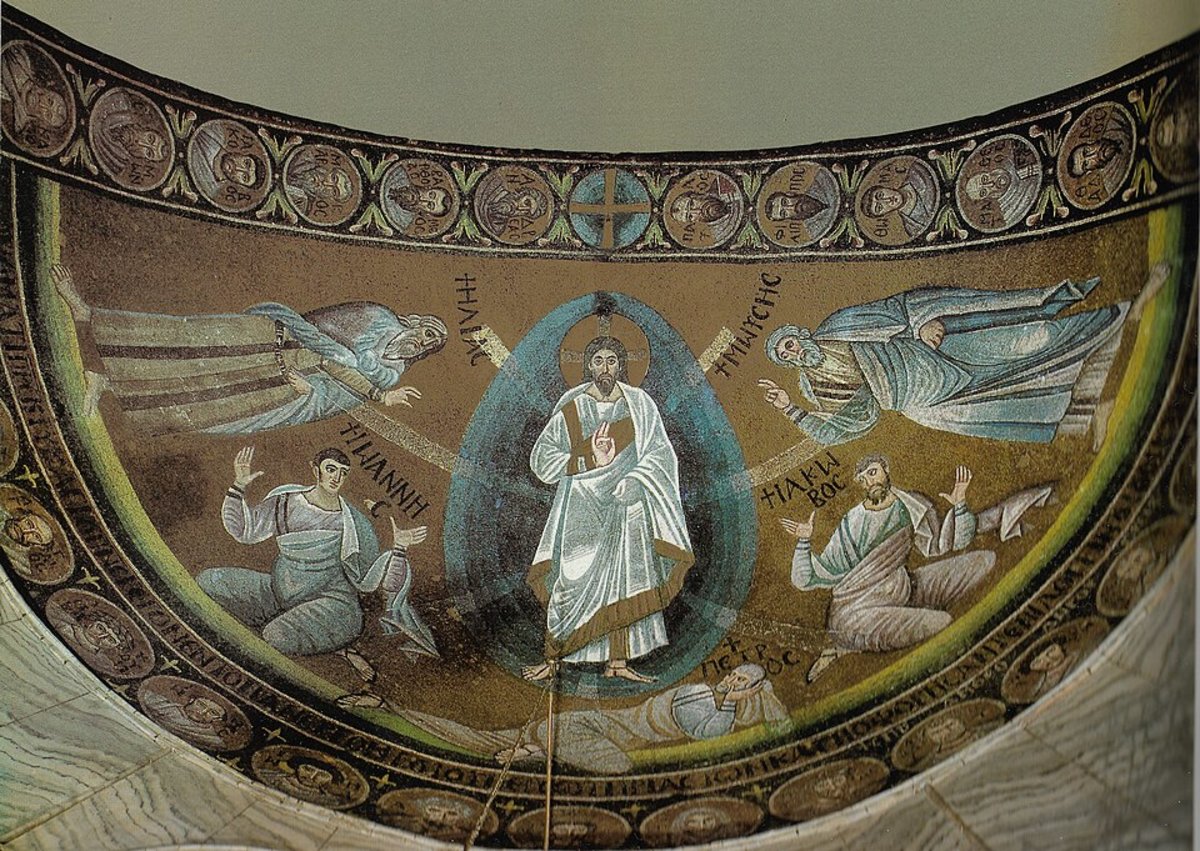
Transfiguration Apse Mosaic
Transfiguration mosaic — St Catherine's, c.565 AD
Byzantine, Public domain, via Wikimedia Commons
The Transfiguration mosaic in the apse of the Basilica of the Transfiguration at St Catherine's Monastery is the oldest large-scale Christian mosaic in situ at the site for which it was made — completed around 565 AD during the reign of the Emperor Justinian I (who built the monastery). The mosaic covers the entire apse of the basilica (approximately 6 by 3.5 metres) and shows Christ in glory at the Transfiguration (Matthew 17:1-8): standing in a blue mandorla at the centre, his robes white, his face radiating divine light, flanked by Moses (left) and Elias (right).
The apostles Peter, James, and John are shown at the base of the composition, overwhelmed by the divine manifestation. Around the central group, the fourteen medallion portraits in the arch (including Christ and the Virgin, apostles, and Church Fathers) are among the most important surviving examples of 6th-century Byzantine portraiture.
For the context of St Catherine's Monastery, see entries 148 and 186. The Transfiguration mosaic was made at the same time as the Basilica itself (completed 565 AD) and has survived in near-original condition — the tesserae have been reset and restored in places but the composition is essentially as Justinian's craftsmen laid it. The mosaic predates the Byzantine Iconoclasm (726-843) and is therefore the oldest surviving large-scale Christian mosaic in a functioning Eastern Christian church.
The mosaic is visible in the apse of the basilica during visiting hours at the monastery. The best light for seeing the mosaic is in the morning, when the apse is lit from the east windows.
The blue mandorla around Christ — the standard Byzantine symbol of divine glory (the mandorla is the almond-shaped field of light surrounding a figure in divine manifestation) — is made of tesserae in multiple shades of blue, creating a graduated atmospheric effect. The faces of Moses and Elias are specific portrait types distinct from the standard Byzantine formula.
When standing before this work, look carefully: Transfiguration mosaic — St Catherine's, c.565 AD. Give it time — what seems decorative often carries the central meaning.
When standing before this work, look carefully: Christ in the blue mandorla — divine glory. Give it time — what seems decorative often carries the central meaning.
When standing before this work, look carefully: Moses and Elias flanking Christ. Give it time — what seems decorative often carries the central meaning.
When standing before this work, look carefully: The arch medallion portraits — 6th-century Byzantine portraiture. Give it time — what seems decorative often carries the central meaning.
St Catherine's Monastery, Mount Sinai, Egypt. See entry 148 for visiting details.