
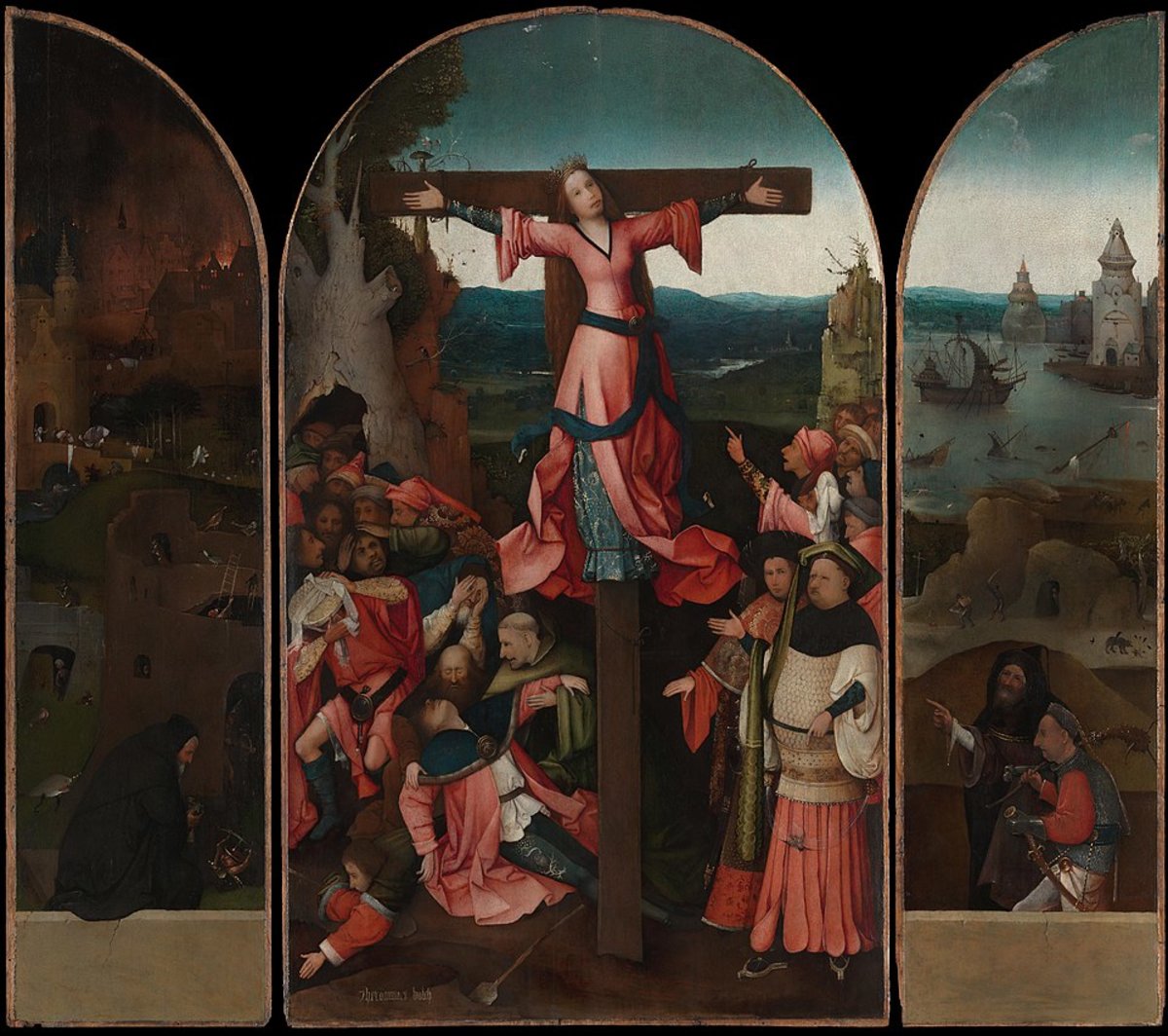
Triptych of the Crucifixion (Vienna Crucifixion Triptych)
Crucifixion Triptych — Rogier van der Weyden, c.1445
Rogier van der Weyden, Public domain, via Wikimedia Commons
Rogier van der Weyden's Vienna Crucifixion Triptych is the most powerful and formally original of his large-scale altarpieces — a triptych approximately 96 by 237 cm (open) with the Crucifixion in the central panel and donor portraits in the wings, painted around 1445. The central panel is extraordinary in its compositional invention: the Crucifixion is set not in a landscape or interior but against a flat red ground, the figures (Christ on the cross, the Virgin fainting, St John supporting her) reduced to their essential forms against an absolutely abstract red field.
This anti-naturalistic setting — the red ground instead of sky or landscape — creates a devotional intensity that is overwhelming precisely because of its formal reduction: there is nowhere else to look but the figures. The donor portrait wings show the donors kneeling in prayer, separated from the central scene by a fictive stone arch.
Rogier van der Weyden (c.1399/1400-1464) was the most influential Flemish painter of the 15th century — more widely copied and adapted across Europe than Jan van Eyck. His approach to the religious image was psychological and devotional rather than descriptive: where van Eyck accumulates detail in service of surface description, Rogier distils detail in service of emotional impact. The red ground of the Vienna Crucifixion is the most extreme example of this distillation: the Crucifixion is reduced to its essential human and theological elements, stripped of all contextual naturalism.
The red ground of the central panel has been interpreted as the blood of Christ (the redemptive sacrifice filling the entire space), as a liturgical curtain, or as an abstract theological statement of divine love. Whatever its precise meaning, the formal effect is overwhelming: the figures stand out from the red with absolute clarity, their grief specific and concentrated. The Virgin's swoon (she collapses backward into St John's arms, her blue mantle spreading around her) is one of the most deeply felt passages in any Flemish painting.
When standing before this work, look carefully: Crucifixion Triptych — Rogier van der Weyden, c.1445. Give it time — what seems decorative often carries the central meaning.
When standing before this work, look carefully: The red ground — anti-naturalistic devotional abstraction. Give it time — what seems decorative often carries the central meaning.
When standing before this work, look carefully: The Virgin's swoon — grief at its most specific. Give it time — what seems decorative often carries the central meaning.
When standing before this work, look carefully: The donor portrait wings — kneeling in prayer. Give it time — what seems decorative often carries the central meaning.
Kunsthistorisches Museum, Maria-Theresien-Platz, Vienna. See entry 178 for visiting details.