
Triumph of Divine Providence (Ceiling Fresco)
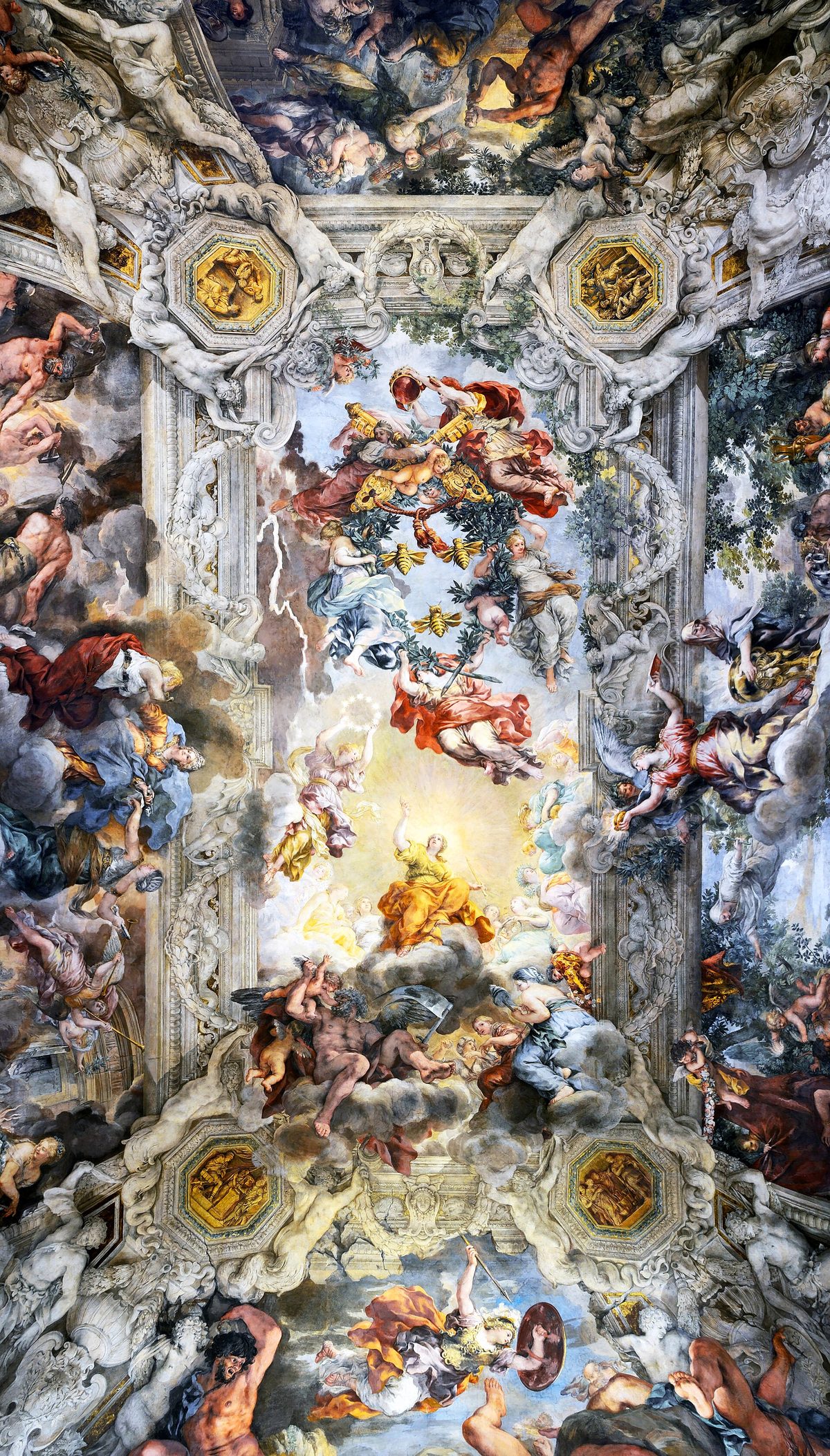
Triumph of Divine Providence — the full ceiling
Pietro da Cortona's Triumph of Divine Providence is the most spectacular ceiling fresco in Rome outside the Sistine Chapel — a baroque illusionistic ceiling of breathtaking ambition covering the entire vault of the Gran Salone of the Palazzo Barberini. The fresco dissolves the ceiling into an apparent opening to the sky, with hundreds of figures (allegorical, mythological, and divine) arranged on clouds, on architectural prosceniums, and in the open heavens, all converging on the central group where Providence directs Immortality to place a crown on the Barberini bees — the heraldic device of Pope Urban VIII, whose family built the palazzo. The composition represents Providence using the divine institutions (Religion, Justice, Power, etc.) to glorify the Barberini papacy.
Pietro da Cortona (1596–1669) received the commission from Cardinal Francesco Barberini in 1633 and painted the ceiling over six years. It inaugurated a new approach to baroque illusionistic fresco that would influence Luca Giordano, Giovanni Battista Tiepolo, and the entire ceiling painting tradition of the next century.
The illusionistic architecture — painted arches and cornices that appear to extend the real room into the sky — creates a continuum between the physical space of the salon and the painted heavens above. The scale is overwhelming: the salon measures approximately 23 by 11 metres.
Stand in the centre of the salon and look up. The ceiling is divided into a central oval (Providence enthroned) and four surrounding panels (personifications of virtues and vices, divine and secular allegories).
The Barberini bees in the centre oval are enormous — the entire cosmic programme culminates in a piece of family heraldry, which is simultaneously absurd and magnificent. Notice the painted architectural frames (the feigned cornices and arched openings) through which figures appear to lean into the room or recede into the sky. Some figures are shown from below at foreshortened angles that require Cortona to depict the human body in positions of extreme complexity.
When standing before this work, look carefully: Triumph of Divine Providence — the full ceiling. Give it time — what seems decorative often carries the central meaning.
When standing before this work, look carefully: Central group — Providence and the Barberini bees. Give it time — what seems decorative often carries the central meaning.
When standing before this work, look carefully: The Gran Salone — room and fresco in context. Give it time — what seems decorative often carries the central meaning.
When standing before this work, look carefully: Detail — foreshortened figures on painted cornices. Give it time — what seems decorative often carries the central meaning.
Palazzo Barberini is at Via delle Quattro Fontane 13, near the Piazza Barberini. It now houses the Galleria Nazionale d'Arte Antica. The Gran Salone fresco can be seen on the museum's upper floor.