
Tympanum and Capitals of Vézelay
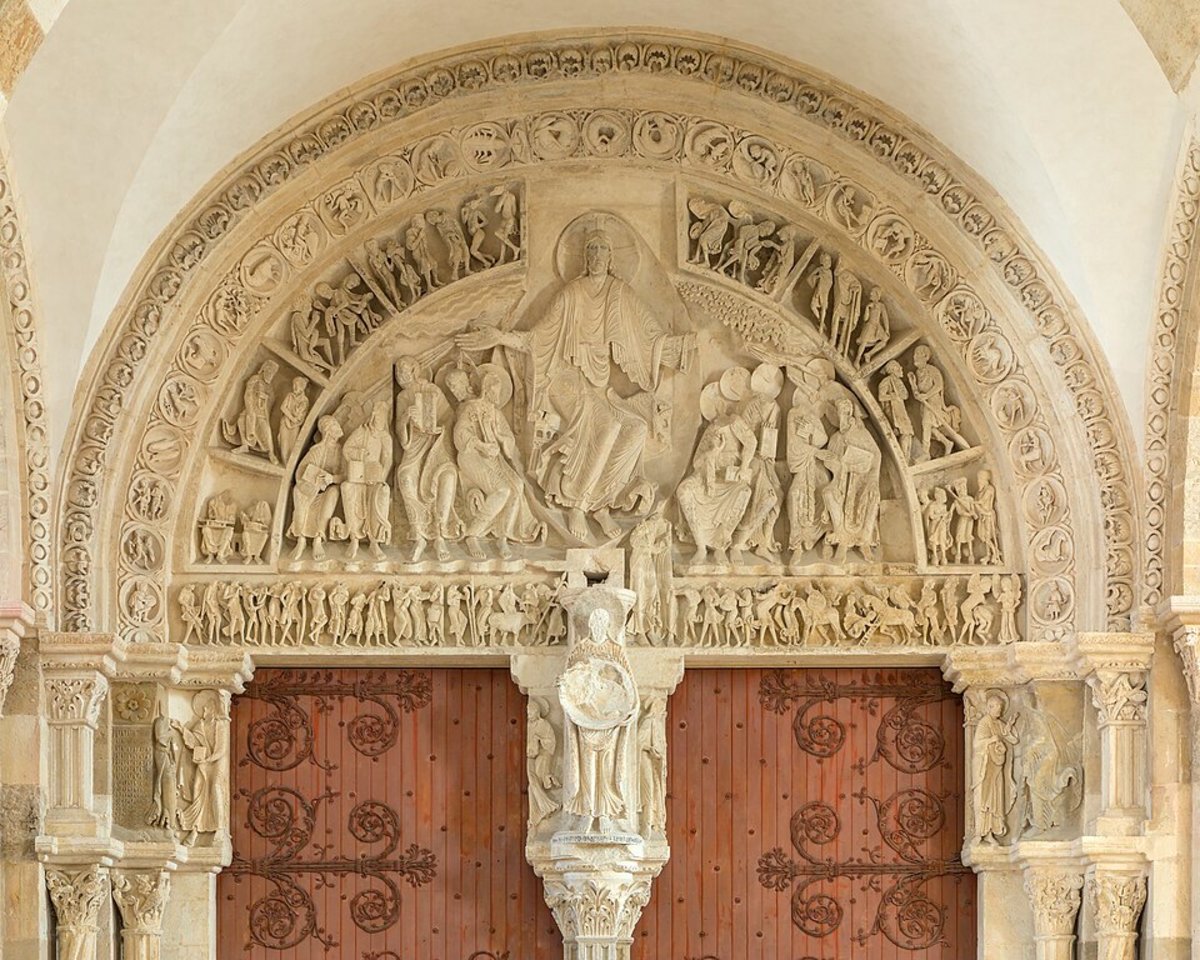
Vézelay narthex tympanum — Pentecost, c.1120-1135
Public domain, via Wikimedia Commons
The Basilica of Sainte-Madeleine at Vézelay is the finest surviving Romanesque church in France — a pilgrimage church housing the relics of Mary Magdalene and the starting point of one of the four great caminos to Santiago de Compostela. The nave capitals (approximately 110 carved stone capitals) are the most varied and expressive collection of Romanesque narrative carving in Burgundy, depicting scenes from the Old and New Testaments, allegories of vices and virtues, mythological subjects, and decorative elements with an inventive freedom unparalleled in the period. The narthex tympanum (the carved entrance portal, c.1120-1135) is the most important Romanesque tympanum in France after Autun: it shows Christ at the apex with the apostles around him, the twelve nations of the earth receiving the Holy Spirit (the Pentecost-mission theme), and scenes from the lives of the peoples at the edges.
Vézelay's Romanesque church was built in the 11th and 12th centuries to house the relics of Mary Magdalene and to serve the Benedictine pilgrim route to Santiago. The nave was damaged and partially rebuilt after a fire in 1120; the narthex tympanum and the nave capitals date from the rebuilding of c.1120-1135.
The Burgundian Romanesque style at Vézelay is distinct from Cluny and Autun: more narrative, more inventive in its approach to the human figure, more willing to depict exotic peoples and marginal subjects. The nave's light — the windows placed to create a sequence of sun-shafts in the nave at specific times of year (the nave was reportedly designed for the summer solstice light to fall on the central axis) — is one of the most famous experiences of Romanesque architecture.
The narthex tympanum is entered through the narthex (the entry vestibule of the basilica). The main tympanum shows Christ with his arms extended, sending the Holy Spirit to the apostles (shown as small figures at the lintel level).
Around the tympanum, the people of the world (depicted with medieval ethnographic imagination — dog-headed men, pygmies, earless people, etc.) receive the Christian mission. The nave capitals are best appreciated slowly, moving from bay to bay: the subjects range from the Temptation of St Anthony (with elaborate demon figures) to the Mystic Mill (Moses pouring grain into the millstone, Paul receiving the flour — an allegory of the Old and New Testaments) to narrative scenes of David and Bathsheba, St Martin, and many others.
When standing before this work, look carefully: Vézelay narthex tympanum — Pentecost, c.1120-1135. Give it time — what seems decorative often carries the central meaning.
When standing before this work, look carefully: The nave capitals — Romanesque narrative invention. Give it time — what seems decorative often carries the central meaning.
When standing before this work, look carefully: The Mystic Mill capital — Old and New Testament allegory. Give it time — what seems decorative often carries the central meaning.
When standing before this work, look carefully: The nave of Vézelay — Romanesque light. Give it time — what seems decorative often carries the central meaning.
Basilica of Sainte-Marie-Madeleine, Place de la Basilique, Vézelay, Burgundy. The basilica is an UNESCO World Heritage Site and part of the Santiago de Compostela pilgrimage route designation. Vézelay is approximately 220 km from Paris.