
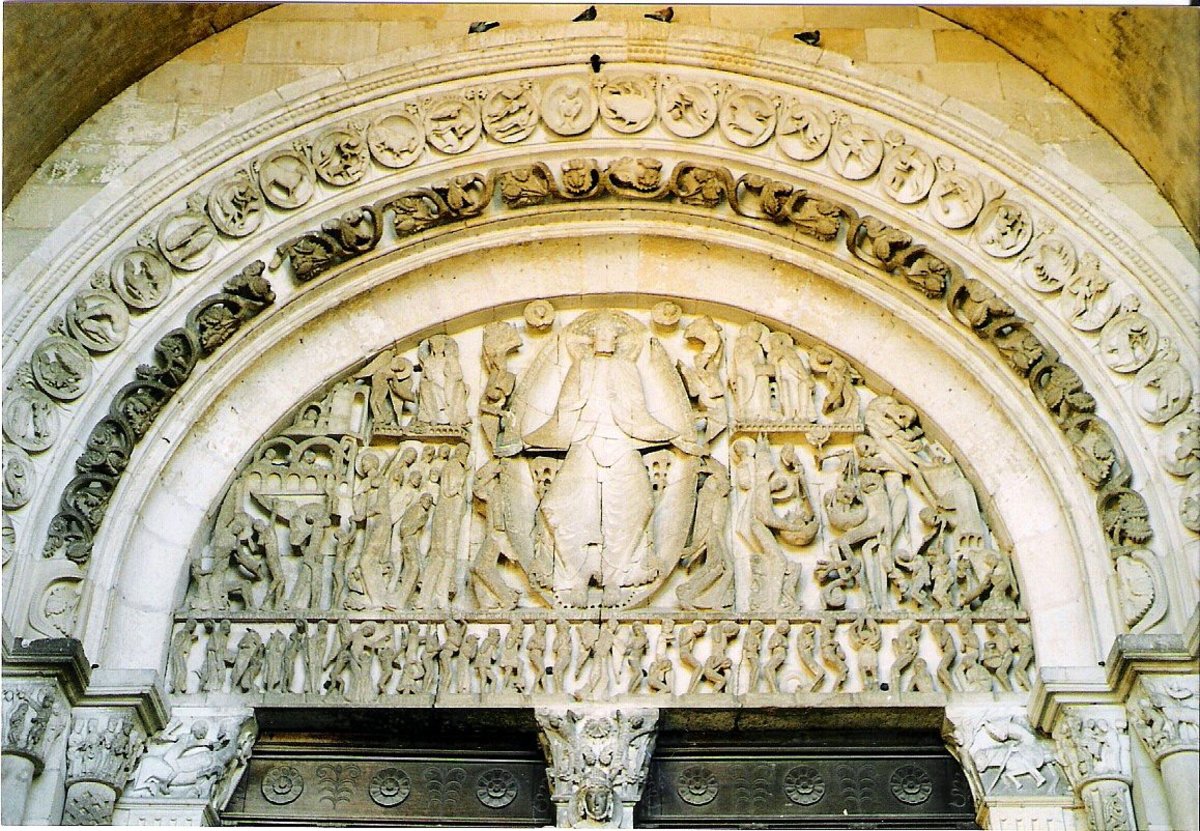
Tympanum: Last Judgment
Last Judgment tympanum — Gislebertus, c.1120-1135
Gislebertus, Public domain, via Wikimedia Commons
Gislebertus's Last Judgment tympanum on the western portal of Autun Cathedral is the supreme masterpiece of Romanesque sculpture and one of the most psychologically powerful images of the medieval period. The tympanum (approximately 4.4 metres wide and 2.4 metres tall) depicts Christ in Majesty at the apex, surrounded by the twenty-four Elders of the Apocalypse, with the Resurrection of the Dead below (souls emerging from graves, being weighed by St Michael, and separated toward paradise or hell), and the Damned being seized by monstrous hands and demons at the lower right.
The faces of the damned — their terror, their futile resistance, their despair — are depicted with an expressiveness that anticipates the more naturalistic sculpture of the High Gothic. Gislebertus carved his name on the lintel below the tympanum: 'GISLEBERTUS HOC FECIT' (Gislebertus made this) — among the earliest signed works in medieval sculpture.
The tympanum was carved around 1120-1135 for the portal of the cathedral of Saint-Lazare d'Autun in Burgundy, a major pilgrimage church. The identity of 'Gislebertus' was debated for much of the 20th century; the signature is now accepted as that of the master sculptor who directed the entire decorative programme of the cathedral, including the extraordinary capitals in the nave.
The capitals of Autun — depicting narratives from the Old and New Testaments, the lives of saints, and allegorical subjects — are among the finest Romanesque narrative reliefs in France, with an expressive range that includes tenderness, humour, horror, and spiritual ecstasy. The western tympanum is the culmination of this programme.
The most discussed figures are the Damned at the lower right: a hand (the enormous claw-like hand of a demon or angel) seizes a human soul by the head; the figures around it twist in terror or resignation. The proportions of the figures are deliberately non-naturalistic — the damned are elongated, their bodies distorted by emotion; the blessed are calmer and more composed.
The Christ at the apex is the largest figure, his arms extended in the gesture of judgment, his face expressionless and absolute. Look also at the detail of souls being weighed by St Michael (centre lower section) — the scales are depicted with specific documentary attention to their mechanism.
When standing before this work, look carefully: Last Judgment tympanum — Gislebertus, c.1120-1135. Give it time — what seems decorative often carries the central meaning.
When standing before this work, look carefully: The Damned — seized by demonic hands. Give it time — what seems decorative often carries the central meaning.
When standing before this work, look carefully: The Resurrection of the Dead — souls from their graves. Give it time — what seems decorative often carries the central meaning.
When standing before this work, look carefully: 'GISLEBERTUS HOC FECIT' — the sculptor's signature on the lintel. Give it time — what seems decorative often carries the central meaning.
Cathédrale Saint-Lazare d'Autun, Place du Terreau, Autun, Burgundy. The western tympanum was partially mutilated in the 18th century (the head of Christ was removed to make the portal more fashionable — it was found walled up in a later renovation and restored); the head is now original but slightly incongruous. The interior of the cathedral is equally important for the narrative capitals.