
Wilton Diptych
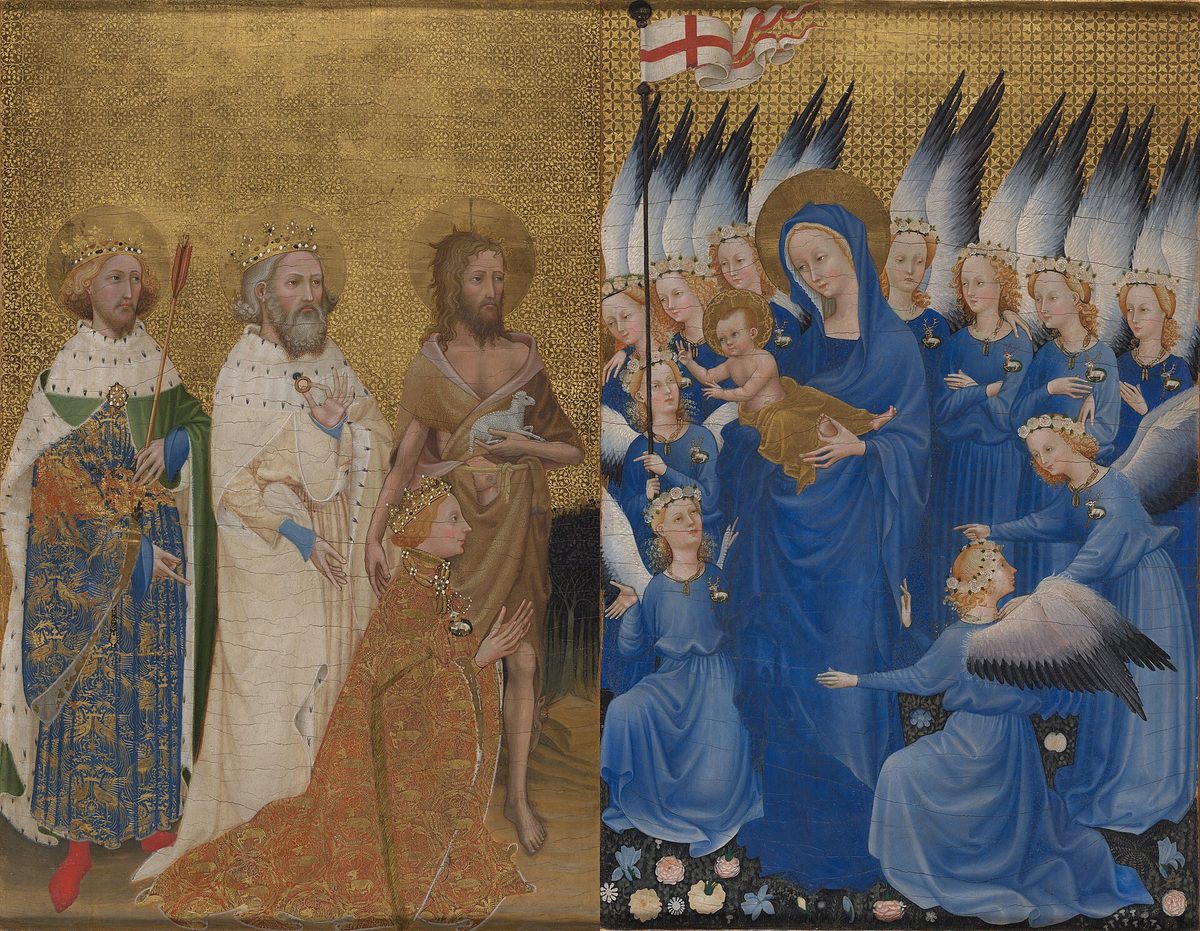
Wilton Diptych — c.1395-1399, National Gallery London
Public domain, via Wikimedia Commons
The Wilton Diptych is a small, portable double-panel altarpiece (approximately 53 by 37 cm when open) that is one of the masterpieces of International Gothic painting and the most important surviving English royal devotional object. On the left panel, the young King Richard II of England kneels in prayer, presented by his three patron saints (Edmund King and Martyr, Edward the Confessor, and John the Baptist); on the right panel, the Virgin and Child appear surrounded by eleven angels wearing Richard's personal badge (the white hart). The painting is a private devotional image — Richard brought it with him on his journeys — and a political statement: the angels wear the white hart and are therefore the king's heavenly court; Christ is being offered England (the orb on the flag contains a miniature of a green island, identified as England).
The Wilton Diptych is attributed to an unknown painter — possibly English, possibly French, or possibly Bohemian (Richard II was married to Anne of Bohemia). The date is approximately 1395-1399, during the final years of Richard's reign before his deposition by Henry IV in 1399.
The painting came to the National Gallery in 1929 from Wilton House (home of the Earls of Pembroke — hence its name). The painting was probably made for Richard's own use, and its quality suggests a court artist of the highest skill, working in the International Gothic style at its most refined.
The angels' blue robes, scattered with white harts and rosemary sprigs (possibly referencing Queen Anne), create a heavenly court that mirrors the earthly court on the left panel. The orb on the flag in the right panel — containing what appears to be a miniature landscape — is the most discussed detail: it seems to show a green island, possibly England itself, being offered to Christ and the Virgin as a realm under their protection. The Christ Child reaches toward Richard in what may be a gesture of kingship confirmation.
When standing before this work, look carefully: Wilton Diptych — c.1395-1399, National Gallery London. Give it time — what seems decorative often carries the central meaning.
When standing before this work, look carefully: Left panel — Richard II and patron saints. Give it time — what seems decorative often carries the central meaning.
When standing before this work, look carefully: Right panel — Virgin, Child, and angels. Give it time — what seems decorative often carries the central meaning.
When standing before this work, look carefully: The orb detail — England offered to Christ. Give it time — what seems decorative often carries the central meaning.
National Gallery, Trafalgar Square, London WC2N 5DN. Free admission.
Open daily. The Wilton Diptych is in Room 53 (English and Northern European painting).