
The Life
Anthony of Padua was the most effective popular preacher of the 13th century and, after the Virgin Mary, probably the most universally invoked saint in the Catholic Church. He was born Fernando Martins de Bulhoes in Lisbon in 1195, into a family of the minor Portuguese nobility, educated at the Augustinian monastery of the Holy Cross in Coimbra, and then — inspired by the relics of five Franciscan martyrs from Morocco passing through Coimbra on their way to burial — transferred to the Franciscan order at the age of twenty-five, with the intention of going to Morocco and being martyred. He was diverted from Morocco by illness, shipwrecked on Sicily, recovered at Messina, and ended up in Italy, where the rest of his story took place. He died in Padua at the age of thirty-five.
He was a figure of paradoxes. He was profoundly learned — one of the greatest scholars of his era, with a command of Scripture, patristics, and theology that Francis himself acknowledged — and he became a Franciscan precisely to leave all that behind and embrace poverty and simplicity. He was then instructed by his superiors to use his learning for the Church. He was called the Hammer of Heretics for the ferocity of his preaching against the Cathar heresy in southern France and northern Italy. He is remembered as the gentlest saint in the popular devotion. He preached to the fish when the people of Rimini refused to listen (they reportedly swam to the shore and bowed their heads), a legend that captures something real about his capacity to communicate.
His popular patronage of lost things has a specific historical origin: a novice stole his psalter — his personal copy of the Psalms, annotated in his own hand. Anthony prayed for its return. The novice was compelled by some experience we cannot specify to return it and confess. The psalter is now in the Franciscan library at Bologna. From this specific incident, the generalised devotion of asking Anthony for help finding what has been lost developed — and spread across the world. In India, Anthony devotion is one of the most widespread forms of Catholic popular piety, cutting across caste lines, and his shrines are visited by Hindu and Muslim devotees alongside Catholics.
The Sermon to the Fish
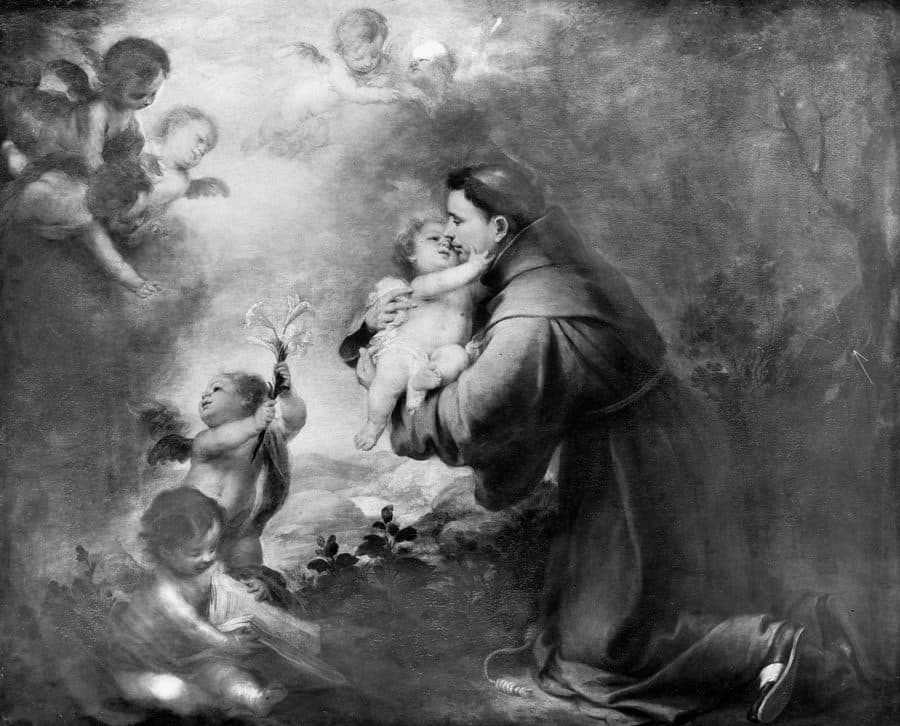
Anthony went to Rimini to preach to the Cathars and the heterodox. The people refused to listen. He went to the shore of the Adriatic and began preaching to the sea. The fish came — their heads above the water, their bodies straight and still — and appeared to listen. The crowd on the shore, astonished, came to hear what was making the fish gather. Anthony then turned and preached to them. The sermon to the fish is a legend that has been depicted hundreds of times in art; it captures something true about Anthony's persuasive power and his Franciscan sense of relationship with creation. The Hammer of Heretics In southern France and northern Italy, the Cathar heresy had established itself so completely that entire regions had effectively abandoned Catholic Christianity. Anthony was sent to preach against it. His combination of deep learning, rhetorical brilliance, and personal holiness was devastatingly effective. He is said to have converted thousands. He was called the Hammer of Heretics (Malleus Hereticorum) — a title that sits oddly with his gentle popular image but reflects the intensity of his commitment to orthodoxy and his effectiveness in defending it. The Christ Child — the vision The most famous image of Anthony — more common than any other in Catholic art — shows him holding the Christ Child, who appeared to him in a vision while he was staying as a guest of a French nobleman. The host, curious about the light emanating from Anthony's room, looked through the window and saw Anthony in ecstasy, holding a radiant child who was embracing him. The vision became the iconic image of Antonian devotion: the great preacher and scholar, in his brown Franciscan robes, holding the Child he served. The image communicates the Franciscan conviction that all learning and all ministry must be held in the arms of love. The Lost Psalter — the foundation of popular devotion A novice in Anthony's community stole his personal psalter — the annotated Psalms that were his primary tool of prayer and study. Anthony prayed for its return. The novice was moved (by what means the sources differ) to return the psalter and confess his theft. From this specific incident — a stolen book, a prayer, a return — the entire global devotion of asking Anthony for help finding lost things developed. Two billion people (approximately) have asked Anthony to help them find what they lost. It all started with a stolen psalter.
Walk in Their Footsteps
Pilgrimage sites connected to St Anthony of Padua
Ask St Anthony of Padua to Intercede
Bring these intentions to this saint in prayer:
Anthony preached to the fish when the people would not listen. That is the perfect image of his vocation: communicating the Gospel to whatever audience presents itself, without complaint about the quality of the audience. The people of Rimini who came to mock stayed to listen because of what they saw in the water. Sometimes the most effective sermon is the one preached to the sea.
“Or suppose a woman has ten silver coins and loses one. Does she not light a lamp, sweep the house and search carefully until she finds it? And when she finds it, she calls her friends and neighbors together and says, Rejoice with me; I have found my lost coin.”
St Anthony, finder of lost things — I have come with what I have lost. Help me light the lamp and sweep the whole house. And when what was lost is found — the object, the person, the faith, the direction — let me rejoice with my neighbours. You know what I am looking for. Point me toward it. Amen.