
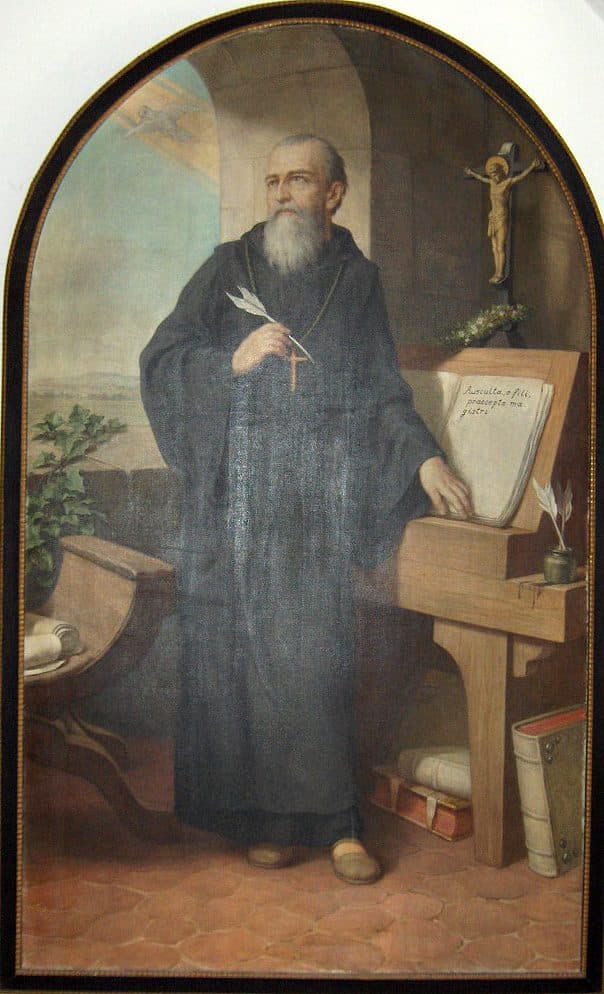
The Life
Benedict of Nursia was born around 480 AD at Nursia (modern Norcia) in Umbria, Italy, and became the founder of the monastery of Monte Cassino and the author of the Rule of Saint Benedict — the monastic rule that defines Western monasticism and has shaped the cultural, intellectual, and spiritual life of Europe for fifteen centuries. He is called the Father of Western Monasticism and is the patron saint of Europe.
He was sent to Rome for his education and found the moral environment of the city intolerable — he left and retreated to the mountain village of Enfide (modern Affile), then further into the mountains to a cave at Subiaco, where he lived as a hermit for three years. His reputation for holiness attracted followers; he organised them into twelve small monasteries of twelve monks each before moving to Monte Cassino around 529, where he founded the great monastery that bears the mountain's name, wrote the Rule, and died around 547.
The Rule of Saint Benedict — Regula Sancti Benedicti — is the governing document of Western monastic life. It is a masterpiece of practical wisdom: humane, balanced, flexible, and demanding in ways that are calibrated to what human beings can actually sustain. Its key provisions are the vows of obedience, stability, and conversio morum (conversion of life); the opus Dei (the Divine Office, the prayer of the hours seven times a day); the balance of prayer and manual work (ora et labora — pray and work); the regulation of food, sleep, and labour; and the vision of the monastery as a school for the Lord's service. It created the template for thousands of monasteries that preserved European civilization — its libraries, its agriculture, its medicine, its learning — through the centuries of migration and political instability that followed the fall of Rome.
Pope Paul VI declared Benedict patron of Europe in 1964. The Benedictine medal — which carries the initials of the exorcism prayer Vade retro Satana (Begone Satan) — is one of the most widely used sacramentals in the Catholic world, used as protection against evil.
The Cave at Subiaco — three years as a hermit
The three years Benedict spent in the cave at Subiaco — alone with God, unknown, fed by a monk who let down a basket of bread on a rope — formed the interior foundation of everything that followed. The desert fathers of Egypt had pioneered the hermit life; Benedict brought it to Italy. The cave (the Sacro Speco — the Holy Cave) is now enclosed in the Monastery of San Benedetto at Subiaco, one of the most beautiful Franciscan buildings in Italy. The actual cave, with its altar, is still accessible. It is the most intimate of Benedict's sites. The Rule — the charter of Western monasticism The Rule of Saint Benedict is one of the most influential documents in Western history — the governing charter of the monasteries that preserved European civilization through the centuries of barbarian invasion. Its genius is moderation: Benedict knew that extreme asceticism burned people out. The Rule is demanding but humane: sufficient food, sufficient sleep, work, reading, and above all the steady rhythm of the opus Dei — the seven daily prayer offices that structure the day around worship. Ora et Labora, pray and work, creates a life that is simultaneously contemplative and productive. Monte Cassino — and its destruction The monastery of Monte Cassino, founded by Benedict around 529, was one of the greatest centres of learning and culture in medieval Europe. It was destroyed four times: by the Lombards (580), the Saracens (883), an earthquake (1349), and Allied bombing in 1944 — and rebuilt each time. The current buildings are the post-war reconstruction, completed in 1964. The tomb of Benedict and Scholastica (his twin sister, also a saint) is in the crypt. The monastery sits on the summit of Monte Cassino above the town of Cassino, commanding a view across the Liri Valley. The Benedictine Medal — protection against evil The Medal of Saint Benedict is one of the most widely used sacramentals in the Catholic world. Its reverse side is covered with initials spelling out the exorcism prayer: Vade retro Satana (Begone Satan, never tempt me with vain things). The medal's use as protection against evil, temptation, and physical harm is ancient and widespread. It is used by Catholics worldwide, displayed in homes, worn around the neck, and attached to objects. The initials on the cross and around the edge encode a prayer in Latin that has been in use for over a thousand years.
Walk in Their Footsteps
Pilgrimage sites connected to St Benedict of Nursia
Ask St Benedict of Nursia to Intercede
Bring these intentions to this saint in prayer:
The Rule of Saint Benedict did not save Europe by dramatic intervention. It saved it by stability — by communities of people who stayed in one place, prayed seven times a day, worked the land, copied manuscripts, received pilgrims, and passed everything on. The monasteries were the carriers of everything Rome had known. Ora et Labora was a way of being in the world — not spectacular, but steady. Steadiness saved civilisation.
“One thing I ask from the Lord, this only do I seek: that I may dwell in the house of the Lord all the days of my life.”
Father Benedict, patriarch of Western monks — teach me your way: the balance of prayer and work, the rhythm of the hours, the stability that makes everything else possible. I live in a world of constant movement and noise. Give me a cave — interior if not physical — where I can spend the three years I need with God before I try to teach anyone else. Ora et Labora. Pray and work. Begin with pray. Amen.