
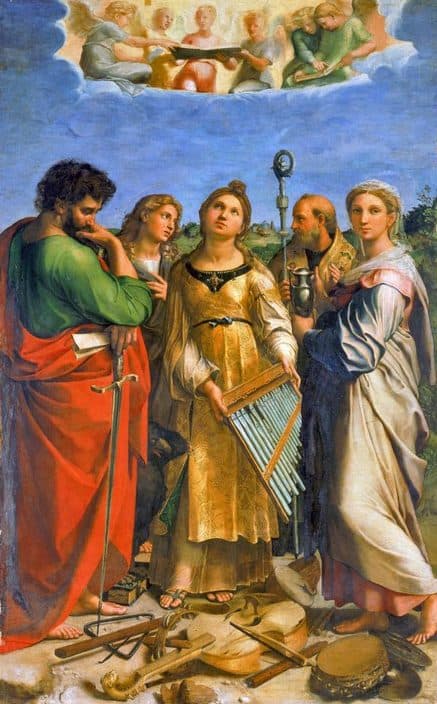
The Life
Cecilia of Rome is one of the most famous of the early Christian martyrs and the patron saint of music — an association that comes from a single line in her Acts (a 5th-century hagiographic text that is largely legendary): as the organs played at her wedding, she sang in her heart to God alone, asking him to keep her heart and body undefiled. From this single detail — a young woman singing an interior song to God while the wedding music played around her — the entire tradition of Cecilia as patron of music, of choirs, of composers, and of the Church's musical life developed.
The historical Cecilia was almost certainly a real person — there is a basilica in Trastevere, Rome, bearing her name that was built above what may have been her family's home as early as the 3rd or 4th century, and the Roman Martyrology includes her as a martyr of the early Church. The details of her Acts — the vow of virginity, the husband who converts and is martyred with her, the beheading that takes three strokes and does not kill her immediately, the three days she lives after the beheading, the finding of her incorrupt body in the catacombs in 1599 — are the standard elements of a martyr legend, not necessarily historical in the modern sense.
What matters for the vast tradition of Cecilia's patronage of music is not the historical precision of her Acts but the image they created: a woman who sang to God in the silence of her heart while all the noise of the world surrounded her. This is the model of Christian musical devotion: not music performed for an audience, but music offered to God, whether anyone else can hear it or not. Hundreds of composers have set the text of her legend to music — Handel, Purcell, Britten, and thousands of others have composed Cecilian Odes and settings of her life.
The Wedding Song — music to God alone
The detail in Cecilia's Acts that created her entire legacy is a single sentence: while the musical instruments played at her wedding, Cecilia sang in her heart to God alone, saying: May my heart and my body remain undefiled, so that I may not be confounded. She was surrounded by wedding music and she sang a different song — an interior song, audible only to God. This image of the divided attention — exterior participation in the world's music, interior devotion to God — became the model of the consecrated musician: one who uses the gift of music to transcend the merely musical. The Incorrupt Body — discovered in 1599 When Cardinal Sfondrati excavated the catacombs of Callixtus in 1599 and found a sarcophagus bearing the name Cecilia, he found a body described as perfectly preserved — lying on her side, in the position of sleep, still dressed in the golden garments of a noblewoman. The sculptor Stefano Maderno was commissioned to make a marble sculpture reproducing exactly the position and attitude of the body as it was found. Maderno's sculpture of Cecilia — lying on her side, her neck with three cuts, her hands extended with three fingers on one hand and one on the other (the traditional Christian symbol of the Trinity and Unity) — is one of the most moving sculptures in Rome and now lies beneath the altar of the Basilica of Santa Cecilia in Trastevere. The Feast of St Cecilia — music's patron day November 22 has been celebrated as the day of music since the Middle Ages. Music societies across Europe were founded under Cecilia's patronage — the Cecilian Movement of the 19th century sought to reform church music and bring it back to the purity of the Gregorian tradition. Handel wrote his Ode for St Cecilia's Day (1739). Britten wrote his Hymn to St Cecilia (1942). Composers across the centuries have written for her feast day in a tradition of musical tribute that has produced some of the finest sacred music in the repertoire. The Basilica of Santa Cecilia in Trastevere The basilica in Trastevere, Rome, was built above what may be Cecilia's family home and has been a place of Cecilian devotion since at least the 5th century. The apse mosaic is from the 9th century. Beneath the main altar is Maderno's extraordinary sculpture of the found body. The cloistered convent attached to the basilica is run by Benedictine nuns who continue the tradition of liturgical prayer above Cecilia's home.
Walk in Their Footsteps
Pilgrimage sites connected to St Cecilia
Ask St Cecilia to Intercede
Bring these intentions to this saint in prayer:
Cecilia sang to God while the wedding orchestra played around her. The interior song was louder than the external music — or at least, it was the one that mattered. This is the theology of musical devotion: the sound is not the point. The sound is the vehicle. The point is the interior act of offering, the heart directed toward God, the music as the form that the love takes when it reaches for language. She was surrounded by noise and she found the silence within it.
“Sing to the Lord a new song; sing to the Lord, all the earth.”
St Cecilia, patron of music — let me sing to God alone. Not for the audience, not for the approval, not for the effect. Let me find the interior song that continues when the external music stops. And when I sit down at the instrument or open my mouth to sing, let what comes out be the overflow of what is happening in my heart — music offered to the one who gave the gift. Amen.