
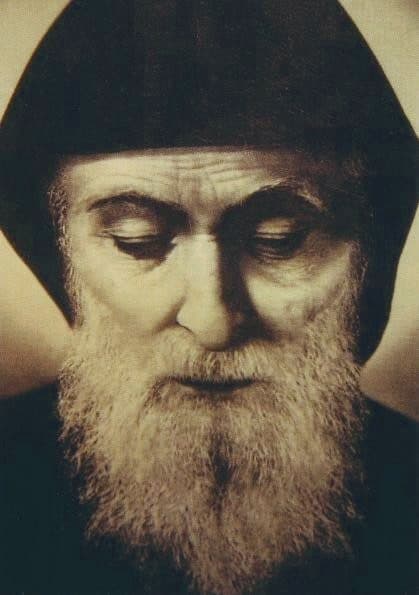
The Life
Youssef Antoun Makhlouf was born in 1828 in Beka'a-Kafra, a remote mountain village in what is now Lebanon, the youngest of five children of a mule driver who died when Youssef was three. He was raised by a maternal uncle. He left home secretly at age 23, leaving a note of apology to his mother, and entered the Monastery of Saint Maron at Annaya in 1851. He took the name Charbel (the name of an early Antiochene martyr) and was ordained a priest in 1859.
He lived for sixteen years as a Maronite monk, then in 1875 received permission to live as a hermit in the hermitage of Saints Peter and Paul, approximately five minutes' walk from the monastery. He lived in this hermitage for the remaining twenty-three years of his life, in almost complete solitude, celebrating Mass daily, practicing severe penances, and praying. He ate barely, owned almost nothing, and was known for extraordinary feats of stillness in prayer. He died on December 24, 1898, while celebrating Mass, having suffered a stroke during the words of consecration.
The story of his body begins after his death. His body was found to emit a bright light in the tomb — witnessed by monks — for 45 days after his death. When the tomb was opened, the body was found to be incorrupt, flexible, and exuding a liquid mixture of sweat and blood from the pores. The body continued to exude this liquid for decades. It was examined multiple times by medical authorities. Many miraculous cures have been reported at his tomb and attributed to the liquid from his body.
He was beatified in 1965 by Paul VI and canonized in 1977. He is the most universally beloved saint in Lebanon — venerated by both Maronite Catholics and other Christian communities, and respected by many Lebanese Muslims.
Leaving in Secret — the call to solitude
Charbel left his family home in Beka'a-Kafra in secret, leaving only a note for his mother. The secrecy reflects the awareness that his family would have tried to stop him: he was the youngest son of a widowed mother, in a rural community where family obligation was absolute. He left anyway. The call to solitude was, for Charbel, as absolute as the family obligation. He apologized in the note and left. He did not return. He wrote to his mother periodically. He spent the rest of his life in the mountains, increasingly alone, until he died at the altar. The Hermitage — twenty-three years of solitude The hermitage of Saints Peter and Paul at Annaya is a small, simple building in the Lebanese mountains, a few minutes from the monastery. Charbel lived here for twenty-three years in almost complete solitude. He celebrated Mass daily, prayed the hours, fasted severely, and was known for the completeness of his stillness in prayer — monks who observed him reported that he could remain motionless for hours. The simplicity of the life was absolute: no comfort, almost no food, no visitors except his confessor and those who brought him the daily Eucharistic elements. The Glowing Body — forty-five nights of light After Charbel's death on December 24, 1898, the monks observed a bright light emanating from his tomb for 45 consecutive nights. When the tomb was opened, his body was found to be incorrupt and emitting a fluid mixture of sweat and blood from the pores. The body has been exhumed and examined multiple times; the exudate has been collected, analyzed, and has been the vehicle of reported miraculous cures. The phenomenon has not been satisfactorily explained by medical science. The body remains at Annaya, enshrined in the monastery church. The Cures — a living patronage The reported miraculous cures attributed to Charbel's intercession are among the most numerous and best-documented in the modern saints. They continue to be reported — many by Lebanese diaspora communities around the world who invoke him through his image and relic. The range of cures reported covers cancer, paralysis, blindness, and other serious conditions. The Maronite Church has investigated many of these and accepted some as miraculous. The living nature of the reported cures — still occurring decades after his canonization — is one of the most striking features of his cult.
Walk in Their Footsteps
Pilgrimage sites connected to St Charbel Makhlouf
Ask St Charbel Makhlouf to Intercede
Bring these intentions to this saint in prayer:
Charbel glowed in his tomb for forty-five nights. The body that had been mortified for decades exuded sweat and blood after death. The hermit who had been almost invisible in life became visible in death — a light in the Lebanese mountains that still draws pilgrims from around the world. God has a way of illuminating what was hidden. Charbel hid himself in a hermitage for twenty-three years and now his light is seen in every country the Lebanese have reached.
“You are the light of the world. A town built on a hill cannot be hidden.”
Charbel, who glowed in the dark — illuminate me. I am in the dark about something: a decision, a suffering, a doubt. Light it from the inside, as your body was lit from inside after death. And for Lebanon — for that ancient Christian presence in the mountains that has endured everything — pray. For the Maronite Church, for the hermitages, for the mountains where you prayed. May the light hold. Amen.