
The Life
Christopher — whose name means Christ-bearer in Greek (Christophoros) — is one of the most universally popular saints in Catholic popular devotion, despite the fact that the Roman Martyrology removed his feast from the universal calendar in 1969, citing insufficient historical evidence for his existence. The removal did not stop the devotion. Christopher medals continue to sell in the millions; Christopher statues are fixed to dashboards across the world; travellers pray to him as they have prayed to him since the Middle Ages.
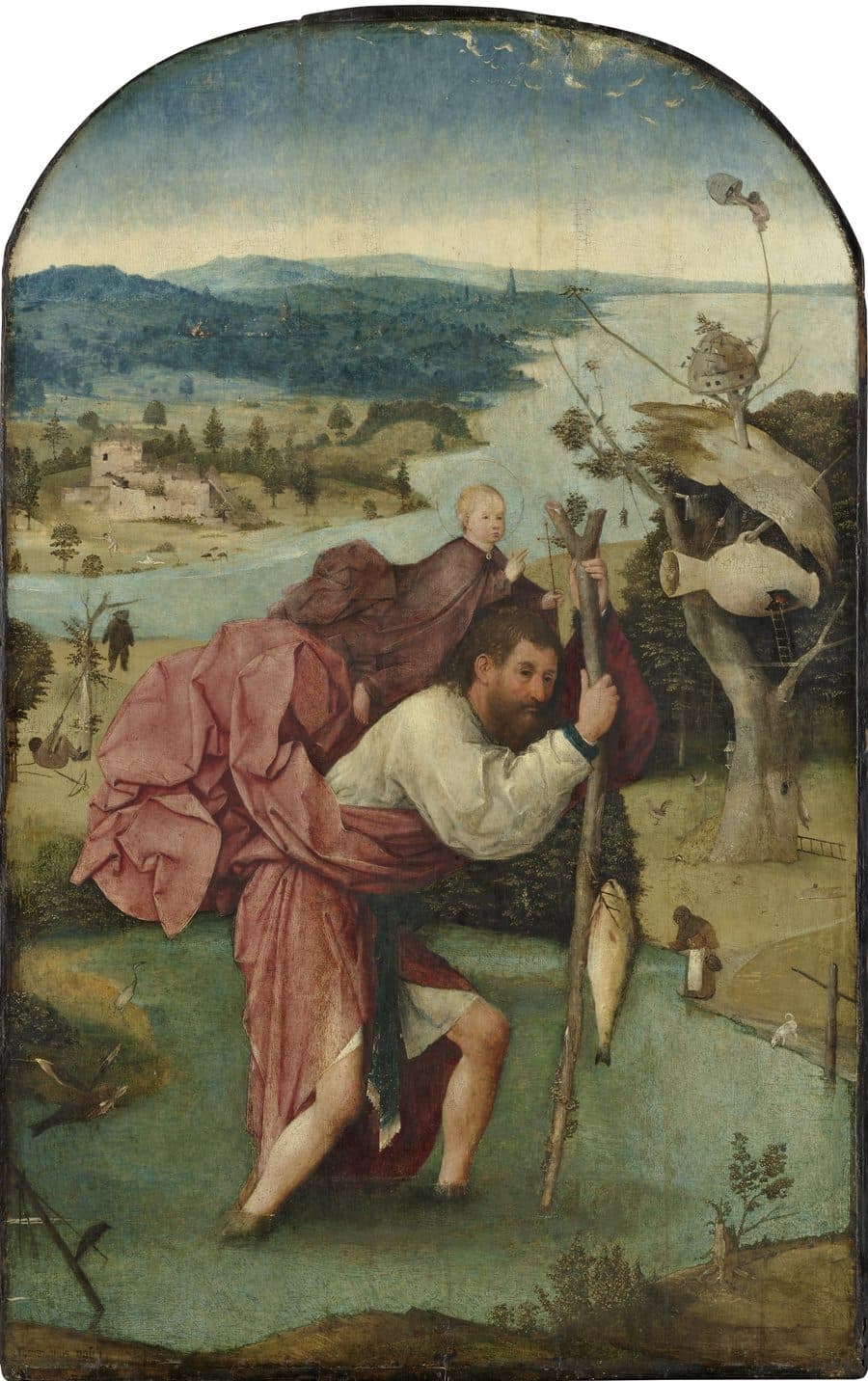
The legend of Christopher — recorded from at least the 5th century — tells of a giant of a man who decided to serve the most powerful master in the world. He served a great king until he discovered the king was afraid of the devil; he served the devil until he discovered the devil was afraid of Christ; he then sought Christ, and a hermit told him to serve Christ by carrying travellers across a dangerous river. One night a child appeared and asked to be carried across. Christopher placed the child on his shoulders and entered the river, but with each step the child became heavier, until he was struggling under an almost unbearable weight. When he reached the other bank, the child revealed himself as Jesus Christ, carrying the weight of the whole world — and told Christopher that in carrying him he had carried the one who had created and sustained all creation. Christopher then planted his staff in the ground and it became a flowering tree.
The theological content of the legend is rich: the hero who seeks the most powerful master, discovering that real power descends to childhood and river-crossings; the physical weight of the world as the body of the Christ; the service that does not know what it is doing until the crossing is complete. Whether Christopher was a historical person — some traditions identify him as a 3rd-century martyr in Lycia — is less important than what his legend communicates: that bearing others across the dangerous crossing, however heavy the burden becomes, is the precise form of service that bears Christ.
The River Crossing
The river that Christopher carried travellers across was a dangerous one — deep and fast, without a ford or bridge. He was strong enough to carry people who could not cross alone. The child who appeared at night was lighter than he expected and then heavier than he could bear. The heaviness was the weight of the world — the accumulated weight of all creation, carried in the body of a child. Christopher crossed with the weight. He arrived on the other side to find that what he had been carrying was the maker of the river. The service that feels impossibly heavy is often the service that carries what is most holy. The Patron of Travellers — the medieval tradition In medieval Europe, Christopher was considered one of the most important saints to invoke. His image was placed at the entrance to churches, cities, and bridges — so large that it could be seen from a distance — because it was believed that seeing the image of Christopher on a given day would protect one from sudden death that day. The logic was protective magic in religious form: the Christ-bearer at the threshold protecting all who passed. This tradition has evolved into the Christopher medal on the dashboard, the Christopher statue in the car, the Christopher prayer before a long journey. The Calendar Controversy In 1969, the Vatican's revision of the Roman Calendar removed Christopher from the universal feast calendar, placing him among saints whose historical existence is uncertain. The popular reaction was extraordinary: this was probably the most controversial calendrical decision of the reform, generating more protest than any other saint's removal. The Church has since clarified that the removal from the universal calendar does not mean the Church denies his existence or forbids his veneration — local calendars may retain his feast, and the devotion continues as a legitimate expression of Catholic popular piety. The St Christopher Medal The St Christopher medal — typically showing the giant carrying the Christ child across the river, with the words Saint Christopher protect us — is one of the most widely sold and worn Catholic devotional objects in the world. It is worn by soldiers, given to children leaving home, fixed to car dashboards, and carried by travellers who may not be practising Catholics but know the tradition. The medal is the popular form of the invocation: I am crossing a dangerous river; I ask the Christ-bearer to accompany me.
Walk in Their Footsteps
Pilgrimage sites connected to St Christopher
Ask St Christopher to Intercede
Bring these intentions to this saint in prayer:
Christopher carried the child across the river not knowing who the child was. He discovered who he had been carrying when he arrived on the other bank. This is the structure of much service: we find out who we were serving after the crossing is complete, not before. The weight that is heaviest often contains the holiest cargo.
“Truly I tell you, whatever you did for one of the least of these brothers and sisters of mine, you did for me.”
St Christopher, Christ-bearer, patron of my journey — go before me on this road. I am setting out across the dangerous river of this day, this journey, this passage. When the weight becomes unbearable, give me the strength of the giant who carried the world on his shoulders and arrived at the other bank. And when I arrive, let me discover who I have been carrying all along. Amen.