
The Life
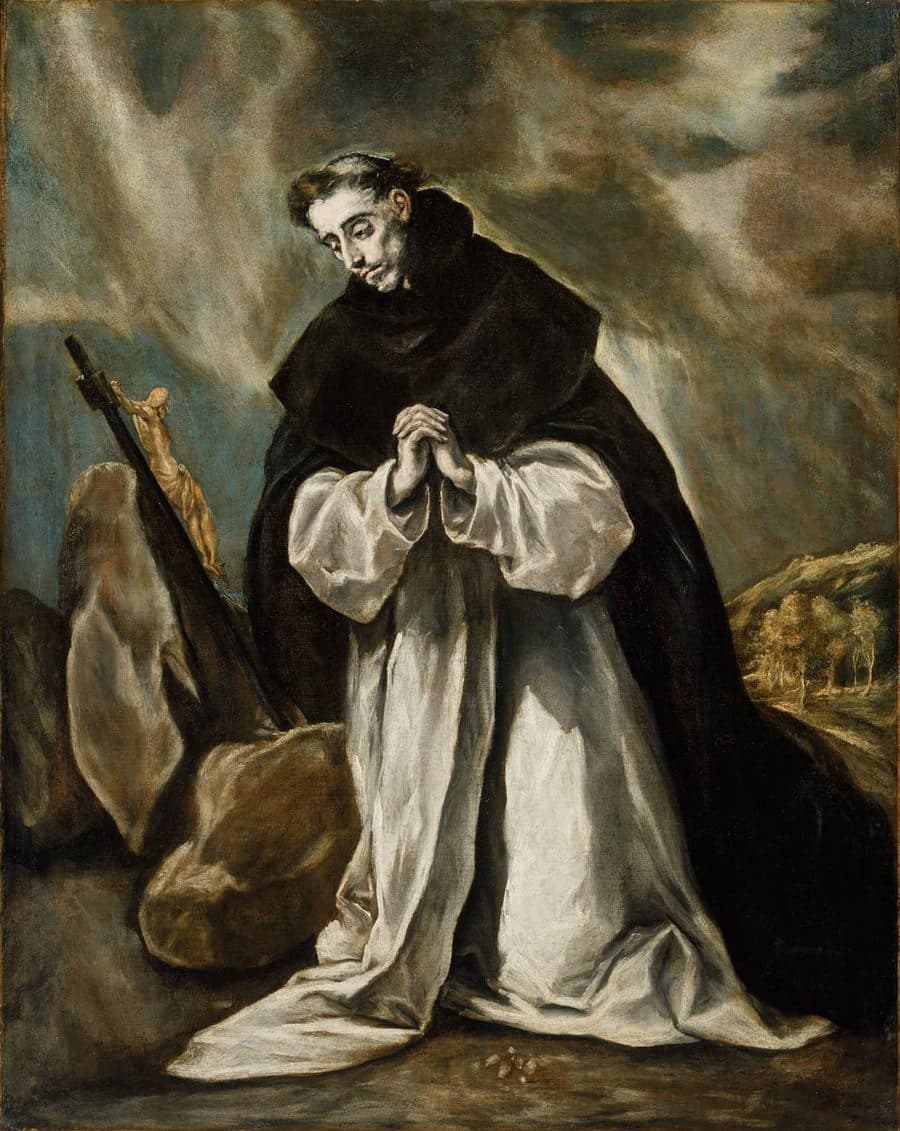
Dominic de Guzman was born around 1170 in Caleruega, in the Kingdom of Castile (modern Spain). He was a cathedral canon in Osma, a university-educated priest with a deep formation in Scripture, who became the founder of the Order of Preachers — the Dominicans — and a central figure in the Church's response to the Cathar heresy in southern France. He is traditionally credited with receiving the Rosary from the Virgin Mary in a vision, making him the patron of one of the most widely practiced forms of Catholic prayer.
He first encountered the Albigensian (Cathar) heresy in southern France on a journey to Denmark with Bishop Diego of Osma in 1203. The Cathars were a dualist sect that taught that the material world was evil and the spiritual world good, rejected the sacraments, and had built an extensive alternative church structure in Languedoc. The Church's initial response to Catharism — sending Cistercian legates who traveled in great state — had been ineffective; the Cathars contrasted their own apostolic poverty with the Cistercians' wealth and won the comparison.
Dominic and Diego reversed the approach: they dismissed their entourages, traveled on foot and in poverty like the apostles, debated the Cathar teachers publicly, and sought to win people by argument and example rather than by authority. This apostolic method — poverty, preaching, learning, and debate — became the model for the Dominican order Dominic founded in 1216.
The Dominicans (officially the Order of Preachers, or OP) were specifically an order of preachers — educated, mobile, mendicant friars whose specific charism was the preaching of the Gospel through argument, learning, and personal poverty. The Franciscans and the Dominicans were the two great mendicant orders that revitalized the 13th-century Church. The Dominicans produced Thomas Aquinas, Albert the Great, Meister Eckhart, and Catherine of Siena. They also staffed the Inquisition — a complexity that is part of the Dominican legacy.
The Mission to the Cathars — meeting poverty with poverty
The Albigensian heresy had proven resistant to the Church's official response because the Cistercian legates arrived in state — horses, entourages, fine food — while the Cathar perfecti lived in genuine apostolic poverty and contrasted themselves favorably with the Church's wealth. Dominic and Diego had the insight to reverse the terms: they dismissed their entourage, traveled on foot, debated in public, ate simply. You will catch more flies with honey than with vinegar, and more Cathars with apostolic poverty than with papal legates on horseback. The Order of Preachers grew from this insight. The Foundation of the Order of Preachers Pope Honorius III confirmed the Order of Preachers in 1216. The Dominicans were the first order explicitly founded for preaching — mobile, mendicant, university-educated friars who went where the intellectual need was greatest. Their motto — Laudare, Benedicere, Praedicare (to praise, to bless, to preach) — described a specific vocation: the service of truth through learned preaching. Within a generation the Dominicans had produced Thomas Aquinas. Within two, they were in every university in Europe. The Vision of the Rosary The tradition that Dominic received the Rosary from the Virgin Mary in a vision during the Albigensian mission — as a weapon against heresy — is late medieval in origin (13th-century Dominicans do not mention it) but has become an essential part of Dominican identity. Whether or not the specific vision occurred, Dominic's association with the Rosary is historically real: Dominican preachers popularized and developed the Rosary as a form of meditative prayer in the 15th century. Pope John Paul II added the Luminous Mysteries in 2002. Prouille — the first Dominican monastery In 1206, Dominic founded the monastery of Prouille in southern France — originally as a house for Cathar women who had converted to Catholicism and needed a community. Prouille is the first Dominican community, predating the formal foundation of the order. It still exists, run by Dominican nuns, in the foothills of the Pyrenees. The site is a reminder that Dominic's mission was not primarily institutional but personal: he was trying to receive individual people and give them a place to live their new faith.
Walk in Their Footsteps
Pilgrimage sites connected to St Dominic de Guzman
Ask St Dominic de Guzman to Intercede
Bring these intentions to this saint in prayer:
Dominic's genius was the insight that the best response to error is not power but truth — not Cistercian legates in state, but friars on foot who could out-argue the Cathars in public. The Order of Preachers was built on this conviction: that the Gospel, preached by learned people who lived it, could win hearts that would never be won by authority alone. The Dominicans gave the Church Thomas Aquinas. The method and the man are inseparable.
“As it is written: How beautiful are the feet of those who bring good news!”
Saint Dominic, founder of Preachers — give me your fire for truth. I am surrounded by confusion and error; give me the learning to engage it honestly and the personal poverty to make my argument credible. Let me travel on foot, eat simply, and debate in public. And when I have spoken, let me hand the prayer beads to the Virgin and let her do what argument cannot. Amen.