
The Life
Dymphna is a 7th-century Irish saint about whom only a legend survives — but it is a legend whose power and relevance to modern suffering has made her the most invoked saint for mental illness and the patron of one of the most extraordinary psychiatric communities in the world.
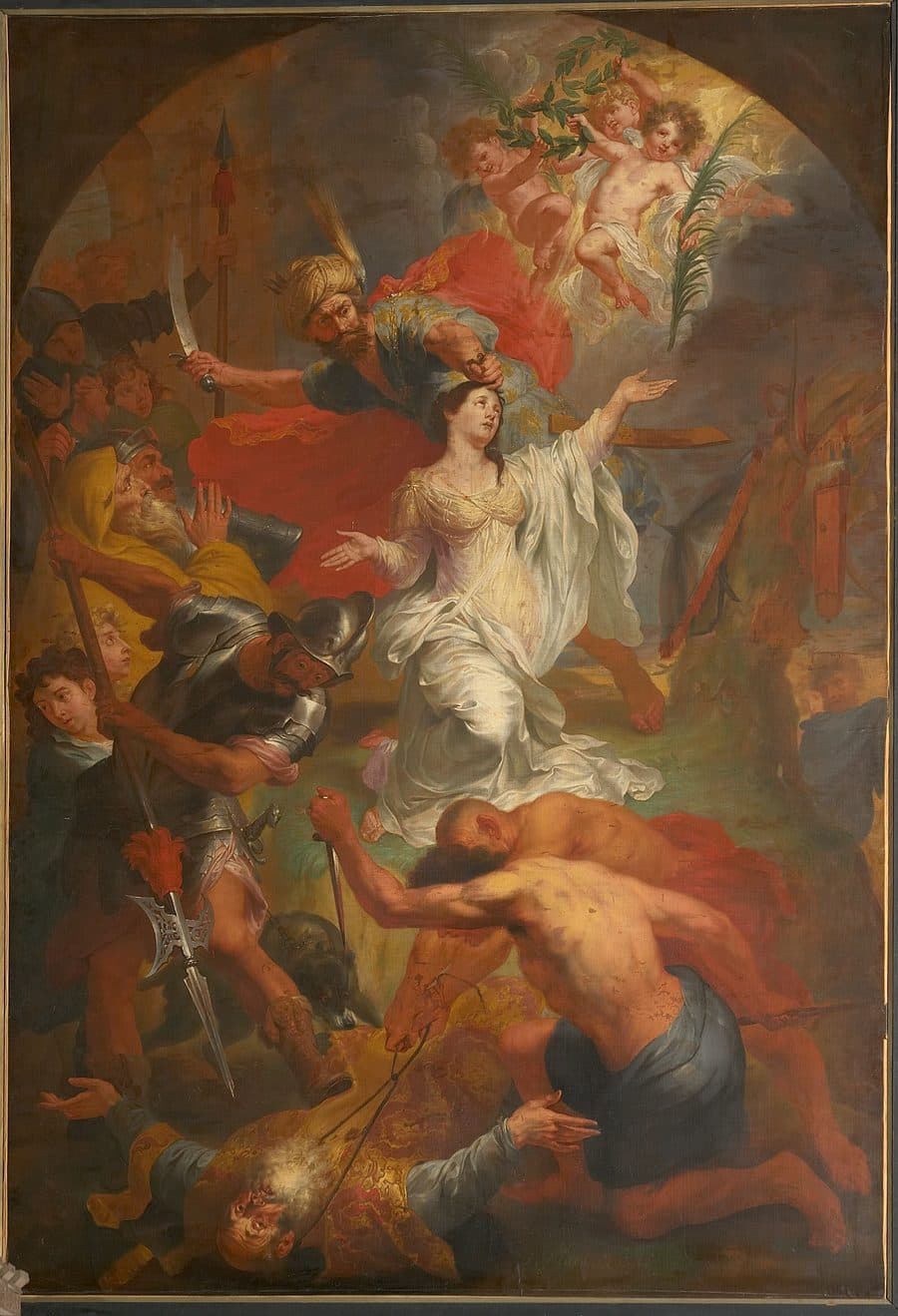
According to the legend, recorded by Thomas of Cantimpre in the 13th century, Dymphna was the daughter of an Irish or British king who had converted to Christianity. Her mother died when she was young. The king, who loved his wife deeply and was himself possibly suffering from a mental breakdown, became obsessed with his daughter's resemblance to her mother and began pressing her to marry him. Dymphna fled with her confessor, the priest Gerebernus, and two companions to the coast of Belgium, where they settled near Gheel (modern Geel).
The king tracked her down. When she refused to return, he ordered his soldiers to kill Gerebernus; he himself beheaded his daughter. She was approximately 15 years old. Both she and Gerebernus were venerated locally. The shrine at Gheel became associated with miraculous cures of mental illness, epilepsy, and other neurological conditions.
The most remarkable legacy of Dymphna's cult is the town of Geel (modern spelling) itself: from the medieval period, the townspeople began taking mentally ill pilgrims into their homes when the pilgrim hostel was full. This practice of home care for the mentally ill has continued for eight centuries — unbroken — making Geel the world's oldest and most sustained experiment in community-based mental health care. Today, approximately 500 people diagnosed with serious mental illness live in private homes in Geel as family members — the Family Care system — in what has been recognized as a model of psychiatric community care.
Flight from Abuse — the patron of those who flee
Dymphna fled her father. She took a priest, two companions, and she left. The legend is the story of a young woman who recognized what was being asked of her, refused it, and ran. The flight across the sea to Belgium is not a detail; it is the substance of her identity. She is the patron of those who flee abuse precisely because she did so herself. The fact that she was killed in the end does not undo the flight; it consecrates the attempt. She is the patron of those who need the courage to leave as well as the patron of those who did not survive the leaving. The Beheading and the Shrine at Gheel When the king's soldiers could not persuade Dymphna to return, he beheaded her himself. She was approximately 15. Her body and that of Gerebernus were buried by local people; miraculous cures of mental illness were reported at the tomb. The shrine became a destination for the mentally ill. The town of Gheel grew up around it. From the medieval period, the pilgrims who could not be housed in the pilgrim hostel were taken in by local families — and stayed, and were cared for, and were sometimes not released when they recovered. The Family Care system of Geel is still operating. Geel's Family Care System — 800 years of community psychiatry The Geel Family Care system is one of the most extraordinary social experiments in human history. For eight centuries, people with serious mental illness have lived as family members in the private homes of Geel's residents — eating at the family table, participating in daily life, working if able, and being cared for not as patients but as boarders. Today approximately 500 such residents live in Geel homes. The system has been studied by psychiatrists, anthropologists, and social reformers as a model of destigmatizing and community-based care. It began because a princess was beheaded in a Belgian field in the 7th century. The Legend as Resource for Sufferers Dymphna's legend is unusually useful for those who suffer mental illness and their families: it provides a patron who was herself a victim of someone with a serious mental disorder (her father), who suffered from unjust treatment, who fled, and who was killed because someone could not accept no. The patron of mental illness is not a theorist of mental health — she is a survivor who became a victim. This specific biography makes her accessible to people in situations of domestic violence, familial abuse, and the intersection of mental illness and family dysfunction.
Walk in Their Footsteps
Pilgrimage sites connected to St Dymphna
Ask St Dymphna to Intercede
Bring these intentions to this saint in prayer:
Dymphna is the patron of mental illness because she fled from it and was killed by it. Her father may have been suffering from grief and possibly psychosis; her response was to run. The medieval town of Gheel received the people who came to her shrine and did not have beds in the hospital, and took them home instead, and kept them for eight centuries. The patron of mental illness produced the oldest community psychiatry system in the world. The legend, whatever its historical basis, generated something real.
“The Lord is close to the brokenhearted and saves those who are crushed in spirit.”
Dymphna, who knows the darkness — be close today to everyone suffering in the darkness of their mind. For those with depression who cannot get out of bed. For those with anxiety who cannot leave the house. For those with psychosis who cannot trust their own perceptions. For those fleeing someone who should have protected them. You fled too. You know what it is to run in the night toward something safer. Guide them. Amen.