
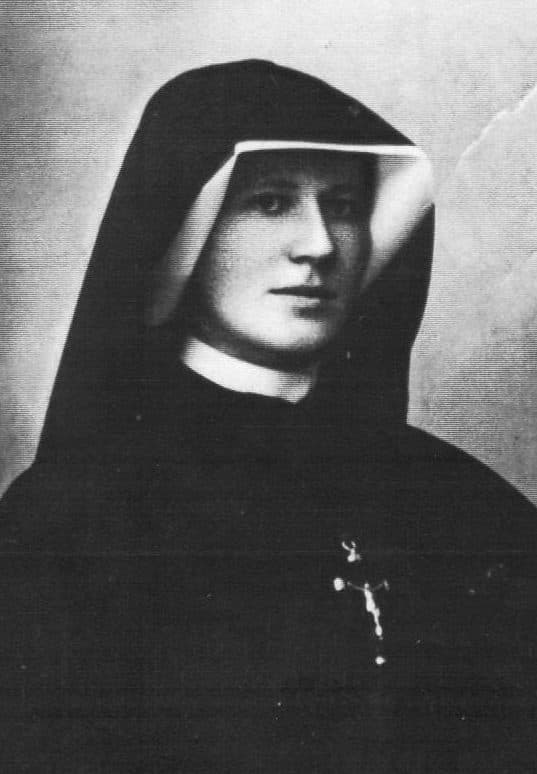
The Life
Helena Kowalska was born in 1905 in Glogowiec, a small village in Russian-partitioned Poland, the third of ten children of a poor farming family. She entered the Congregation of the Sisters of Our Lady of Mercy in Warsaw in 1925, taking the name Sister Maria Faustina, and spent the rest of her short religious life in various convents of her congregation — Vilnius, Warsaw, and Krakow.
She had an intense interior mystical life which she recorded in her Diary (officially titled Divine Mercy in My Soul) on the instruction of her confessor and spiritual director, Father Michal Sopocko. The Diary records her visions, conversations with Christ, and the mission she was given: to spread the devotion to Divine Mercy and to have a particular image painted — the Image of Divine Mercy, showing Jesus with two rays of light (white for the water and red for the blood from his side) emerging from his heart, with the inscription Jesus, I trust in You.
The Diary also describes her instruction to promote three devotional practices: the Chaplet of Divine Mercy (prayed on rosary beads), the Divine Mercy Novena, and the Hour of Mercy (3pm — the hour of Christ's death). She was told: I desire that the Feast of Mercy be a refuge and shelter for all souls, and especially for poor sinners. The feast was to be celebrated on the Sunday after Easter (now called Divine Mercy Sunday throughout the Catholic Church).
Faustina suffered from tuberculosis and died in Krakow in 1938 at age 33. Her diary was initially suppressed by the Vatican in 1959 due to concerns about the translation, then rehabilitated in 1978 when Karol Wojtyla (shortly to become John Paul II) led an investigation that cleared it. John Paul II, a Polish pope with a particular devotion to Divine Mercy, beatified her in 1993, canonised her in 2000, and established Divine Mercy Sunday throughout the universal Church in 2000.
The Vision of Divine Mercy and the Image
The central vision Faustina received was an image of Jesus with two rays of light emerging from his heart — white and red, representing the water and blood from his pierced side. She was instructed to have a painting made with the inscription Jesus, I trust in You. The first image was painted in Vilnius in 1934 under her direction by artist Eugeniusz Kazimierowski. The image, and its inscription, has become one of the most widely distributed Catholic devotional images in the world. The Diary — divine mercy in my soul Faustina's Diary was kept on the instruction of her spiritual director and records approximately six years of interior experience. It is one of the most extensive and detailed records of mystical experience in the modern period — covering visions, locutions, suffering, consolations, and the specific devotional practices she was instructed to spread. The Diary was suppressed in 1959, then rehabilitated in 1978 by an investigation led by Karol Wojtyla. John Paul II called it a guide for the spiritual life for the faithful in our time. The Chaplet and the Hour of Mercy Faustina was instructed to spread three specific devotional practices: the Chaplet of Divine Mercy (prayed on standard rosary beads, with specific prayers replacing the Our Father and Hail Mary), the Divine Mercy Novena (nine days of prayer beginning on Good Friday), and the Hour of Mercy (3pm daily, the hour of Christ's death — a moment of intense prayer for mercy). These practices have spread worldwide; the Chaplet in particular is prayed daily by millions of Catholics. John Paul II and the rehabilitation The relationship between Karol Wojtyla and Faustina's Divine Mercy devotion is one of the formative threads of John Paul II's pontificate. As Archbishop of Krakow he led the investigation that rehabilitated the Diary; as Pope he beatified her, canonised her, established Divine Mercy Sunday, and entrusted the world to Divine Mercy at the Shrine in Lagiewniki on August 17, 2002. He died on the vigil of Divine Mercy Sunday, April 2, 2005.
Walk in Their Footsteps
Pilgrimage sites connected to St Faustina Kowalska
Ask St Faustina Kowalska to Intercede
Bring these intentions to this saint in prayer:
Faustina was told to spread a message that is both extremely simple and extremely radical: Jesus, I trust in You. The devotion to Divine Mercy is the devotion to the belief that God's mercy is greater than any sin. Greater than any failure, any backsliding, any distance from God. Faustina received this message in a tuberculosis sanatorium in 1930s Poland and died at 33. The devotion she spread has reached every country on earth. Divine Mercy Sunday is now universal. The message outlasted the messenger by decades.
“But while he was still a long way off, his father saw him and was filled with compassion for him; he ran to his son, threw his arms around him and kissed him.”
Faustina, apostle of mercy — I need what you preached. Jesus, I trust in You. Let me say it until I mean it. I have feared God's judgment; teach me to run toward God's mercy instead. I am still a long way off. I need the father who runs. At three o'clock today, the hour of mercy, meet me in the place of my greatest need. Jesus, I trust in You. Amen.