
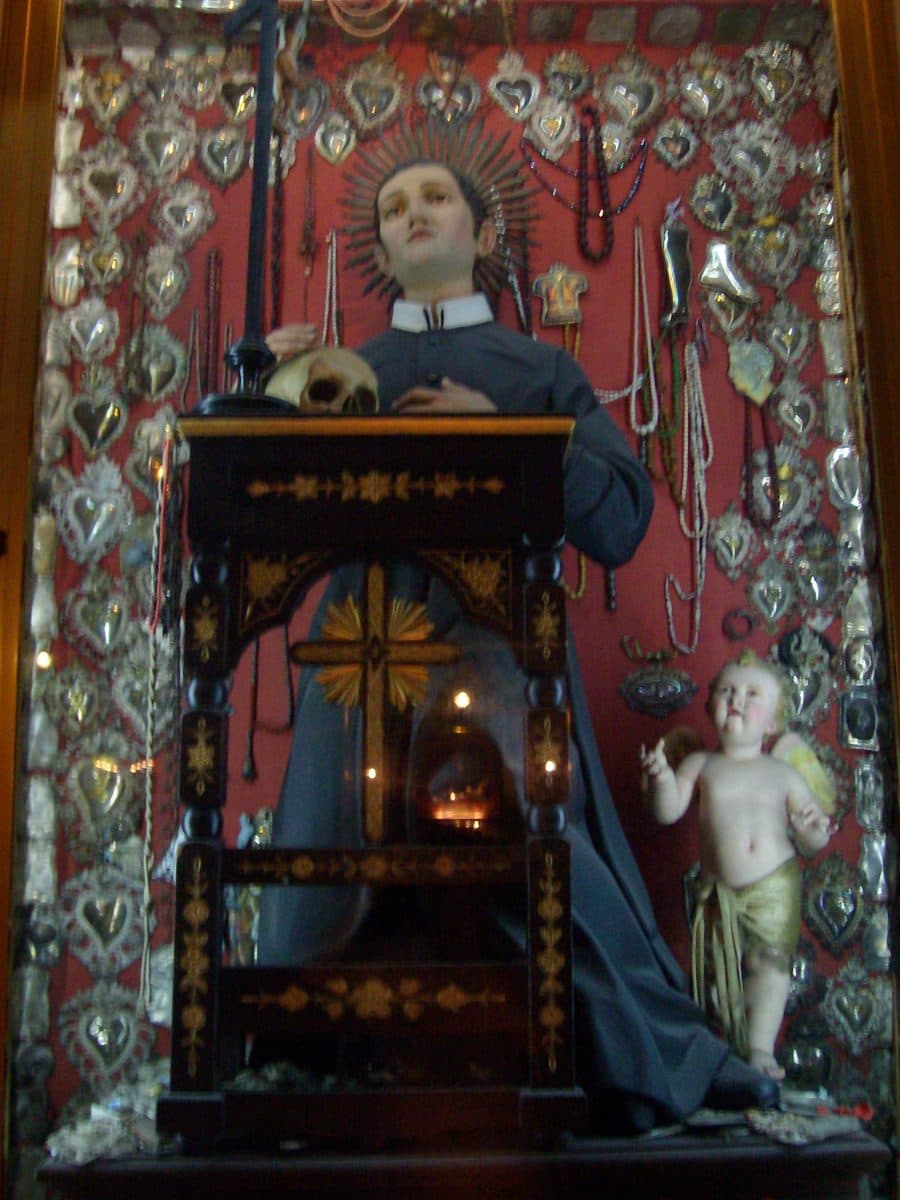
The Life
Gerard Majella was born in 1726 in Muro Lucano, in the Kingdom of Naples. He was the son of a tailor who died when Gerard was 12, leaving the family in poverty. He tried to enter the local Capuchin monastery but was refused — too sickly. He worked as a servant to the Bishop of Lacedonia. He then knocked on the door of a Redemptorist house in 1749 and begged to be admitted as a lay brother.
He was admitted and spent the remaining five years of his life — he died at 29 of tuberculosis in 1755 — in extraordinary mystical experiences and heroic charity. He reportedly had the gift of reading hearts (knowing what was in people's souls), bilocation, levitation, and miraculous multiplication of food. He worked in the novitiate, in the fields, and as a traveling companion to the Redemptorist missionaries.
The episode that defines his sanctity most sharply is a false accusation. A young woman named Neria Caggiano, apparently motivated by resentment at being refused by a young man in Gerard's social circle, accused him of improper conduct. The Redemptorist superior, Father Francis Cafaro, confronted Gerard, who made no defense — simply remaining silent in acceptance of the accusation. The Rule of the Redemptorists forbade the accused to defend himself without permission; Gerard followed the Rule. He was punished accordingly — forbidden to receive Communion for a period. Some months later, Neria Caggiano confessed that the accusation had been false. Gerard continued in the same silence with which he had borne the accusation.
His patronage of expectant mothers comes from a legend: leaving a house where he had been a guest, he dropped his handkerchief. A girl ran after him to return it. He told her to keep it, adding that she would find it useful one day. Years later, in a difficult labor, she asked for Gerard's handkerchief and immediately gave birth safely.
He was canonised in 1904.
The False Accusation and the Silence
When Neria Caggiano falsely accused Gerard of improper conduct, his response was silence. Not denial, not protest, not evidence of his innocence — silence. The Redemptorist Rule forbade him to defend himself without permission; he interpreted his vow of obedience as requiring him to accept the accusation and its consequences. He was forbidden Communion for a period. When the false accusation was eventually confessed by the woman who made it, Gerard received the news with the same equanimity with which he had received the accusation. He bore the false accusation in silence because he trusted that God knew the truth, and that God's knowledge was sufficient. The Gifts — reading hearts and bilocation The accounts of Gerard's extraordinary gifts are unusually well-attested — they come from multiple witnesses who had no reason to collaborate. He reportedly knew what was in people's consciences, including sins they had not confessed. He reportedly appeared in two places simultaneously. He reportedly levitated during prayer. He multiplied food on multiple occasions. These gifts are described with the matter-of-fact quality of eyewitness testimony rather than hagiographic elaboration: they occurred in domestic, daily settings, observed by ordinary people. The Handkerchief — patron of expectant mothers The legend of the handkerchief — left behind when Gerard departed from a household, returned to him by a girl he told to keep it, used years later in a difficult labor with apparently miraculous effect — is one of those hagiographic details that is probably unverifiable but theologically coherent. Gerard had already demonstrated the specific gift of being useful in crises. The handkerchief became the symbol of his patronage of expectant mothers: every woman who invokes him in labor has, in some sense, received the handkerchief. The Short Life — five years of holiness Gerard died at 29 of tuberculosis, having spent only five years in the Redemptorist order. The intensity of his mystical gifts, his charity, and the documented miracles attributed to him are concentrated into those five years. He had tried to enter the Capuchins and been refused; he had knocked on the Redemptorist door and been accepted as a lay brother. He served in the novitiate and in the fields. He died young, with what witnesses described as complete peace and even joy, and was canonised 150 years later.
Walk in Their Footsteps
Pilgrimage sites connected to St Gerard Majella
Ask St Gerard Majella to Intercede
Bring these intentions to this saint in prayer:
Gerard had five years. Five years as a lay brother, refused by the Capuchins, accepted by the Redemptorists, dying at 29. In five years he bore a false accusation in silence, demonstrated extraordinary mystical gifts, served the poor and sick and dying, and left a handkerchief to a girl who would need it in labor. Five years is enough, if they are five years of complete gift. Gerard had no years to waste and did not waste any of them.
“He was oppressed and afflicted, yet he did not open his mouth; he was led like a lamb to the slaughter, and as a sheep before its shearers is silent, so he did not open his mouth.”
Gerard, who bore false accusation in silence — give me your peace with being misunderstood. I want to defend myself; I want to make the record straight; I want to be believed. Help me know when the silence is the right response: when God's knowledge of the truth is sufficient and my own defense is not required. And in the meantime — for any expectant mother who prays to you today — let her feel the handkerchief in her hand. Amen.