
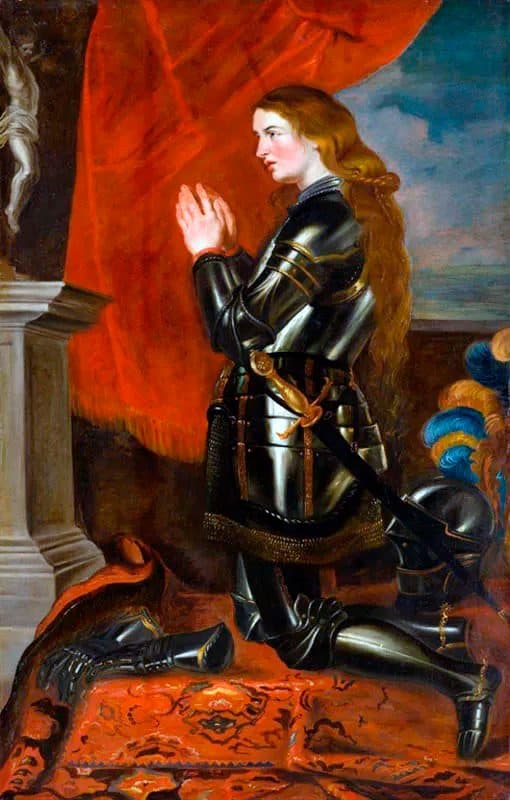
The Life
Jeanne d'Arc was born around 1412 in Domremy, a village on the border between France and the Duchy of Bar, to a farming family. At approximately age 13, she began hearing voices which she identified as Saint Michael, Saint Catherine, and Saint Margaret, giving her a specific mission: to support the Dauphin (the uncrowned Charles VII) and to drive the English from France. The Hundred Years War had been devastating France for generations; the English and their Burgundian allies held most of northern France including Paris; the Dauphin's claim to the throne was contested.
In 1429, at age 17, she persuaded the captain at Vaucouleurs to give her an escort to the Dauphin's court at Chinon. She convinced the Dauphin, was examined by theologians at Poitiers, and was given command of the relief force for the siege of Orleans — the strategic keystone of the English position in France. She raised the siege of Orleans within nine days. She led the army to a series of victories that led to the coronation of Charles VII at Reims Cathedral on July 17, 1429. She stood at the king's side during the coronation.
She was captured by Burgundian forces in May 1430, sold to the English, and tried by an ecclesiastical court at Rouen presided over by Bishop Pierre Cauchon. The trial was a travesty: the questions were designed to entrap her; her requests for access to a legal adviser were denied; her testimony showed extraordinary clarity, intelligence, and courage. She was convicted of heresy and witchcraft, handed to the secular arm, and burned alive at the market square in Rouen on May 30, 1431. She was 19.
A rehabilitation trial ordered by Charles VII (twenty years late, after the political situation changed) declared the original trial null in 1456. She was beatified in 1909 and canonized in 1920, 489 years after her death.
The Voices — thirteen years old in Domremy
Joan's first voices came to her around the age of 13, in the garden of her father's house in Domremy. She identified the voices over time as Saint Michael, Saint Catherine, and Saint Margaret. The content of the voices was specific and practical: go to France, support the Dauphin, lift the siege of Orleans. She obeyed. The instruction to a peasant girl to go and lead an army is one of the most improbable divine commissions in history. She obeyed not because she understood the military situation — she did not initially — but because the voices told her to go. Orleans and the Coronation — the mission accomplished Within two years of hearing the voices, Joan had accomplished the specific mission she was given: she had raised the siege of Orleans (May 1429), led the army to the Loire valley victories, and stood at the side of Charles VII at his coronation in Reims Cathedral. She had done what she was sent to do. The subsequent capture, trial, and burning came after the mission was completed. This is theologically significant: she was not rescued from the consequences of obedience to the voices; she accomplished the mission and then suffered for having accomplished it. The Trial — clarity under interrogation Joan's trial at Rouen is one of the most remarkable documents of the medieval period. The transcripts survive; they show a young woman of 19 with no formal education answering sophisticated theological questions with extraordinary clarity and consistency. When asked whether she was in a state of grace (an unanswerable question, since if she said yes she was claiming knowledge she could not have, and if she said no she admitted guilt), she answered: If I am not, may God put me there; if I am, may God keep me there. The court fell silent. The answer was perfect. The Burning and the Rehabilitation Joan was burned alive on May 30, 1431, in the market square of Rouen. A Dominican friar held a cross before her as she burned. She died calling on Jesus. The English secretary who witnessed the execution reportedly said: We are lost; we have burned a saint. A rehabilitation trial was opened in 1450 at Charles VII's request. In 1456 — 25 years after the burning — the original trial was declared null and void, the conviction quashed. She was beatified in 1909 and canonised in 1920. The Church condemned her, burned her, then canonised her. She is the patron of France.
Walk in Their Footsteps
Pilgrimage sites connected to St Joan of Arc
Ask St Joan of Arc to Intercede
Bring these intentions to this saint in prayer:
Joan accomplished her mission and then was burned. The voices sent her to raise the siege of Orleans and crown the king; she did both. The burning came after. God does not guarantee safety; he guarantees the mission, if you will take it. Joan took it at 17 and was dead at 19 and was the patron saint of France for centuries thereafter. The fire that burned her is the fire in which the fleur-de-lis was forged.
“When you pass through the waters, I will be with you; and when you pass through the rivers, they will not sweep over you. When you walk through the fire, you will not be burned; the flames will not set you ablaze.”
Joan, who burned and became a saint — I have a voice I am not sure I can trust, a mission that seems improbable, a tribunal that has already decided against me. Walk with me across my Domremy and tell me what you heard. If it is real, help me obey it, whatever the cost. And if I am burned — let me be burned calling on Jesus, and let some English secretary watching from the back say: we have burned a saint. Amen.