
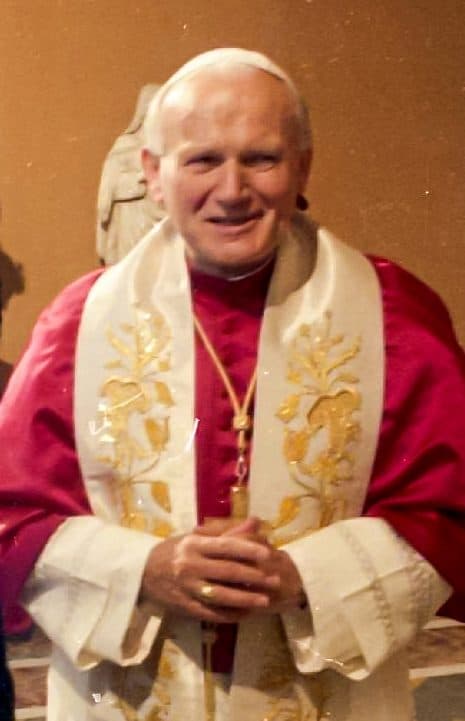
The Life
Karol Jozef Wojtyla was born in 1920 in Wadowice, a small town in southern Poland, the son of an army officer. His mother died when he was 8; his only brother when he was 12; his father when he was 20. By the time he was ordained a priest in 1946, everyone in his immediate family was dead. He was ordained secretly during the Nazi occupation, completing his seminary training in a clandestine underground program organized by Cardinal Sapieha of Krakow.
He was a poet, playwright, actor, skier, kayaker, and intellectual as well as a priest — qualities that remained evident throughout his life. He completed two doctorates (in theology and phenomenological philosophy), became a professor, then Archbishop of Krakow, then Cardinal. On October 16, 1978, he was elected Pope — the first non-Italian pope in 455 years, the first Slavic pope ever, and at 58, one of the youngest. He took the name John Paul II.
He reigned for 26 years and 5 months — the third longest pontificate in history. He traveled more than any previous pope, visiting 129 countries. He spoke eight languages fluently. He was instrumental — through his encouragement of Solidarity in Poland and his relationships with Ronald Reagan and Mikhail Gorbachev — in the peaceful collapse of Soviet Communism in Eastern Europe. He beatified and canonized more people than all previous popes combined. He established World Youth Day. He published 14 encyclicals, the Catechism of the Catholic Church, the Code of Canon Law, and the Theology of the Body. He survived an assassination attempt in 1981 (visiting his attacker in prison afterward). He reigned with Parkinson's disease for the last years of his pontificate, increasingly unable to speak, visibly suffering — a final testimony to the dignity of human vulnerability.
He died on April 2, 2005 — the vigil of Divine Mercy Sunday, the feast he had established. The crowd in St Peter's Square chanted Santo subito (Saint immediately). He was beatified by Benedict XVI in 2011 and canonized by Francis in 2014.
The First Words — Be Not Afraid
John Paul II's first words as pope, spoken from the loggia of St Peter's Basilica on October 16, 1978, set the tone for the entire pontificate: Be not afraid. Open wide the doors for Christ. The Polish pope, elected from behind the Iron Curtain, addressed a world living in Cold War anxiety. The words were simultaneously theological (quoting Joshua and the angel at the Annunciation) and geopolitical — a message to the communist bloc that the Church was not afraid. He said it in Italian, with an accent, and the crowd laughed in delight and then understood what they were seeing. Poland 1979 and the Fall of Communism John Paul II's first return visit to Poland in June 1979 is considered by many historians the beginning of the end of Soviet Communism in Eastern Europe. He was back in the country from which he had come; he was received by millions of Poles who turned out in a public display of Catholic identity that the communist regime could not prevent. He did not speak against communism directly; he spoke about human dignity, about Christ, about Poland. The effect was to reveal that communism had not won the interior of the Polish people. Solidarity followed. The Berlin Wall followed. The Assassination Attempt and the Forgiveness On May 13, 1981 — the feast of Our Lady of Fatima — Mehmet Ali Agca shot John Paul II twice in St Peter's Square. The pope nearly died. During his recovery, he attributed his survival to the intercession of Our Lady of Fatima and had the bullet that struck him set in the crown of the Fatima statue. On December 27, 1983, he visited Agca in prison and spoke with him for twenty minutes. What was said was not disclosed. Agca said afterward: I cannot understand it. John Paul II had forgiven the man who tried to kill him. Suffering and Death — the final testimony The last years of John Paul II's pontificate were marked by visible suffering from Parkinson's disease — shaking hands, slurred speech, eventual near-silence. He chose not to resign, and many felt his public suffering was itself a teaching: that suffering and diminishment do not remove human dignity, that the suffering person has as much to offer the world as the vigorous one. His death on April 2, 2005 — the vigil of Divine Mercy Sunday, the feast he had established for the universal Church — was understood by many as a final act of Providence.
Walk in Their Footsteps
Pilgrimage sites connected to Pope St John Paul II
Ask Pope St John Paul II to Intercede
Bring these intentions to this saint in prayer:
John Paul II buried his mother, his brother, and his father before he was 21. He was ordained in secret under Nazi occupation. He was shot in St Peter's Square. He reigned with Parkinson's disease, visibly, publicly, without resignation. At each point he said: Be not afraid. The instruction was not theoretical. He had earned the right to say it. The man who said Be not afraid had been given many things to be afraid of and had met each one with the same response.
“Be strong and courageous. Do not be afraid; do not be discouraged, for the Lord your God will be with you wherever you go.”
John Paul II, pilgrim pope — say it to me again: Be not afraid. I have my own things to fear: specific, real, personal. Open wide the doors for Christ in the places I have been keeping them closed. Give me your courage. You buried your family before you were 21 and went on to change the world. Teach me that loss is not the last word and fear is not the final answer. Totus tuus. Amen.