
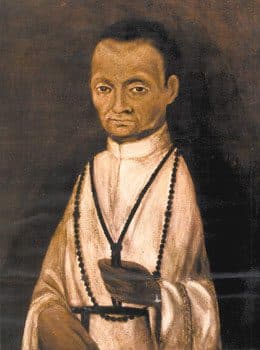
The Life
Martin de Porres was born in 1579 in Lima, Peru, the illegitimate son of a Spanish nobleman (Don Juan de Porres) and a freed African slave (Ana Velazquez). His mixed racial heritage, in the society of colonial Lima, was a source of stigma throughout his life. His father registered him as "unknown" on his birth record, later acknowledged him but left him in poverty. Martin was apprenticed to a barber-surgeon (a medical role in the 16th century) and then sought entrance to the Dominican friary in Lima.
Because of his mixed racial heritage, he could not under existing rules be admitted as a lay brother. He was accepted as a donado — a lay helper with no formal religious status, who could perform menial tasks. He swept floors, cleaned latrines, begged for alms, and tended the sick. He served in this lowly capacity for years. Eventually the Dominican prior, observing his holiness, granted him the lay brother's habit against the rules — and eventually the rules were changed.
He lived in the friary for 45 years, until his death in 1639, and became known for extraordinary practical charity: founding an orphanage and a children's hospital, caring for the sick poor, feeding hundreds of poor people daily. He is reported to have had the gifts of bilocation, the ability to pass through locked doors, levitation, and miraculous healing. He cared for animals as well as humans — reportedly living in peace with the rats in the friary cellar, feeding them to keep them from damaging the stores.
He was beatified in 1837 and canonized by John XXIII in 1962 — the first time a Peruvian-born saint was canonized. He is the patron of mixed-race people and of social justice because his life was lived at the intersection of colonial racial hierarchy and Christian charity.
The Illegitimate Son — the stigma and the grace
Martin was born illegitimate in colonial Lima — the son of a Spanish nobleman and a freed African slave. His father registered him as unknown. His mixed racial heritage placed him at the bottom of the complex racial hierarchy of colonial Peru. He could not be admitted to the Dominicans as a full lay brother because of racial rules. He accepted the donado status — the lowest possible — and swept floors and cleaned latrines for years without resentment. The stigma was real; the grace was also real. God makes saints at the bottom of every social hierarchy, including the most unjust. The Rats in the Cellar — care without hierarchy One of the most characteristic stories about Martin concerns the rats. The friary was troubled by rats damaging the stores; the prior wanted them exterminated. Martin went to the cellar and reportedly spoke to the rats: he would feed them in the garden if they would stay out of the stores. The rats reportedly complied. Whether or not the literal account is accurate, the story characterizes something real about Martin: he cared for what no one else bothered to care for. He was at the bottom of the human social hierarchy himself; he extended the same care to the creatures at the bottom of the animal hierarchy. The Hospital for Abandoned Children Martin's most concrete institutional achievement was the founding of an orphanage and hospital for Lima's abandoned children and sick poor. He funded it partly through begging and partly through donations from Lima's wealthier citizens, whom he approached without embarrassment. He was known for being able to extract money from difficult donors. The hospital continued after his death. Martin's charity was practical and institutional — not just personal almsgiving but the creation of structures that would outlast him. The Canonization of 1962 Martin was beatified in 1837 but not canonized until 1962 — when John XXIII canonized him during the Second Vatican Council. The timing was theologically significant: the Council was convening to open the Church to the modern world; the canonization of the illegitimate mixed-race son of a freed slave and a Spanish nobleman, who had spent his life at the lowest rungs of colonial religious life, was a statement about who the Church belonged to. John XXIII was explicit: Martin is the patron of social justice.
Walk in Their Footsteps
Pilgrimage sites connected to St Martin de Porres
Ask St Martin de Porres to Intercede
Bring these intentions to this saint in prayer:
Martin swept floors for years without the status of a lay brother. He was not allowed to be admitted because of his race. He swept anyway, prayed anyway, healed anyway. The friary changed the rules eventually; Martin had not waited for the rules to change before becoming holy. He became holy in the most unjust possible conditions, which is the only condition available to most human beings most of the time. God makes saints out of what is available.
“There is neither Jew nor Gentile, neither slave nor free, nor is there male and female, for you are all one in Christ Jesus.”
Martin, who swept floors and fed rats and healed the sick and was not allowed to be a lay brother until he had already become a saint — pray for all those who serve without status. For those who are at the bottom of every hierarchy and are doing the most necessary work. For those whose heritage is used to exclude them. Lead me to the kitchen, the cellar, the infirmary — the places where the real work is done. Amen.