
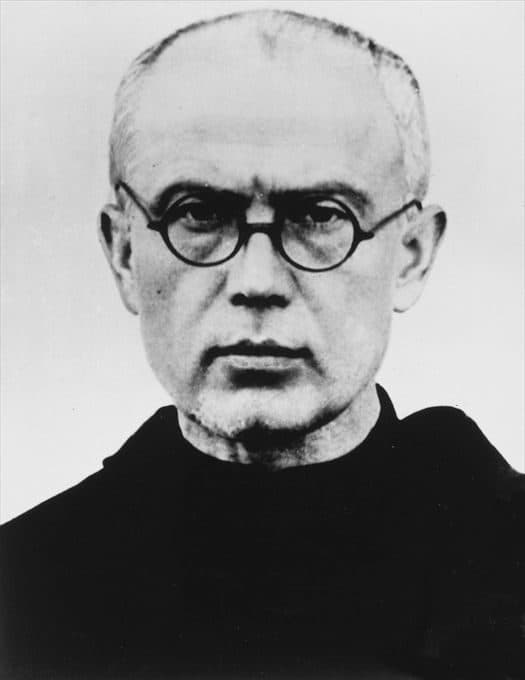
The Life
Rajmund Kolbe was born in 1894 in Zdunska Wola, in Russian-partitioned Poland. He entered the Conventual Franciscan order and was ordained a priest, taking the name Maximilian Maria. He founded the Militia Immaculatae (Army of Mary Immaculate) in 1917 and the publishing house and monastery at Niepokalanow (City of the Immaculate) in Poland, which became the largest Catholic publishing operation in the world, with a daily newspaper circulation of 750,000 copies. He spent time as a missionary in Japan, founding a monastery in Nagasaki (whose location, on the back slope of a hill, protected it from the worst of the atomic bomb blast in 1945). He returned to Poland and was arrested by the Gestapo in 1941.
He was sent to Auschwitz. In July 1941, following an escape from the camp, the SS selected ten men to be starved to death in the starvation bunker as a deterrent. One of the selected men, Franciszek Gajowniczek, cried out that he had a wife and children. Maximilian stepped forward from the ranks: I am a Catholic priest. Let me take his place. I am old. He is good for nothing. The SS commandant Karl Fritzsch allowed the exchange.
Maximilian and nine other men were placed in the starvation cell. He led the men in prayer and hymns; eyewitnesses reported that the cell became a place of prayer rather than despair. After two weeks, four men remained alive, including Maximilian. The SS physician Karl Schlottke administered a lethal injection of carbolic acid on August 14, 1941 — the vigil of the Assumption of Mary, to whom Maximilian had devoted his entire priestly life. Gajowniczek survived the war and was present at Maximilian's canonization in 1982.
He was canonized by John Paul II in 1982, who called him a martyr of charity. Gajowniczek, then 82, stood in the front row at St Peter's Square.
The Exchange at Auschwitz
In July 1941, after an escape from Auschwitz (Block 14), the SS commandant assembled the prisoners of that block to select ten men for death by starvation. When Franciszek Gajowniczek's number was called and he cried out that he had a wife and children, Maximilian stepped forward and identified himself as a Catholic priest and offered to take the man's place. The exchange was accepted. Maximilian's offer was not an impulse — it was the logical conclusion of an entire spiritual life organized around the question: I am all yours, O Mary. The exchange was the act; the life of prayer was its foundation. The Starvation Cell — prayer instead of despair Eyewitness testimony from Auschwitz guards and survivors describes the starvation cell — Cell 18 of Block 11 — as transformed by Maximilian's presence. He led the men in prayer, the rosary, and hymns. The guards reported that when they approached the cell, they heard singing. The men who died in the cell died in prayer. This transformation of a place of punishment into a place of prayer is the specifically priestly dimension of what Maximilian did: he did not only take the man's place, he served the men in whose company he died. Niepokalanow — the city of the Immaculate The monastery and publishing house Maximilian founded at Teresin, near Warsaw, was one of the largest Catholic media operations in the world by 1939: 750,000 daily newspaper copies, a radio station, and an airstrip under construction. The location was chosen for a specific reason — Maximilian placed himself and his entire enterprise explicitly under the protection of the Immaculate. Niepokalanow means City of the Immaculate. After his arrest in 1941, the monastery was used by the Nazis to house Jewish refugees. It still operates as a Franciscan monastery and pilgrimage centre. The Nagasaki Monastery — on the back of the hill When Maximilian founded a monastery in Nagasaki, Japan in 1930, he chose a site on the back slope of a hill against the advice of local planners who preferred the front slope. The specific location was determined by what he believed was Our Lady's guidance. When the atomic bomb fell on Nagasaki on August 9, 1945, the monastery on the back slope was protected from the worst of the blast and largely survived. The community, led by Japanese Franciscans, continued. Whether or not one attributes the location to miraculous guidance, the fact is that the monastery survived while everything on the other slope was destroyed.
Walk in Their Footsteps
Pilgrimage sites connected to St Maximilian Kolbe
Ask St Maximilian Kolbe to Intercede
Bring these intentions to this saint in prayer:
Maximilian asked: Who are you, O Immaculate Conception? This was his theological question, the mystery he organized his life around. At Auschwitz, the question received its practical answer: the person who is entirely given to Mary is entirely given to others. The immaculacy he devoted himself to was not a theory — it produced the act. He stepped forward because he had been stepping forward his entire life, in prayer, in publishing, in Japan. The exchange at Auschwitz was not a dramatic exception; it was the logical conclusion of everything that came before it.
“Greater love has no one than this: to lay down one's life for one's friends.”
Maximilian, martyr of charity — give me your recklessness with your own life and your care with others'. I want to step forward. I don't know when the moment will come — when the name will be called and the family mentioned. Prepare me for that moment by the ordinary practice of stepping forward now, in the small exchanges: the small inconveniences I accept for others, the small places I give up. Make me ready for the large exchange by beginning with the small. Amen.