
The Life
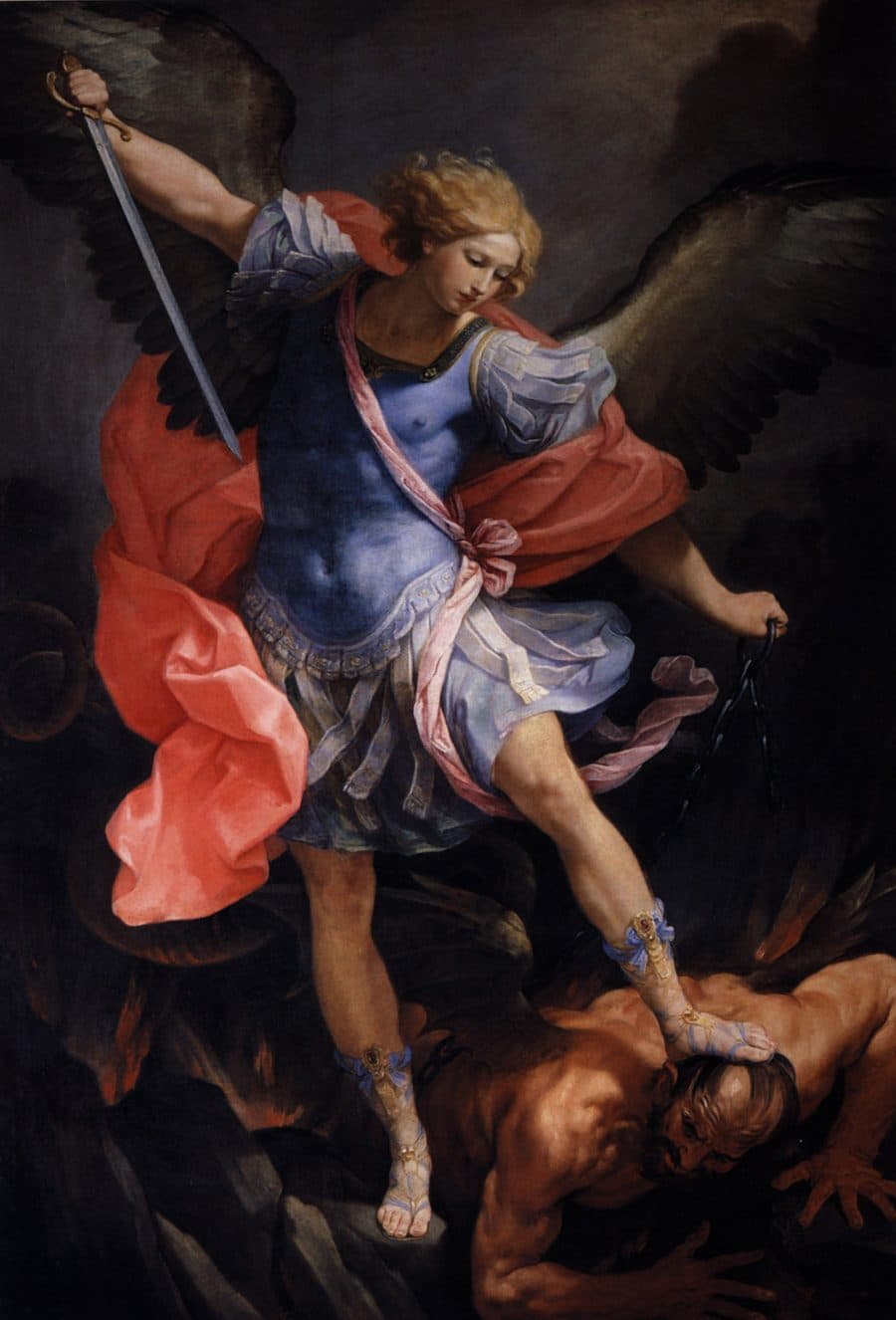
Michael is the greatest of the archangels and the commander of the heavenly armies — the captain of God's forces in the war against evil that Scripture describes as preceding, accompanying, and concluding human history. His name is a question and a battle cry: Mi-ka-El means Who is like God? — which was his war-cry when Lucifer said I will make myself like the Most High and Michael drove him from heaven.
He appears four times in the Bible. In Daniel 10-12 he is the great prince who protects Israel, the one who will stand up and deliver God's people in the final crisis. In Jude verse 9, he disputes with the devil over the body of Moses, citing divine authority rather than engaging in mutual cursing. In Revelation 12 he leads the heavenly armies against the dragon — the ancient serpent, the devil, Satan — and casts him down to earth. Each appearance is military, decisive, protective.
Catholic tradition has added to these four biblical appearances a long body of apparition and apparition theology. The most famous apparition of Michael is at Monte Gargano in Puglia, Italy, in 490 AD, where he appeared in a cave and left behind the mark of his foot — the site became one of the great medieval pilgrimage destinations. In 590 AD, during a plague in Rome, Pope Gregory the Great led a procession through the city praying for mercy; Michael was seen above the Castel Sant'Angelo sheathing his sword, signalling the end of the plague. The castle's angel statue commemorates this vision. On the rock island of Mont-Saint-Michel off the Normandy coast, he appeared to the bishop of Avranches in 708 and instructed him to build a church there — the abbey that grew from that instruction is one of the masterpieces of medieval architecture.
Michael is invoked at the end of Mass in the traditional Prayer to Saint Michael, composed by Pope Leo XIII in 1886 after a vision: Saint Michael the Archangel, defend us in battle; be our protection against the wickedness and snares of the devil. This prayer, suppressed after the Second Vatican Council and restored by Pope John Paul II as optional after Low Mass, is one of the most widely known prayers in Catholic devotional life.
The War in Heaven
Revelation 12 describes a war in heaven in which Michael and his angels fight against the dragon (Satan) and his angels. The dragon is defeated and cast down to earth: And there was war in heaven. Michael and his angels fought against the dragon, and the dragon and his angels fought back. But he was not strong enough, and they lost their place in heaven. The great dragon was hurled down — that ancient serpent called the devil, or Satan, who leads the whole world astray. He was hurled to the earth, and his angels with him. Michael's victory is the foundation of his role as protector of God's people. The enemy has been cast down; Michael stands between the enemy and those under his protection. Monte Gargano — the cave apparition In 490 AD, the archangel appeared in a cave on Monte Gargano (the spur of the Italian boot in Puglia) and left the imprint of his foot on the stone floor. The cave became the Sanctuary of Monte Sant'Angelo, one of the great medieval pilgrimage destinations — visited by Lombard kings, Norman rulers, Francis of Assisi, Thomas Aquinas, and millions of ordinary pilgrims over fifteen centuries. It is still operating today, still drawing pilgrims to the same cave where Michael appeared. The footprint is still venerated. The Plague of Rome — the sheathed sword In 590 AD, Rome was suffering a devastating plague. Pope Gregory the Great organised a penitential procession through the city, praying for God's mercy. As the procession passed the Castel Sant'Angelo (Hadrian's Mausoleum), people saw the archangel Michael above the castle, dressed in armour, sheathing his sword — the gesture indicating that the plague would end. The plague did end. The Castel Sant'Angelo has borne its current name (the castle of the holy angel) ever since, and the statue of Michael at the summit of the castle commemorates this vision. The Prayer to Saint Michael After a vision in 1886 in which Pope Leo XIII saw a confrontation between God and the devil concerning the future of the Church, he composed the Prayer to Saint Michael and ordered it to be said after all Low Masses. The prayer — defend us in battle; be our safeguard against the wickedness and snares of the devil; may God rebuke him, we humbly pray — was one of the most widely recited Catholic prayers for eighty years. Pope John Paul II restored it as optional after Mass in 1994. Michael, as protector of the Church, is the appropriate intercessor for the Church in whatever battle it faces.
Walk in Their Footsteps
Pilgrimage sites connected to St Michael the Archangel
Ask St Michael the Archangel to Intercede
Bring these intentions to this saint in prayer:
Who is like God? The name Michael contains both the question and the answer. Nothing is like God. Nothing can compare. The greatness of God is so far beyond everything else that the question Who is like God? is not a question at all — it is a declaration of incomparability. Michael drives the enemy from heaven by asking the right question. Sometimes the most effective weapon against evil is a clear statement of the truth about God.
“Then war broke out in heaven. Michael and his angels fought against the dragon, and the dragon and his angels fought back. But he was not strong enough, and they lost their place in heaven.”
Saint Michael the Archangel, defender in battle — stand between me and what I am afraid of. Whatever is coming against me — the external danger, the internal temptation, the spiritual oppression — stand between it and me and ask the question that defeats it: Who is like God? Nothing is. Be my captain, my protector, my escort. And when I die, receive my soul and bring it safely to the judgment seat of the one who made us both. Amen.