
The Life
Nicholas of Myra was a 4th-century bishop in the city of Myra in Lycia (modern Turkey) who became one of the most universally venerated saints in both the Eastern and Western Church. His historical existence is not in doubt; the precise details of his life are disputed. What is certain is that he was a bishop of Myra who attended (or was associated with) the Council of Nicaea in 325, that he was noted for extraordinary generosity to the poor and the suffering, and that his cult spread with remarkable speed across the Christian world — East and West — and eventually across the entire globe in the transformed form of Father Christmas / Santa Claus.
The most famous story about Nicholas concerns three young women — daughters of a nobleman who had lost his fortune — whose father could not afford their dowries, which meant they could not marry and were threatened with being sold into slavery or prostitution. Nicholas, learning of their plight, secretly threw bags of gold through the window of their house on three successive nights — enough for the dowry of each girl. One of the bags fell (or was thrown) into a stocking hung by the fireplace to dry. The image of the stocking and the secret gift is the origin of the Christmas stocking tradition and, more broadly, of the entire gift-giving mythology of Christmas. Santa Claus is St Nicholas in his Dutch name (Sinterklaas), filtered through the Dutch tradition of Sinterklaas Eve (December 5-6) and transformed by 19th-century American commercial culture into the global figure of Christmas.
Nicholas is also credited with saving three military officers from unjust execution by appearing to the Emperor Constantine in a dream; saving sailors from drowning by calming a storm; and resurrecting three boys who had been murdered and pickled in brine by a butcher during a famine. These legends accumulate around a figure of whom the historical record says principally: he was a bishop who was extraordinarily kind, who gave without ostentation, who served the weak and the poor with particular dedication, and who was loved by everyone who encountered him.
The Three Bags of Gold — the origin of Christmas gifts
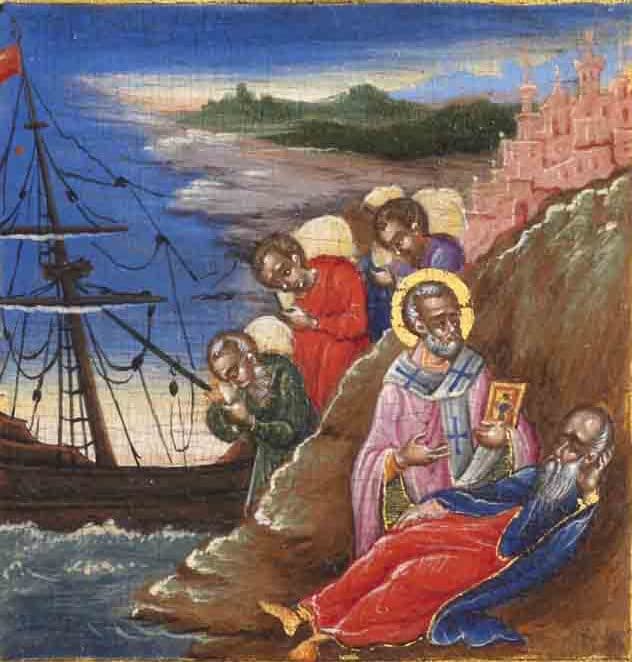
The three daughters of the ruined nobleman were about to be sold because their father could not afford their dowries. Nicholas, hearing of their plight, went in the night to the house and threw a bag of gold through the window. The next night he threw a second bag. On the third night, the father was watching, and caught Nicholas as he threw the third bag. Nicholas asked him to keep the gift secret. He could not. The story of the midnight gifts — given in secret, for the most vulnerable, without expectation of recognition — spread and became the foundational image of the Christmas gift-giving tradition. The Rescue of the Sailors While Nicholas was on a pilgrimage to Jerusalem, a terrible storm threatened to sink the ship. The sailors were in despair. Nicholas prayed. The storm calmed immediately. This miracle — the calming of the sea through the saint's prayer — is one of the foundational stories of his patronage of sailors. Across the Mediterranean world, sailors prayed to Nicholas for centuries before the maritime trade routes that made the Mediterranean world were superseded by the Atlantic ones. His image was kept on ships. His shrines were built at ports. He is still the patron of the Russian navy. The Three Boys Restored to Life During a famine, a butcher murdered three boys, dismembered them, and packed them in brine to sell as meat. Nicholas discovered what had been done, restored the boys to life, and had the butcher brought to justice. This miracle — the most dramatic in the Nicholas cycle — is depicted in medieval art as the three boys in a tub or barrel, restored to wholeness by the bishop's prayer. It explains his patronage of children and of pawnbrokers (the three balls of the pawnbroker's sign are derived from the three bags of gold, through the merchant association of the three gifts). Sinterklaas to Santa Claus — the global transformation Nicholas's feast day (December 6) was celebrated in the medieval Netherlands as a gift-giving holiday — Sint Nikolaas (Sinterklaas) brought gifts to children the night before his feast. Dutch settlers brought this tradition to New Amsterdam (New York). Washington Irving's 1809 history of New York popularised Sinterklaas as a jolly Dutch gift-bringer. Clement Clarke Moore's 1823 poem A Visit from St Nicholas fixed the modern image. The Coca-Cola Company's 1930s advertisements in red and white fixed the final visual image. The 4th-century bishop of Myra became, through this long chain of transformation, the most recognisable figure of global commercial Christmas.
Walk in Their Footsteps
Pilgrimage sites connected to St Nicholas of Myra
Ask St Nicholas of Myra to Intercede
Bring these intentions to this saint in prayer:
Nicholas gave in secret. He specifically asked the nobleman to tell no one. The secret was not kept — how could it be? — but the intention was pure: the gift given without any expectation of recognition, solely for the welfare of the recipient. This is the gold standard of generosity, and it is exactly what the Christmas tradition, in all its commercial excess, preserves in garbled form: the impulse to give without receiving, the joy of the gift that costs the giver but asks nothing of the given-to.
“But when you give to the needy, do not let your left hand know what your right hand is doing, so that your giving may be in secret. Then your Father, who sees what is done in secret, will reward you.”
St Nicholas, gift-giver in the night — teach me to give without needing to be known as the giver. Help me find the window to throw the gold through. Let me love the poor and the children and the sailors and the desperate as you loved them: not from a distance, not with speeches, but with specific gifts given in the night when no one is watching. Amen.