
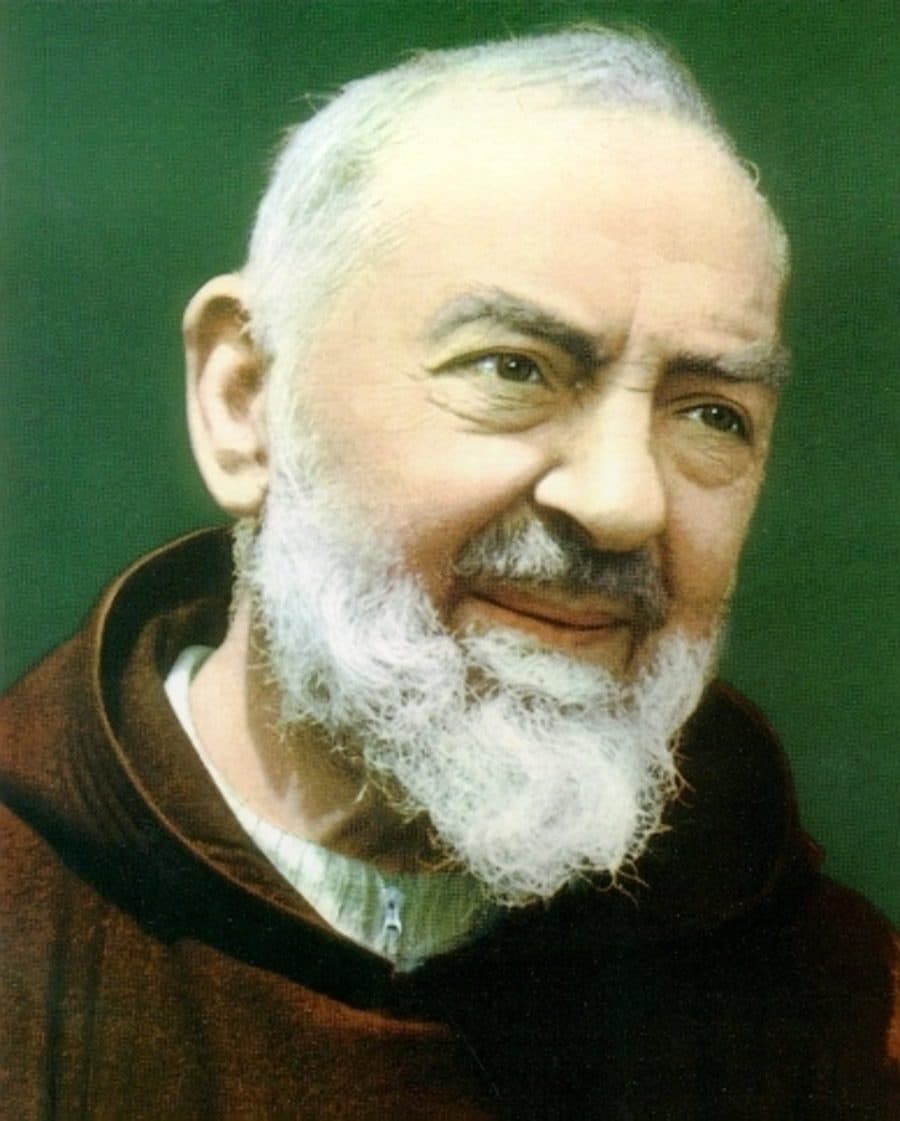
The Life
Francesco Forgione was born in 1887 in Pietrelcina, a small village in the Campania region of southern Italy, to a poor farming family. He entered the Capuchin Franciscan order at age 15, took the name Friar Pius (Padre Pio), and was ordained a priest in 1910. He was sickly, suffering from pulmonary tuberculosis and other conditions; he spent much of his early priesthood at his family home in Pietrelcina for health reasons.
On September 20, 1918, while praying before a crucifix in the choir of the small church of Santa Maria delle Grazie in San Giovanni Rotondo, he received the stigmata — the five wounds of Christ — in a permanent, visible, and apparently physically real form. The wounds bled regularly for fifty years, until shortly before his death in 1968. He wore fingerless gloves to conceal the wounds on his hands; the gloves were a regular feature of his daily life. The wounds were examined by numerous medical authorities and never conclusively explained. They disappeared completely in the days before his death.
He spent the remaining fifty years of his life in San Giovanni Rotondo, hearing confessions for hours each day, celebrating Mass (sometimes lasting three hours, during which he reportedly entered a state of ecstasy), and building the Casa Sollievo della Sofferenza (Home for the Relief of Suffering) — a large modern hospital, funded largely through donations from his followers, that still operates. He had the reported gifts of bilocation (being in two places simultaneously), the ability to read consciences in the confessional, the gift of healing, and the ability to smell the presence of souls in need of prayer (the odour of sanctity, reportedly a fragrance of flowers or incense).
He was investigated twice by the Vatican, placed under restrictions at various points (forbidden to celebrate public Masses, forbidden to correspond with women, forbidden to display the stigmata), and eventually cleared. He was beatified by John Paul II in 1999 and canonised in 2002. He is the most popular saint in Italy and one of the most popular in the Catholic world.
The Stigmata of 1918 — fifty years of wounds
On September 20, 1918, Padre Pio was praying before a crucifix when he experienced a vision of Christ and received the five wounds of the Passion — in his hands, his feet, and his side. The wounds bled, required daily dressing, and were examined by numerous medical authorities without satisfactory natural explanation. He bore them for fifty years, until shortly before his death in 1968. He wore fingerless gloves to conceal the wounds on his hands. The gloves are one of the most recognizable elements of his iconic image. The wounds vanished completely in the days before he died. The Confessional — reading souls Padre Pio spent hours each day in the confessional — sometimes eight hours, sometimes more. He was reported to have the ability to read consciences: to know the sins of penitents before they confessed them, to tell people what they were not confessing, to refuse absolution until a full confession was given. His confessional manner was reputedly direct and sometimes severe. He turned people away who were not ready for confession. He also reportedly knew, in confession, the sins committed by people in other countries — a feature of the reported bilocation. Penitents came from around the world to his confessional. The Casa Sollievo della Sofferenza One of Padre Pio's most concrete achievements is a large modern hospital — the Casa Sollievo della Sofferenza (Home for the Relief of Suffering) — built at San Giovanni Rotondo and opened in 1956. The hospital was funded by donations from his followers and built in an area of extreme poverty. It is now one of the major hospitals of southern Italy and a reminder that Padre Pio's mysticism was not separable from his practical charity. Pray, hope, and don't worry was his advice for every situation; building a hospital was what he did while he waited. Bilocation and the Odour of Sanctity The reported gifts of bilocation and the odour of sanctity are two of the most frequently testified aspects of Padre Pio's ministry. Bilocation — the ability to be physically present in two places simultaneously — was reported by soldiers during World War II who claimed he appeared to them in the field; by people who received his visit in their homes while he was known to be confined to the convent. The odour of sanctity — a fragrance of flowers or incense associated with his presence or with the intercession of his prayers — was reported by many people who had no physical contact with him. Both remain unexplained.
Walk in Their Footsteps
Pilgrimage sites connected to St Padre Pio of Pietrelcina
Ask St Padre Pio of Pietrelcina to Intercede
Bring these intentions to this saint in prayer:
Padre Pio bled for fifty years. He bore the wounds of Christ in his own body, in the daily, unglamorous way of someone who has to get up, put on the gloves, and go to the confessional for eight hours. The stigmata were not a one-time mystical event; they were a daily fact of his life, requiring medical attention, causing pain, and requiring concealment. He said: Pray, hope, and don't worry. This is not shallow optimism; it is the instruction of a man who bled every day and still built a hospital.
“For our light and momentary troubles are achieving for us an eternal glory that far outweighs them all.”
Padre Pio, who bled for fifty years — give me your patience with my own small wounds. I complain about troubles that you would have worn gloves to conceal. Teach me your prayer: Pray, hope, and don't worry. Help me build something useful in the place where I am suffering. And in the confessional of my heart — if you can see my soul as you saw the souls of those who came to San Giovanni Rotondo — tell me what I am not confessing. Amen.