
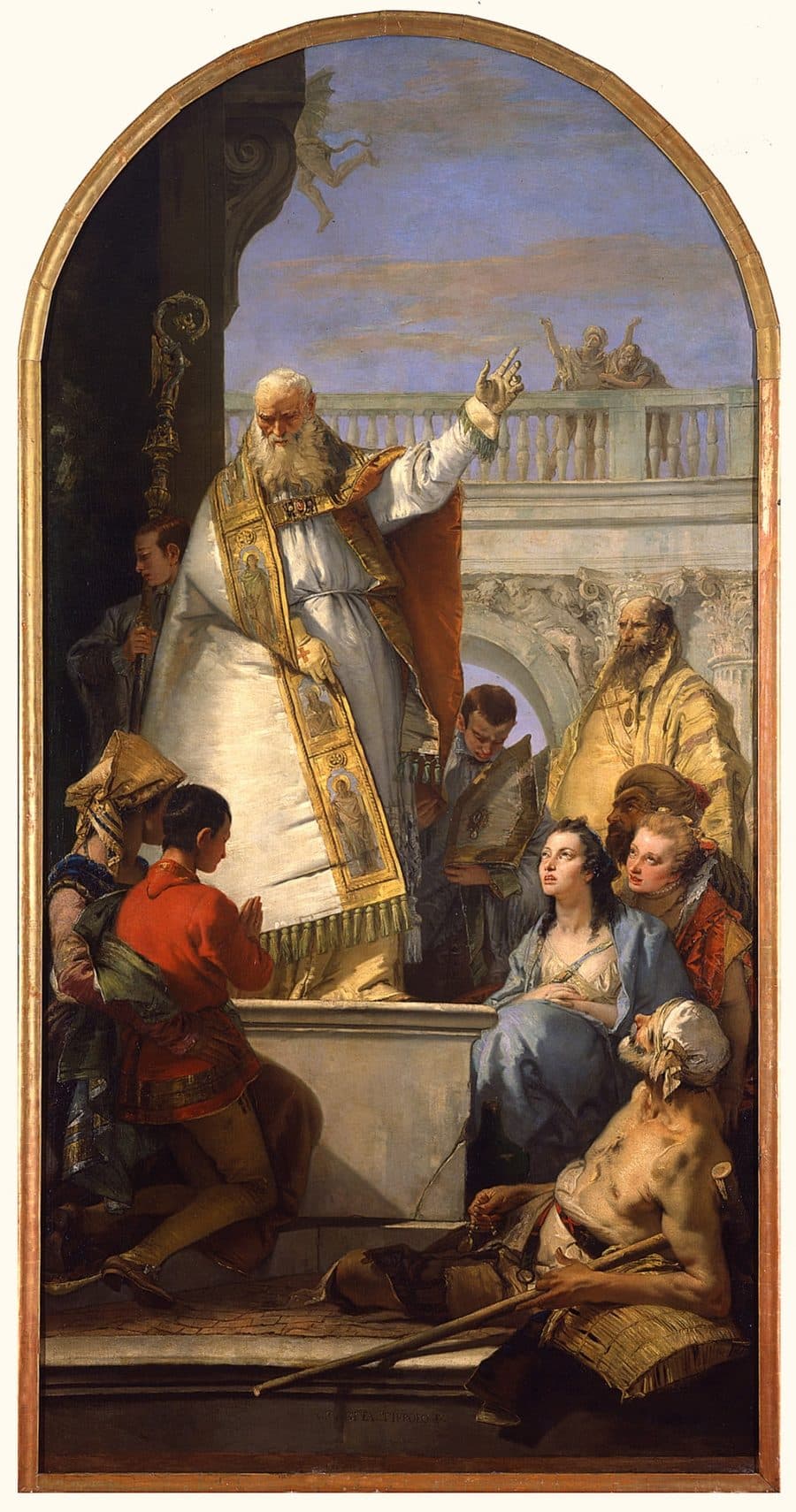
The Life
Maewyn Succat — known to history as Patrick — was born around 385 AD in Roman Britain, the son of a deacon and the grandson of a priest. He was neither Irish nor religious when his story began: at sixteen, he was kidnapped by Irish raiders, taken across the sea, and sold as a slave in Ireland, where he tended sheep for six years in the hills of what is now County Mayo. During those six years of captivity, he had an experience of God that transformed him: he prayed constantly, he said, sometimes a hundred times a day; he was sustained by a faith that deepened in proportion to his suffering.
He escaped, after a dream told him to walk two hundred miles to a ship that would take him home. He walked, the ship was there, and he returned to Britain. He was reunited with his family, who urged him never to leave again. Then another dream came: a figure from Ireland carrying letters titled Voice of the Irish, and in the dream he could hear the voices of the Irish people calling him to come back to the country that had enslaved him. He obeyed. He studied for the priesthood on the Continent, was ordained bishop, and returned to Ireland — to the people who had taken him — to spend the rest of his life preaching Christianity to them.
His mission was one of the most successful in the history of the Church. He found Ireland a pagan country and left it substantially Christian. He traveled its length and breadth, ordained clergy, established monasteries, and baptised thousands. He was a brilliant communicator who used the material culture of Ireland to explain the faith: the shamrock to demonstrate the Trinity; the Paschal fire to challenge the druids; the language and poetry and art of the Irish to carry a Gospel that was not Irish but became so. He wrote two documents that survive: his Confession (an autobiography of his captivity and mission) and his Letter to Coroticus (a fierce protest against a British warlord who had enslaved newly baptised Irish Christians). He is probably the most successfully documented saint of the post-Apostolic early Church.
The Irish diaspora — produced by the Famine, economic emigration, and political exile across four centuries — carried Patrick's feast and Patrick's faith across the world. March 17 is celebrated on every continent. The global scale of Irish diaspora devotion to Patrick is one of the most remarkable expressions of how a saint's feast day can become a global cultural phenomenon.
The Captivity — prayer in the hills
Patrick described his six years of slavery in Ireland as a spiritual transformation: I used to stay in the woods and on the mountain and I would wake for prayer before daylight, through snow, through frost, through rain, and I felt no harm, and there was no sloth in me — as I now see, because the Spirit was burning in me at that time. The captivity that was the worst thing that could happen to him became the condition for the faith that defined the rest of his life. He prayed in the hills of Connacht because there was nothing else to do. He discovered in the nothing else something inexhaustible. The Return — the voice of the Irish Patrick's dream of the Voice of the Irish — a figure from Ireland carrying letters, from which the voices of the Irish people could be heard calling Come back and walk among us — is one of the most remarkable conversion narratives in the history of missions. He was being called back to the people who had enslaved him. He went. This is structurally similar to the call of Moses back to Egypt, of Jonah back to Nineveh, of every prophet sent to the people they would most naturally want to avoid. The call is always to go back, not forward. The mission is in the return. The Shamrock and the Druids' Fire Patrick's use of the shamrock to explain the Trinity to the Irish is the most famous image of his inculturation approach: taking what the people already knew and understood (the three-leafed plant, the unity of three in one) and using it to carry a theological concept. His challenge to the druids at the Easter fire at Tara — lighting the Paschal fire in direct contravention of the druids' ban on fire before their own sacred fire — was a political and religious act of great daring that tradition says converted the high king of Ireland. The Breastplate — the Lorica of Patrick The prayer known as St Patrick's Breastplate (Lorica Patricii) — I arise today through the strength of heaven, the light of the sun, the radiance of the moon, the splendour of fire, the speed of lightning, the swiftness of wind, the depth of the sea, the stability of the earth, the firmness of the rock — is attributed to Patrick and is one of the great poems of early Celtic Christianity. Whether he wrote it or not, it expresses his theology: God in all things, Christ before me and behind me and above me and below me, the natural world as the dwelling of the divine.
Walk in Their Footsteps
Pilgrimage sites connected to St Patrick
Ask St Patrick to Intercede
Bring these intentions to this saint in prayer:
Patrick was a slave before he was a saint. The captivity was not an obstacle to his mission; it was the training ground for it. He learned the language of the Irish in the hills of Connacht. He learned to pray in the worst circumstances possible. He learned what it means to be completely dependent on God when everything else has been taken away. The saint who converted Ireland had already been conquered by Ireland. The missionary had already been the captive. The fire that lit the Paschal flame had been kindled in the hills by a teenager who had nothing else to do but pray.
“For I am convinced that neither death nor life, neither angels nor demons, neither the present nor the future, nor any powers, neither height nor depth, nor anything else in all creation, will be able to separate us from the love of God that is in Christ Jesus our Lord.”
I arise today through the strength of heaven, the light of the sun, the swiftness of the wind. Christ with me, Christ before me, Christ behind me, Christ in me, Christ beneath me, Christ above me, Christ on my right, Christ on my left. I arise today in your strength, Patrick. Go before me to the people I am afraid of and the places I would rather avoid. Amen.