
The Life
Peregrine Laziosi was born around 1260 in Forli, in the Papal States (now Emilia-Romagna, Italy). As a young man he was a member of an anti-papal political faction in Forli and physically struck Philip Benizi, a Servite friar who had come to Forli to try to reconcile the factions. Immediately afterward, Peregrine was struck with remorse; he went to Philip and asked his pardon; Philip forgave him. Peregrine subsequently experienced a conversion, joined the Servite Order, and was ordained a priest.
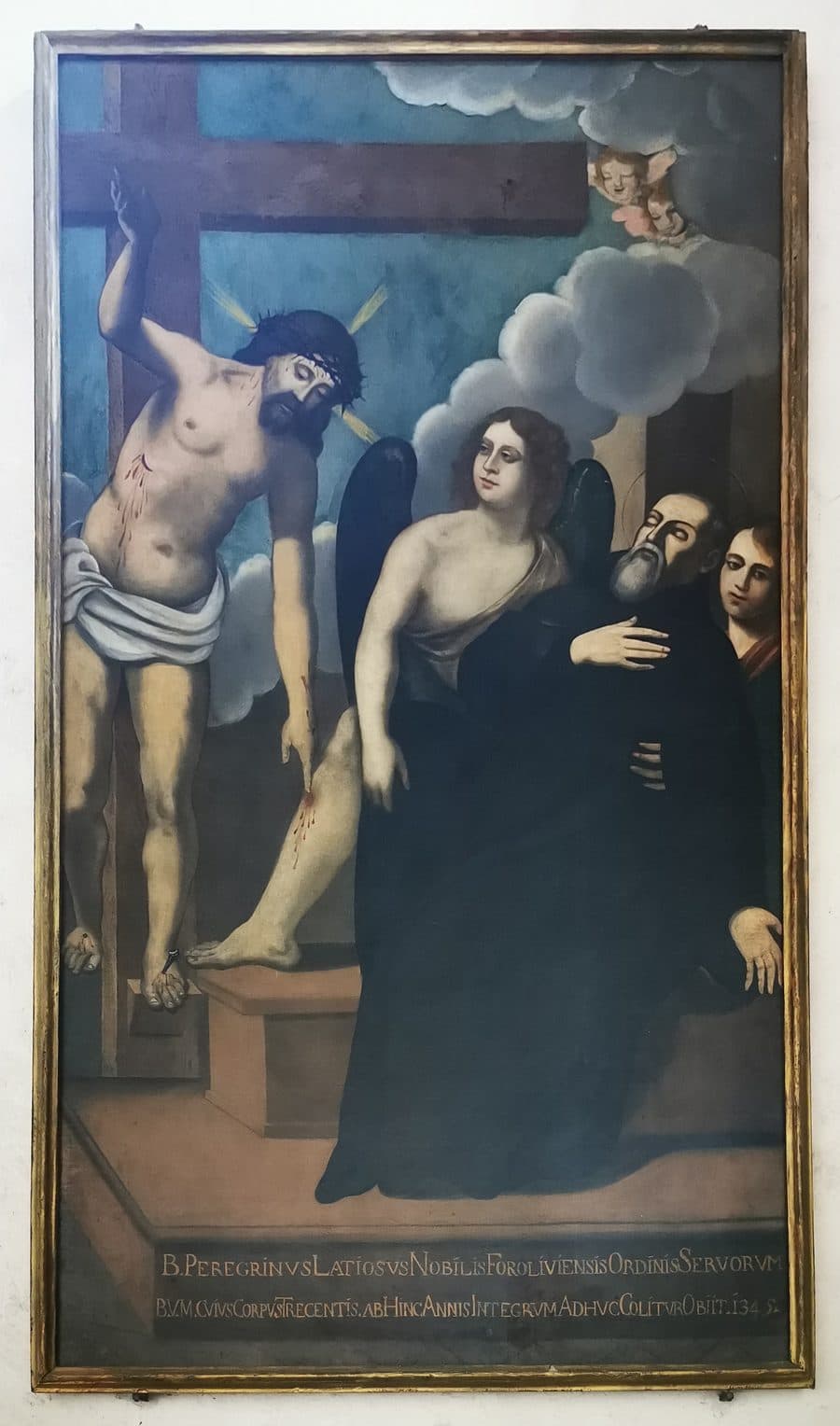
He became known for extreme penances — he stood for long periods without sitting, reportedly standing in prayer for hours — and for his service to the poor and sick. In his old age (around his 60th year), he developed cancer of the foot — a severe cancerous wound that had grown progressively worse and was scheduled for amputation the following morning. The night before the surgery, Peregrine prayed before a crucifix. He fell asleep and had a vision of Christ descending from the cross and touching his foot. When he woke and the surgeons arrived to perform the amputation, they found no trace of the cancer.
He lived until the age of 80, dying in 1345. He was canonised in 1726 and is the patron of cancer patients and those suffering from serious illness — perhaps the most invoked saint in the contemporary Catholic world for those facing terminal diagnoses.
The Strike and the Conversion
Peregrine's striking of Philip Benizi is the starting point of his sanctity — the violent act that became the occasion of conversion. He struck the Servite friar who had come to reconcile his faction. He immediately felt remorse. He went to Philip and asked forgiveness. Philip forgave him. The conversion followed: Peregrine joined the Servites and became a priest. The pattern is a compressed version of Paul on the road to Damascus: the violent act, the immediate remorse, the encounter with Christian forgiveness, the transformation. Philip's response to being struck — immediate forgiveness — was the catalyst. The Penance of Standing One of the characteristic forms of Peregrine's penance was standing: he reportedly refused to sit for years, praying for extended periods in an upright position. This penance is the irony of his eventual patronage: the saint who stood for decades developed a cancerous wound in his foot that should have required amputation. The body that had been used as an instrument of penance became the site of the miraculous cure. Standing in prayer for years; cured of the foot cancer the night before the operation. The Night Miracle — the cancer disappears The miracle that makes Peregrine the patron of cancer patients occurred the night before his scheduled foot amputation. He prayed before a crucifix; fell asleep; experienced a vision of Christ descending from the cross and touching his foot. When he woke and the surgeons arrived, the cancer was gone — no trace of the wound that had been progressively worsening. The miracle was attested by the surgeons and the community. He lived another twenty years without recurrence. The healing was the event; the patronage followed: those who face cancer invoke the man who was cured the night before the amputation. Forli and the Servite Tradition The Servite Order — the Order of Servants of Mary, founded in Florence in 1233 by seven merchants who abandoned their businesses to dedicate themselves to the Virgin — was the context of Peregrine's entire subsequent life. He served the poor and sick of Forli within the Servite tradition of Marian devotion and service. The Servite church in Forli, where he lived and died and where his relics are enshrined, is the principal pilgrimage site.
Walk in Their Footsteps
Pilgrimage sites connected to St Peregrine Laziosi
Ask St Peregrine Laziosi to Intercede
Bring these intentions to this saint in prayer:
Peregrine was going to lose his foot the next morning. He had a wound that had been getting worse for months. He prayed the night before the surgery. He fell asleep. He woke to find no cancer. The miracle is not the dramatic moment — it is the night before, alone in front of the crucifix, with the amputation scheduled for morning. The prayer of the night before is what Peregrine offers those who invoke him: not the guarantee of a cure, but the companionship of someone who prayed in the same darkness and was met there.
“Lord my God, I called to you for help, and you healed me.”
Peregrine, patron of cancer patients — I pray tonight for everyone who has been given a diagnosis that frightens them. For the ones who are alone with the CT scan results and cannot sleep. For the ones whose family is trying to be brave. Sit with them tonight, as you sat before the crucifix the night before your amputation. And when the morning comes — whatever the surgeons find — may they know they are not alone. Amen.