
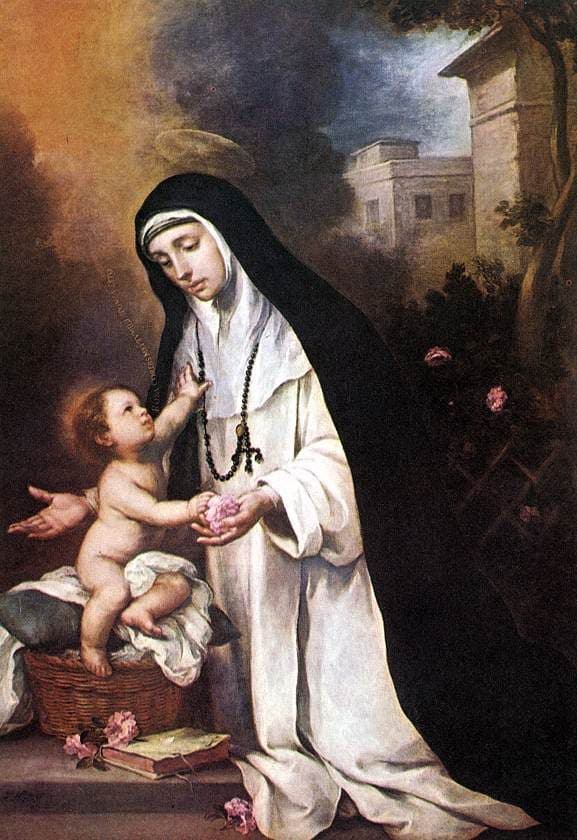
The Life
Isabel Flores de Oliva was born in 1586 in Lima, Peru, the eleventh child of a Spanish colonist and his wife. She was so beautiful as an infant that a neighbor exclaimed she looked like a rose — the name Rose replaced her baptismal name Isabel. She was the first person born in the Americas to be canonized.
She grew up in poverty (despite her Spanish colonial family background, they fell into financial difficulty) and contributed to the family income through needlework and the cultivation of flowers. From an early age she practiced severe physical penances: she wore a hair shirt, rubbed her face with pepper to redden it and make herself ugly, cut her hair to prevent admiration of it, and at one point rubbed her hands with quicklime to damage her skin — because a neighbor had admired her beautiful hands.
The specific severity of her penances has troubled commentators across the centuries. She joined the Dominican Third Order, built a hermitage in the family garden, and lived in the pattern of Catherine of Siena — intense interior prayer, extreme penance, charitable service. She nursed the sick poor and supported a small infirmary attached to her home. She experienced the full range of mystical phenomena: visions, ecstasies, locutions, and also extended periods of severe spiritual desolation.
In 1615, when Lima was threatened by a Dutch pirate attack, Rose prayed in the church of Santo Domingo and reportedly experienced a vision of victory; the attack failed. The popular memory held that her prayer had protected the city. She died in 1617 at age 31, after a long and painful illness. Her funeral was attended by virtually the entire city of Lima.
The Beauty and the Penance — making herself ugly
Rose's response to her own beauty was systematic. She rubbed her face with pepper. She cut her hair. She damaged her hands with quicklime. She wore a hairshirt embedded with small spikes. The theology behind this penance — that beauty is a source of temptation, to the person who has it as much as to those who observe it — reflects the specific spiritual culture of Counter-Reformation Catholicism. Modern readers find it disturbing; Rose's contemporaries found it admirable. What is consistent is the total commitment: she was not doing penance half-heartedly. The Garden Hermitage — a daughter of Catherine Rose built a small hermitage in the family garden and lived in it in imitation of Catherine of Siena's cell. The exterior simplicity and the interior intensity were the same: long hours of prayer, charitable service to the sick poor, the pattern of contemplation and action. The hermitage was not retreat from the family but a form of presence — she worked at needlework and flower cultivation to support the family income while maintaining her interior life. The garden hermitage is the characteristic image of Rose: the colonial Lima house, the garden, the small hut, the figure at prayer. The Pirate Attack and the Protection of Lima When a Dutch pirate fleet threatened Lima in 1615, Rose carried the monstrance with the Blessed Sacrament to the church doorway and prayed for the city's protection. The attack failed. The popular tradition attributed the failure to her prayer. Whether or not the attribution is historically precise, the memory established Rose as the protector of the city and contributed to the speed of her canonization. She was canonised only 53 years after her death — unusually fast for the period. The Funeral — a whole city mourns Rose died on August 24, 1617, after a long and painful illness that she bore with apparent patience. Her funeral was attended, according to contemporary accounts, by virtually the entire population of Lima — including the Viceroy, the Archbishop, and all the civil and religious authorities. Her body had to be held at the church for several days because the crowds would not permit the burial to proceed. The whole city had known her, or known of her; the entire city had come to see her buried.
Walk in Their Footsteps
Pilgrimage sites connected to St Rose of Lima
Ask St Rose of Lima to Intercede
Bring these intentions to this saint in prayer:
Rose of Lima was the first saint of the Americas. She was also, by any modern psychological standard, a person whose penances reflected a deeply troubled relationship with her own body. Both things are true. The Church canonizes people, not theological propositions; and the saints are formed by their time and culture as much as by grace. Rose's specific penances belong to a specific spiritual culture. Her intensity of prayer, her charity to the poor, and her role as the first canonized person from the Americas are not diminished by this. She is a complex figure who belongs to a complex history.
“Dark am I, yet lovely, daughters of Jerusalem.”
Rosa de Lima, first saint of the Americas — from the garden hermitage of Lima, pray for the gardens of the Americas, beautiful and troubled. Pray for the people of the continent you first sanctified. Pray for those who damage themselves trying to be holy. And pray that God, who is the beauty that underlies all things, may be found not in the damaged face but in the face turned toward him. Amen.