
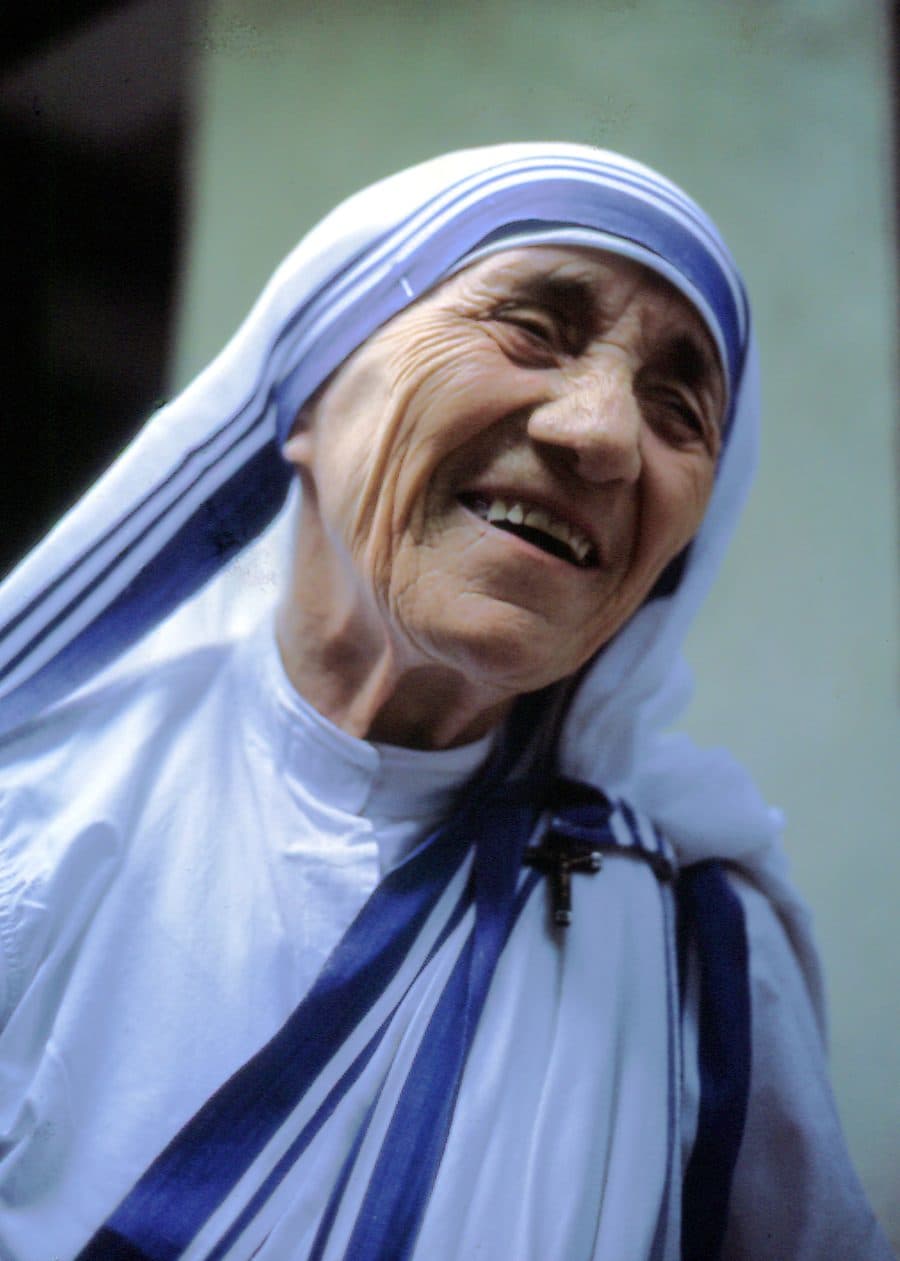
The Life
Agnes Gonxha Bojaxhiu was born in 1910 in Skopje (then part of the Ottoman Empire, now North Macedonia), the youngest of three children of an Albanian businessman and his wife. Her father died when she was 8. She felt a call to religious life and to mission in India at age 12; she joined the Sisters of Loreto at age 18, took the name Sister Mary Teresa, and arrived in Calcutta in 1929. She taught geography at St Mary's School in the comfortable Loreto convent — and began to notice what was outside the convent walls.
On September 10, 1946 — a date she called Inspiration Day — she was traveling by train to Darjeeling for a retreat when she received what she described as a call within a call: a direct instruction from Jesus to leave the convent and serve the poorest of the poor in the slums of Calcutta. She spent two years in an agony of discernment and application to the Vatican before receiving permission. She left the Loreto convent in 1948, exchanged her Loreto habit for a simple white sari with a blue border, received basic medical training, and went into the slums.
She founded the Missionaries of Charity in 1950 — a new religious congregation with a fourth vow, added to the standard three (poverty, chastity, obedience): wholehearted free service to the poorest of the poor. The congregation grew from a handful of sisters to over 4,500 religious operating in 133 countries, running homes for the dying, leper colonies, orphanages, schools, and AIDS hospices.
She received the Nobel Peace Prize in 1979, accepting it on behalf of the poor. She asked the Nobel Committee to cancel the ceremonial banquet and give the money to the poor of Calcutta instead. She was beatified by John Paul II in 2003 and canonised by Francis in 2016. After her death, her published letters revealed that she had experienced fifty years of profound spiritual darkness — an inability to feel God's presence — even as she served the poor with apparently undiminished energy. This revelation transformed how many people understood her.
Inspiration Day — the call within the call
September 10, 1946, on a train to Darjeeling: Teresa heard a call within a call. The first call had been to religious life and India. The second was specific: leave the convent and serve the poorest of the poor. The interior experience was described by her as an instruction from Jesus — a voice with specific content. She did not act on it immediately; she spent two years in careful discernment and application to Church authority before receiving permission to leave the Loreto convent. The call within the call has become one of the most famous phrases in the theology of vocation: the primary call is to Christ; the secondary call is to the specific work. The Home for the Dying — Nirmal Hriday Teresa's first major institution in Calcutta was Nirmal Hriday (Pure Heart) — a home for the dying, established in a pilgrims' hostel adjacent to the Kalighat temple. People dying on the streets of Calcutta — abandoned, destitute, with no family — were brought in, washed, given a bed, and allowed to die with dignity and with someone holding their hand. The home is still operating. The principle was simple: everyone deserves to die feeling loved, even if they have lived feeling nothing of the kind. The dying of Kalighat received what many people who died in palaces did not. The Spiritual Darkness — fifty years of absence Teresa's published correspondence after her death revealed that she had experienced approximately fifty years of profound spiritual darkness — an inability to feel God's presence, a sense of abandonment and emptiness — even while continuing her work with apparently undiminished faith. She wrote: I call, I cling, I want — and there is no One to answer. The darkness she experienced has been compared to the dark night of the soul described by John of the Cross. Many people found this revelation more consoling than anything she had said publicly: the woman who served with such visible love felt nothing at all, and served anyway. The Nobel Prize — accepted for the poor At the Nobel Peace Prize ceremony in Oslo in 1979, Teresa asked the committee to cancel the ceremonial banquet — costing approximately $7,000 — and give the money to the poor of Calcutta. The committee agreed. She used her Nobel lecture to speak about abortion as the greatest destroyer of peace, a position that drew criticism from the secular press. She received the prize on behalf of the poor and said so. She then used the prize money to build leprosaria and homes for the dying. She was entirely consistent.
Walk in Their Footsteps
Pilgrimage sites connected to St Teresa of Calcutta (Mother Teresa)
Ask St Teresa of Calcutta (Mother Teresa) to Intercede
Bring these intentions to this saint in prayer:
Teresa felt nothing for fifty years. No consolation, no sense of God's presence, no interior warmth. She picked up the dying from the streets anyway. She built the homes anyway. She prayed the Office anyway. She smiled for the cameras — that extraordinary smile — and felt, in her own description, the darkness and emptiness of abandonment. The service was not sustained by feeling; it was sustained by will. The lesson is not that service is easy but that it does not require feeling good. She served from empty hands for fifty years, and filled the world with love.
“The King will reply, Truly I tell you, whatever you did for one of the least of these brothers and sisters of mine, you did for me.”
Mother Teresa, who served from darkness — teach me to do small things with great love when I feel nothing at all. I am waiting for the consolation before I act; you acted for fifty years without it. Take me to Kalighat in my heart and show me who is dying on the floor nearest to me. What small thing can I do with great love today? For it is not how much we do but how much love we put into what we do. Amen.