
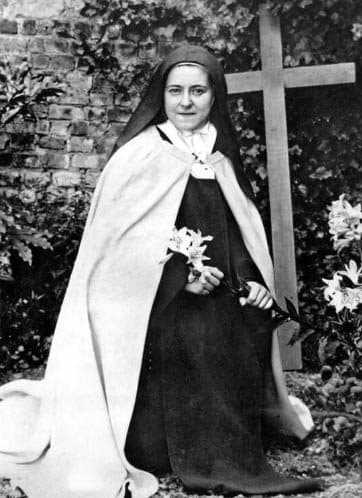
The Life
Marie-Francoise-Therese Martin was born in Alencon, Normandy, on January 2, 1873, the youngest of five daughters of Louis and Zelie Martin (both now canonised saints). She entered the Carmelite convent of Lisieux at the extraordinary age of fifteen — she had petitioned the Bishop of Bayeux directly and then sought permission from the Pope himself during a pilgrimage to Rome — and died there at twenty-four of tuberculosis. She published nothing in her lifetime. She was not a famous preacher, a stigmatic, a founder, or a mystic of obvious spectacular gifts. She was a cloistered nun who spent nine years in a Carmelite convent, mostly hidden, mostly suffering, and then died young.
And yet she is one of the three women Doctors of the Church (with Catherine of Siena and Teresa of Avila); she was declared co-patroness of France with Joan of Arc by Pope Pius XI; she is co-patron of the missions along with Francis Xavier; and she is, by virtually every measure, one of the most widely venerated saints of the modern Church. Forty-seven million copies of her autobiography Story of a Soul have been sold in sixty languages. Her shrine in Lisieux receives over two million pilgrims per year. The Vatican holds more petitions addressed to her than to any other saint except the Virgin Mary.
The reason for this extraordinary influence is a single insight, so simple that most theologians initially dismissed it: the Little Way. Therese discovered, through years of attempting and failing the grand gestures of traditional spirituality, that she was not capable of the great heroic acts of the saints. She was not going to climb the staircase of spiritual perfection by heroic effort. She was a little soul — she called herself the little Therese, the little flower. And she worked out that it was precisely for little souls that Jesus came: not for the great and the heroic, but for children. She would take the spiritual elevator — complete trust in God's mercy, the complete surrender of herself as she was (weak, imperfect, often in darkness), the confident expectation of being carried by Love rather than having to climb by merit. This is the Little Way. Its influence has been incalculable.
The Little Way — the spiritual elevator
Therese was reading a passage from Isaiah when the insight crystallised: As a mother comforts her child, so will I comfort you. She understood that she did not need to climb; she could be carried. God does not require heroic souls, but only trusting children. If you are little, if you are weak, if you have nothing to offer but your poverty and your willingness — that is exactly what is required. The Little Way is not a lowering of the spiritual standard; it is a recognition that the standard is already met by the mercy of God, and what is required of the little soul is not achievement but trust. Offering to Merciful Love — the act of surrender On June 9, 1895, Therese made her Act of Oblation to Merciful Love — offering herself completely to God's merciful love, asking not to be consumed by the justice of God (like the great souls who offer themselves to divine justice) but to be flooded by the waves of infinite tenderness that God wishes to bestow and cannot, because so few open themselves wide enough to receive it. She asked to receive what others refused. This act of oblation is one of the most theologically original moments in the history of Catholic spirituality: the inversion of the traditional penitential logic, the decision to receive rather than earn. The Dark Night — the tunnel without a train From Easter 1896 until her death in September 1897, Therese underwent a profound spiritual crisis: the complete loss of any felt sense of God's presence, of heaven, of faith — a darkness she describes as a tunnel in which she cannot see even the light at the end. She continued to pray, to smile, to practise charity, to write her autobiography. She told no one how dark it was except her superiors. She experienced what she called the night of nothingness: the most shattering spiritual desolation. And she remained faithful to the Little Way — trust in God's mercy — precisely when she could feel nothing to trust in. The Shower of Roses — after death Therese promised before her death that she would spend her heaven doing good on earth — that she would let fall a shower of roses, that her mission would begin when she died. She has been taken at her word. Testimonials of roses — literal flowers, the scent of roses without a source, flowers given to those who pray to her — have been recorded across the world since her death. Her mission after death has arguably been more extensive than any mission in her lifetime. She is the patron of the missions without ever having left her convent.
Walk in Their Footsteps
Pilgrimage sites connected to St Therese of Lisieux
Ask St Therese of Lisieux to Intercede
Bring these intentions to this saint in prayer:
Therese was twenty-four when she died. She had published nothing. She had not founded anything. She had not preached, not performed public miracles, not left the convent. And she is one of the most influential Christians of the modern era. The Little Way is counter to everything the world values: it says that what matters is not achievement but surrender, not heroism but trust, not greatness but the willingness to be carried. The little flower dies and fills the world with its scent.
“Truly I tell you, unless you change and become like little children, you will never enter the kingdom of heaven.”
St Therese, little flower, Doctor of the Little Way — teach me the elevator. I am tired of climbing. I have tried the heroic path and found I am not capable of it. Teach me to be small enough to be carried. Teach me to open wide enough to receive the floods of mercy that God wants to pour out and cannot, because so few open themselves. And let fall on me, as you promised, your shower of roses. Amen.