
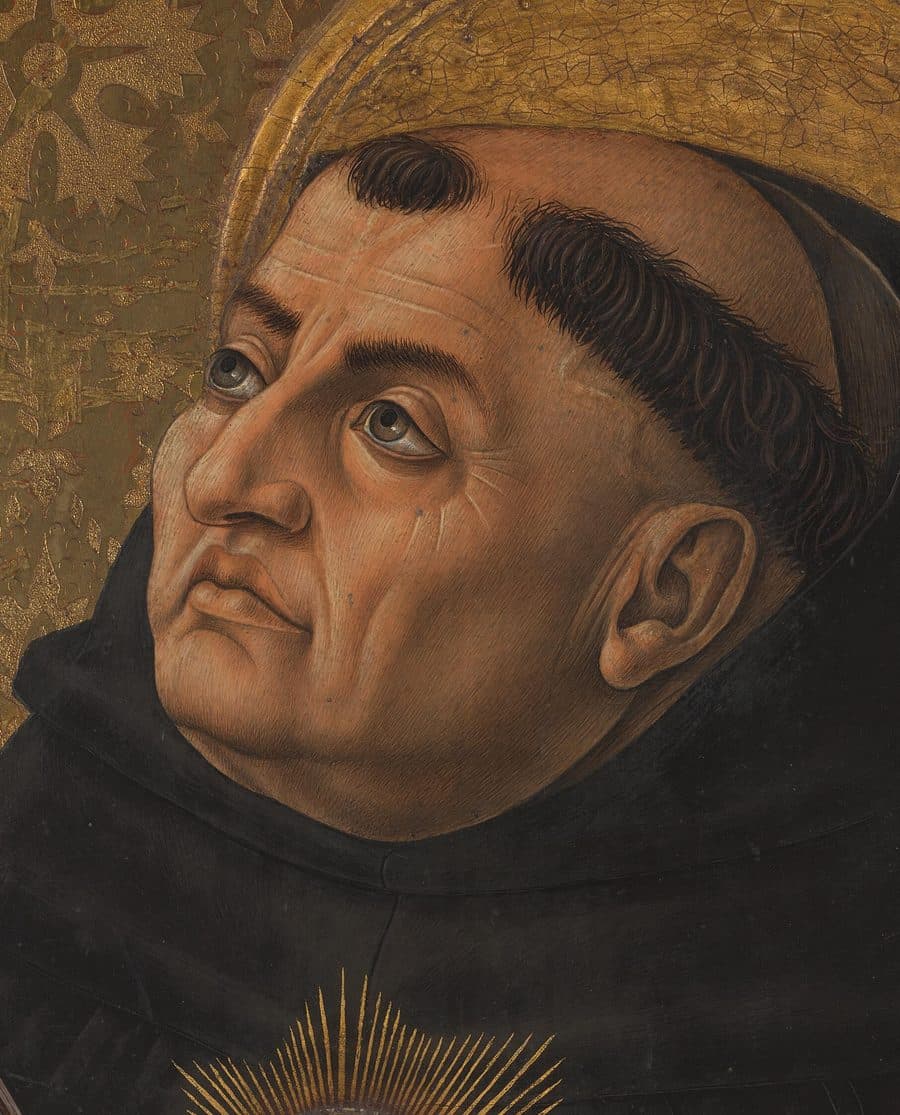
The Life
Thomas Aquinas was born around 1225 at Roccasecca in the Kingdom of Sicily, the son of a minor noble. As a child he was sent to the Benedictine monastery of Monte Cassino, and then to the University of Naples — where he encountered the Dominicans and decided, against violent family opposition, to join the mendicant order. His family kidnapped him and imprisoned him in a tower for a year in an attempt to dissuade him. They sent a woman to tempt him. He drove her from the room with a burning brand and prayed through the night.
At Paris and then Cologne he studied under Albert the Great — one of the leading Aristotelian scholars of the age — who reportedly told the other students: You call him the Dumb Ox, but I tell you that this Dumb Ox will one day fill the world with his lowing. The nickname Dumb Ox arose from Thomas's quietness; he was large, physically quiet, habitually contemplative, and rarely spoke in class. The lowing when it came — the Summa Theologiae, the Summa Contra Gentiles, the biblical commentaries, the liturgical hymns for Corpus Christi — filled the world.
The Summa Theologiae is the greatest systematic theological work of the medieval period and one of the most influential philosophical texts in Western history. Its structure — question, objection, response, reply to objections — reflects the scholastic method Thomas mastered and transformed. Its content is the synthesis of Aristotelian philosophy and Christian theology that defined Catholic intellectual life for centuries: the five ways of demonstrating God's existence from reason; the understanding of grace and nature as distinct but complementary; the structure of virtue ethics; the theology of the sacraments.
He died in 1274, on his way to the Council of Lyon, at the Cistercian monastery of Fossanova. He had put down his pen five months before he died, telling his companion Reginald: I cannot go on. All that I have written seems like straw compared to what I have seen. Whether this was a mystical experience of the direct vision of God — or illness, or the recognition of the inadequacy of all language before the divine reality — he never wrote again.
The Kidnapping — a year in the tower
When Thomas decided to join the Dominicans, his family kidnapped him and held him in the family castle at Roccasecca for approximately a year. They sent his brothers to argue with him, his mother to plead with him, and finally (according to tradition) an attractive woman to tempt him. Thomas drove the woman from the room with a burning brand, drew a cross on the wall, and prayed through the night. He later reported experiencing a mystical confirmation of his vow of chastity. After a year, his family gave up and released him. He returned to the Dominicans. The Dumb Ox — Albert's prophecy Thomas was known to his fellow students as the Dumb Ox — a large, quiet, apparently slow man who rarely spoke in class and gave no indication of the intellectual volcano within. Albert the Great, who recognized what his students could not, reportedly told them: You call him the Dumb Ox. But I tell you this Dumb Ox will one day fill the world with his lowing. It is one of the great prophecies in intellectual history. The lowing of the Dumb Ox became the Summa Theologiae — the greatest systematic theology of the medieval world. All That I Have Written Seems Like Straw On December 6, 1273, Thomas had an experience during Mass at the chapel of Saint Nicholas in Naples — whether mystical vision or medical episode (possibly a stroke or TIA) remains disputed — after which he put down his pen and never wrote again. To his companion Reginald, who urged him to continue, he said: I cannot go on. All that I have written seems like straw compared to what I have seen. Five months later he was dead. The unfinished Summa Theologiae ends mid-question. The greatest systematic theologian of the medieval period left his masterwork incomplete — a silence more eloquent than any conclusion. The Five Ways — reason reaching toward God Thomas's five ways (quinque viae) — five arguments for the existence of God derived from reason without appeal to revelation — are among the most discussed arguments in the history of philosophy. The cosmological arguments (from motion, from causation, from contingency), the teleological argument (from the order and direction of nature), and the argument from gradation are still debated by philosophers. Thomas's project was the systematic demonstration that reason and faith are not opponents: reason can reach God, faith goes further. The five ways are reason at its boundary, pointing toward what reason alone cannot cross.
Walk in Their Footsteps
Pilgrimage sites connected to St Thomas Aquinas
Ask St Thomas Aquinas to Intercede
Bring these intentions to this saint in prayer:
Thomas was quiet for years and then spoke in a way that filled the world. He was called the Dumb Ox. He became the master who synthesised the entire Christian intellectual tradition. He wrote the greatest systematic theology of the medieval world and then put down his pen because he had seen something his words could not reach. The Dumb Ox's silence at the end is more eloquent than most people's speech. He knew when the words ran out.
“For the Lord gives wisdom; from his mouth come knowledge and understanding.”
St Thomas, Dumb Ox who filled the world — give me your diligence, your clarity, and your humility before mystery. Let me study as you studied: with order, with rigor, with the conviction that truth is worth pursuing. And when I arrive, as you arrived, at the place where words run out — where all that I have written seems like straw compared to what I have seen — let me put down my pen in peace. Amen.