
The Life
Thomas, called Didymus (the Twin), is the apostle who became the patron of India — where the ancient Thomas Christian tradition traces its foundation to his mission in the 1st century — and who gave his name to an entire category of spiritual struggle: the doubting Thomas. His absence from the upper room on Easter Sunday evening, his refusal to believe the other apostles' report of the resurrection without direct physical evidence, and his subsequent encounter with the risen Christ eight days later produced one of the most profound confessions in the New Testament: My Lord and my God.
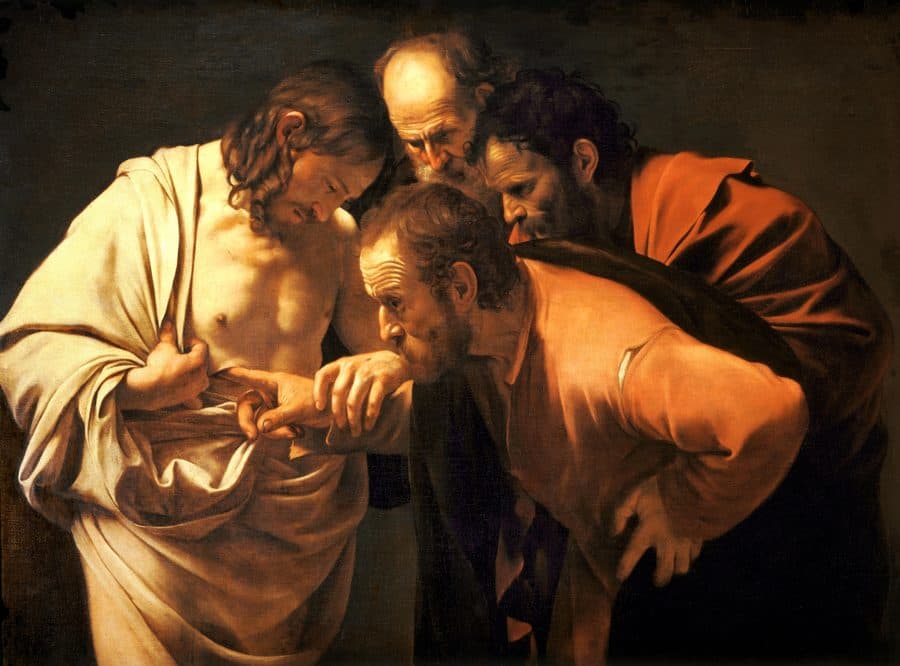
He appears in John's Gospel three times, each appearance illuminating his character. At the news of Lazarus's death, when Jesus proposes returning to Judea — where people had recently tried to stone him — it is Thomas who says: Let us also go, that we may die with him. This is not irony but commitment: Thomas is willing to die with Jesus in Judea. At the Last Supper, when Jesus says he is going to prepare a place for them and they know the way, Thomas says honestly: Lord, we don't know where you are going, so how can we know the way? This is the question that receives the answer: I am the Way, the Truth, and the Life. And after the resurrection, Thomas's demand for physical evidence — Unless I see the nail marks in his hands and put my finger where the nails were, and put my hand into his side, I will not believe — is met eight days later when Jesus appears specifically to Thomas, invites the examination, and Thomas does not need to examine. He simply says: My Lord and my God.
The tradition of Thomas's mission to India is ancient and serious. The Acts of Thomas (3rd century) describes his journey to India, his ministry in the court of the Parthian king Gondophares (a historically attested king), and his eventual martyrdom by spear at Mylapore (modern Chennai). The Thomas Christians of Kerala — the St Thomas Christians — trace their community to his preaching, a tradition that predates any European contact with India. The Cathedral of San Thome in Chennai is built above what is traditionally identified as his tomb.
Let us also go, that we may die with him
When Jesus proposes returning to Judea — where the authorities had recently tried to stone him — Thomas speaks for the whole group: Let us also go, that we may die with him. This is the Thomas who is often overlooked in the focus on the doubt: the Thomas who is committed enough to follow Jesus into mortal danger, who does not hesitate at the prospect of death but says, simply, that dying with Jesus is an acceptable outcome. The doubt of Easter Sunday is the doubt of a man who had been willing to die with Jesus in Judea and who was devastated by the failure of the resurrection to be what he had hoped. Unless I see — the demand for evidence Thomas's demand for physical evidence of the resurrection is sometimes treated as a failure of faith; it is better understood as the honest response of a man with an empirical temperament who had committed everything to Jesus and was not willing to be consoled by rumours. He had been willing to die with Jesus in Judea. He could not accept less than certainty about the resurrection. Eight days later, Jesus appears specifically for Thomas — the appearance seems designed for him — and offers the examination Thomas demanded. Thomas does not examine. The sight is enough: My Lord and my God. My Lord and my God — the deepest confession Thomas's response to the risen Christ — My Lord and my God — is the most direct proclamation of the full divinity of Jesus in the entire New Testament. The doubter produces the deepest confession. This is theologically significant: the demand for evidence, the willingness to examine physically, produced a confession that goes beyond anything the other apostles said at that moment. Thomas did not touch the wounds; the sight of Jesus was sufficient. My Lord and my God: two words for God (Kyrios and Theos), applied to Jesus without qualification. The doubt became the doorway to the deepest faith. The Mission to India The Thomas Christians of Kerala — who call themselves Nasrani (Nazarenes) and trace their community to Thomas's 1st-century mission — are one of the oldest Christian communities in the world, predating any European contact with India by more than a thousand years. The tradition of Thomas's preaching in the Malabar Coast, his journey to Mylapore (Chennai), his martyrdom by spear on the Hill of St Thomas (now San Thome), and his burial there is ancient, internally consistent, and supported by the Acts of Thomas (3rd century) and the presence of historically attested Parthian kings in the narrative. The Cathedral of San Thome in Chennai is built above his traditional tomb.
Walk in Their Footsteps
Pilgrimage sites connected to St Thomas the Apostle
Ask St Thomas the Apostle to Intercede
Bring these intentions to this saint in prayer:
Thomas's doubt was not the opposite of faith — it was the condition of faith for a man with his temperament. He could not accept less than direct encounter with the truth. Jesus appeared for him, specifically, eight days after the others. The invitation to examine the wounds produced not an examination but a confession: My Lord and my God. The most direct proclamation of Christ's divinity in the New Testament came from the apostle whose name is still synonymous with doubt. Doubt, honestly lived, can become the deepest faith.
“Then he said to Thomas, Put your finger here; see my hands. Reach out your hand and put it into my side. Stop doubting and believe. Thomas said to him, My Lord and my God!”
Saint Thomas, honest doubter and deepest confessor — walk with me in my uncertainty. I have questions I cannot resolve, evidence I have not seen, wounds I want to examine. Do not tell me to stop doubting until you have appeared to me as you appeared to Thomas. And when you do appear — when you meet me in the place of my doubt — may I have his response: My Lord and my God. Amen.