
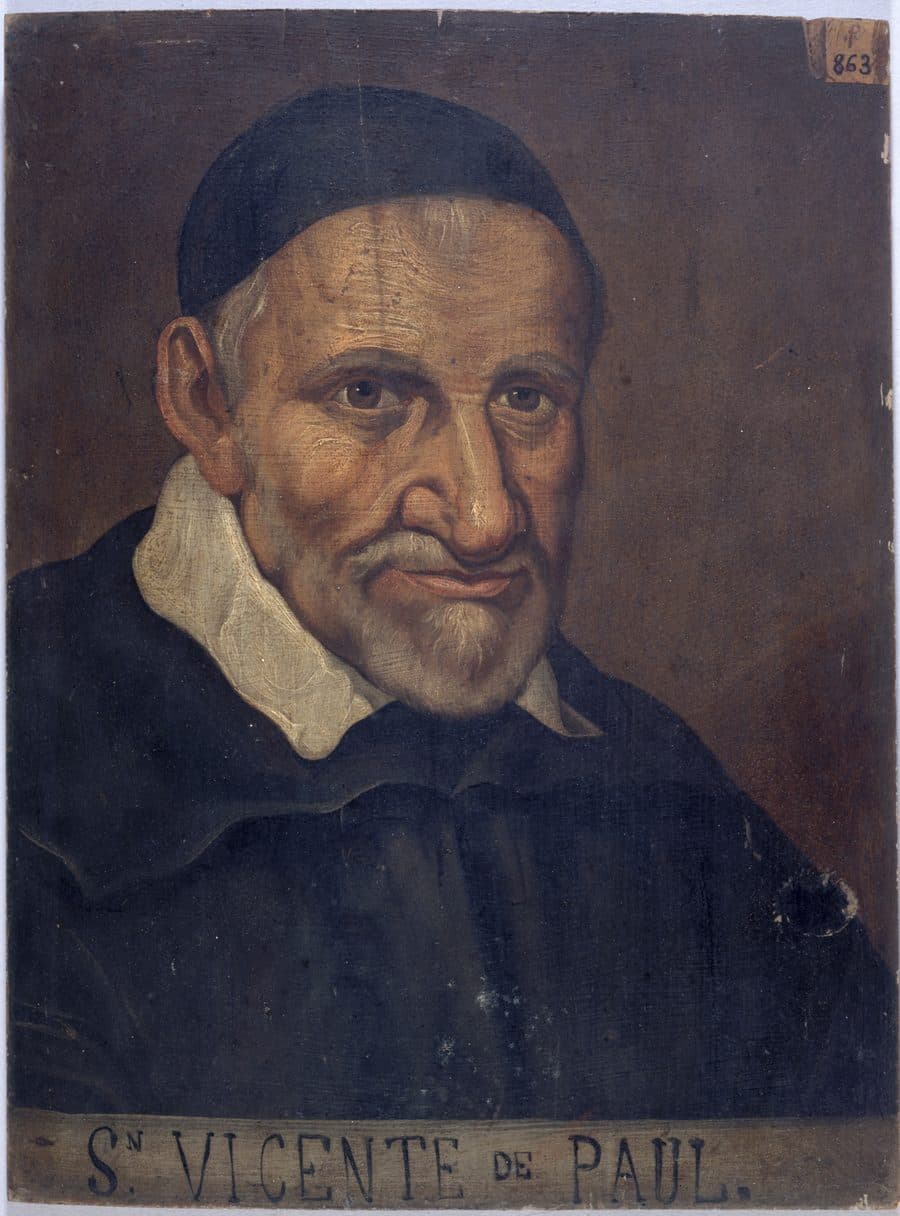
The Life
Vincent de Paul was born in 1581 in Pouy (now Saint-Vincent-de-Paul), in Gascony, France, the son of a peasant farmer. He was educated by the Franciscans, ordained a priest, and was reportedly captured by Barbary pirates on a sea voyage in 1605 and enslaved in Tunis for two years — though some historians doubt this account. He worked as a tutor to the Gondi family (powerful French aristocrats) and became chaplain to the galley convicts.
Encountering the galley convicts — chained to oars, suffering extreme physical conditions — transformed his spirituality and directed his energy. He established the Congregation of the Mission (Vincentians or Lazarists) in 1625, specifically to evangelize the rural poor (who were severely underserved by the Church) and to reform the clergy through seminary education. He established the Confraternity of Charity, which eventually became the Daughters of Charity — founded with Louise de Marillac — the first non-enclosed religious congregation of women serving the poor in the world.
The Daughters of Charity broke completely with the convention that religious women must be enclosed in convents. They went into the streets, the hospitals, the homes of the poor. Their rule was that their convent would be the house of the sick, their cell the hired room, their chapel the parish church, their cloister the city streets. This was revolutionary. It created the template for active religious life for women that has produced most of the Church's healthcare, educational, and social service institutions since the 17th century.
Vincent also established institutions for abandoned children (the most common method of child abandonment in 17th-century Paris was leaving the baby on the street to die of exposure), for galley slaves, for refugees from the Thirty Years War, and for the poor of rural France. He organized massive relief efforts during famines. He was canonized in 1737 and named patron of charitable works by Leo XIII in 1885.
The Galley Convicts — finding God in the suffering
Vincent's encounter with the galley convicts — chained to the oars of French war galleys in conditions of extreme degradation — was one of the formative experiences of his ministry. He served as their chaplain, visiting them in the harbors, hearing their confessions, attending their deaths. He reportedly said that one must go to the poor as to one's lord and master. The galley convicts were, for Vincent, the face of Christ in its most suffering and degraded form. From this encounter he organized systematic charitable ministry to the poor that eventually extended across France and beyond. The Daughters of Charity — breaking the enclosure The Daughters of Charity, founded with Louise de Marillac in 1633, were revolutionary because they were not enclosed. Every previous women's religious congregation was required to remain within the convent walls. The Daughters of Charity went out. Their rule described their convent as the house of the sick, their cell as a hired room, their cloister as the city streets. This breaking of the enclosure created the template for active women's religious congregations that has produced most of the Church's hospitals, schools, and social service institutions. The Daughters of Charity are now the largest women's religious congregation in the world. Abandoned Children — the babies on the streets The most distressing feature of 17th-century Parisian poverty that Vincent addressed was the abandonment of infants — left on the streets to die of exposure. Vincent organized a systematic response: he founded the Hospice of the Holy Name of Jesus, organized women of the Confraternity of Charity to nurse abandoned babies, and eventually established institutions that would care for them. He reportedly held up an abandoned baby in a room of wealthy Parisian women and told them: you are this child's last hope. If you refuse, it will die. The Daughters of Charity agreed to continue. The institution continued. The Congregation of the Mission — reforming clergy One of Vincent's most important but less visible contributions was the reform of the Catholic clergy in France. He established seminaries and conducted missions specifically aimed at training priests and raising the standard of clerical formation. The Congregation of the Mission (Vincentians) were specifically charged with this work. In a period when the Council of Trent's seminary reform was still being implemented inconsistently, Vincent provided a model of clerical formation that spread across France and eventually around the world.
Walk in Their Footsteps
Pilgrimage sites connected to St Vincent de Paul
Ask St Vincent de Paul to Intercede
Bring these intentions to this saint in prayer:
Vincent found God in the galley convicts. He went to the poor as to his lord and master. The extraordinary institutional creativity of his life — the Congregation of the Mission, the Daughters of Charity, the hospitals, the abandoned children's homes, the seminary reform — all flows from the single conviction that the poor are Christ. Not that they resemble Christ, or that serving them earns merit from Christ; but that they are Christ: that the encounter with the suffering poor is the encounter with the face of God. The institutions are footnotes to the encounter.
“For I was hungry and you gave me something to eat, I was thirsty and you gave me something to drink, I was a stranger and you invited me in, I needed clothes and you clothed me, I was sick and you looked after me, I was in prison and you came to visit me.”
Vincent, who found God in the galley convicts — show me where God is in the suffering around me. I walk past the poor. I read about the prisoners. I send a donation and feel I have done my part. Tell me what you told the women holding the abandoned baby: this person is Christ, and they are your last hope. Lead me from the donation to the encounter. And in the encounter, show me the face. Amen.