Of the twelve apostles, most died in lands they had chosen. Thomas is different. The tradition that is ancient, serious, and very much alive holds that he landed on the Malabar Coast in 52 AD — when Rome was still young, when the Colosseum had not yet been built, when Christianity barely existed as a name — and that he never went home. He stayed, he preached, he founded churches, and he died on Indian soil. His tomb today lies beneath a neo-Gothic basilica on the Chennai seafront, one of only three churches in the world built over the grave of an apostle.
For the Catholic pilgrim from India, this is not an abstract claim. The Saint Thomas Christians of Kerala — the Nasrani community — have maintained an unbroken identity for two millennia. Their liturgy, once celebrated in Syriac, their vestments, their cross designs, their music: all bear the marks of a community that was already centuries old when the first European missionaries arrived and were astonished to find Christians who had never heard of Rome.
The Landing at Muziris
The port of Muziris no longer exists. Catastrophic floods in 1341 reshaped the mouth of the River Periyar, silting up one of the ancient world's most important harbours virtually overnight. But in the first century, Muziris — near modern Kodungalloor (Cranganore) in Kerala — was a thriving cosmopolitan port on the Roman-Indian spice route. Pepper, cardamom, and ivory left from here; Roman gold, wine, and glass arrived. Jewish traders had settled here generations before Thomas. It was into this world — mercantile, multilingual, already accustomed to strangers — that Thomas stepped ashore.
The tradition records that he was welcomed at first by a Jewish flute-girl named Miriam, a detail that has the texture of real memory rather than legend. He preached to the Jewish community first, then to Brahmin families. He worked his way down the Kerala coast, founding Christian communities at seven significant locations, plus a half-church — a small, jointly held shrine — along the way. These are the Seven and a Half Churches of St Thomas.
The Seven and a Half Churches
The exact list has varied across traditions, but the core seven — Kodungalloor (Cranganore), Kollam, Niranam, Nilackal (Chayal), Kokkamangalam, Kottakkavu (North Paravur), and Palayur (Chavakkad) — are the foundation stones of Kerala's ancient Christian geography. Palayur is often cited as the first: a site where Thomas is said to have converted a group of Brahmin families who were engaged in ritual bathing, pouring water over their heads in place of the sacred rite they were abandoning.
The half-church is traditionally located at Thiruvithamcode in the far south — 'half' because the building was shared with another tradition, a reminder that the early Christian presence in India existed within a complex, pluralist society rather than in isolation.
Each of these sites is now a church or shrine of considerable antiquity, though the present buildings are centuries-old replacements of what Thomas left behind. The oldest surviving structure associated with his mission is probably the Persian Cross at Kottayam's Valiapally (the 'Big Church') — a 6th-century stone carving in Pahlavi script, evidence of the Syriac-speaking church that maintained contact with Kerala's Christians through the early medieval period.
The Nasrani Community
The Saint Thomas Christians — Nasrani, from Nazarene — are among the oldest continuous Christian communities in the world. By the time Vasco da Gama arrived in 1498, they numbered perhaps 200,000, organised under their own bishops, following the East Syriac rite of the Church of the East, and integrated into Kerala society with a caste status comparable to the Nair nobility. They were exempt from certain taxes, bore ceremonial umbrellas in processions, and were accepted as equals by Hindu kings.
The Portuguese encounter was traumatic. The Synod of Diamper in 1599 attempted to Latinise the Nasrani church — burning Syriac books, changing liturgical rites, installing Roman authority. The community eventually fractured. Today the Thomas Christians are divided among several denominations: the Syro-Malabar Catholic Church (the largest, in full communion with Rome while retaining the Eastern rite), the Syro-Malankara Catholic Church, the Mar Thoma Syrian Church (reformed and Protestant in theology, Eastern in liturgy), the Malankara Orthodox Syrian Church, and the Chaldean Syrian Church — all tracing their roots to the same first-century landing at Muziris.
What unites them, across every theological divide, is St Thomas. His feast day on July 3rd is celebrated with remarkable unity across denominations. The pilgrimage to Malayattoor in Holy Week — where lakhs of pilgrims carry crosses up a steep hillside to the shrine at Kurisumudi — draws Catholics and Orthodox and Mar Thoma Christians together, an ecumenism that no council arranged but that Thomas somehow maintains.
Malayattoor: The Mountain Shrine
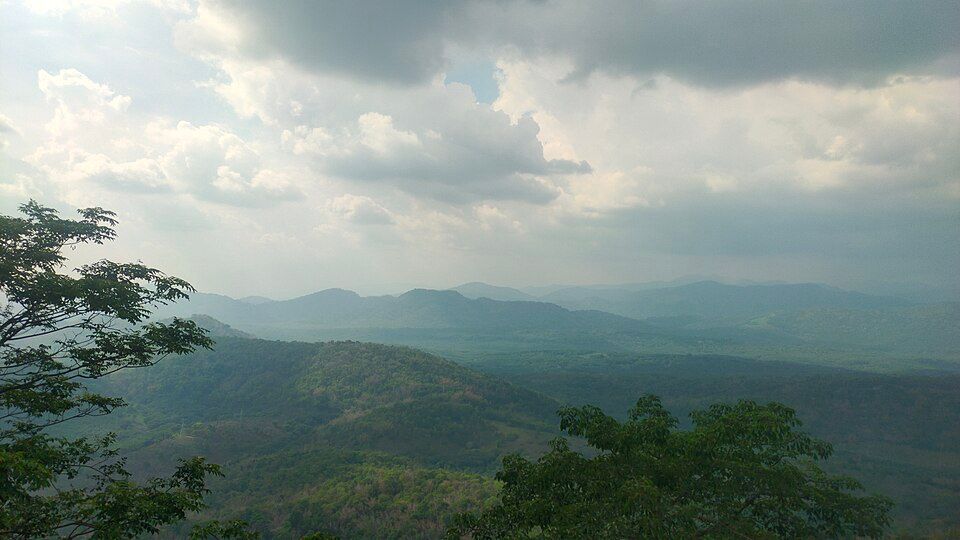
If there is one site in Kerala that captures the living intensity of the Thomas tradition, it is Malayattoor. The St Thomas International Shrine at Kurisumudi — 'cross summit' — rises 1,269 feet above the River Periyar. Tradition holds that Thomas, fleeing a hostile crowd after his arrival in the region, climbed this mountain and spent days in prayer. He struck a rock with his staff and water sprang forth — the spring still flows, and pilgrims collect the water believing it has healing properties. On the rock face are impressions said to be his footprints, now enclosed in glass.
In 2004, the Vatican declared Malayattoor an International Shrine — one of only eight in the world — a recognition of its significance to the global Church. During Holy Week, four million pilgrims visit. On Good Friday, the hillside is a sea of people carrying wooden crosses in an act of penitence that has no equivalent elsewhere in India.
The Seven-and-a-Half Churches Today: Kottakkavu and Santa Cruz, Kochi
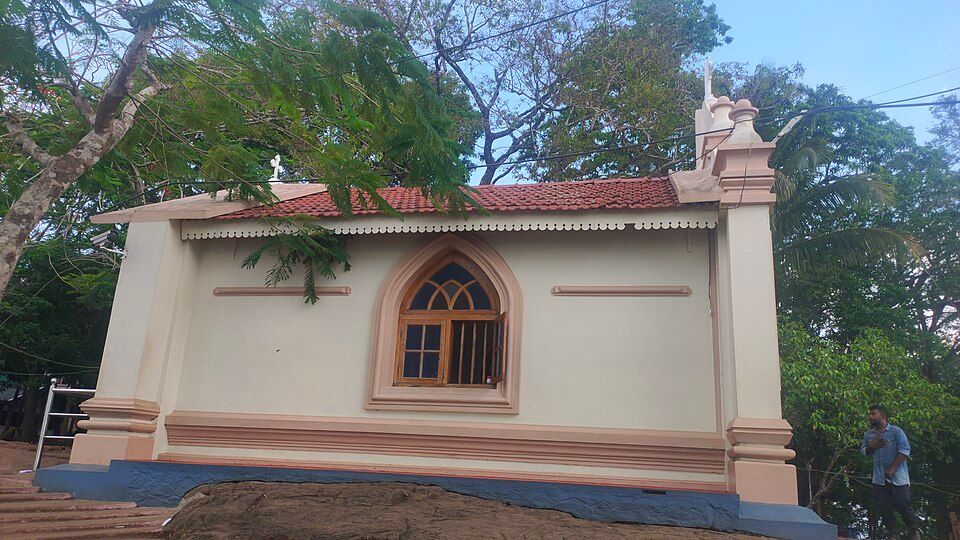
Among the Seven Churches, the Syro-Malabar Church of St Thomas at Kottakkavu (North Paravur, Kerala) is one of the most evocative. Tradition records Thomas founding a church here for the Nair and Brahmin families he converted. The present church is a simple, ancient-feeling structure — restored but not over-restored — that retains the atmosphere of a place of very long prayer.
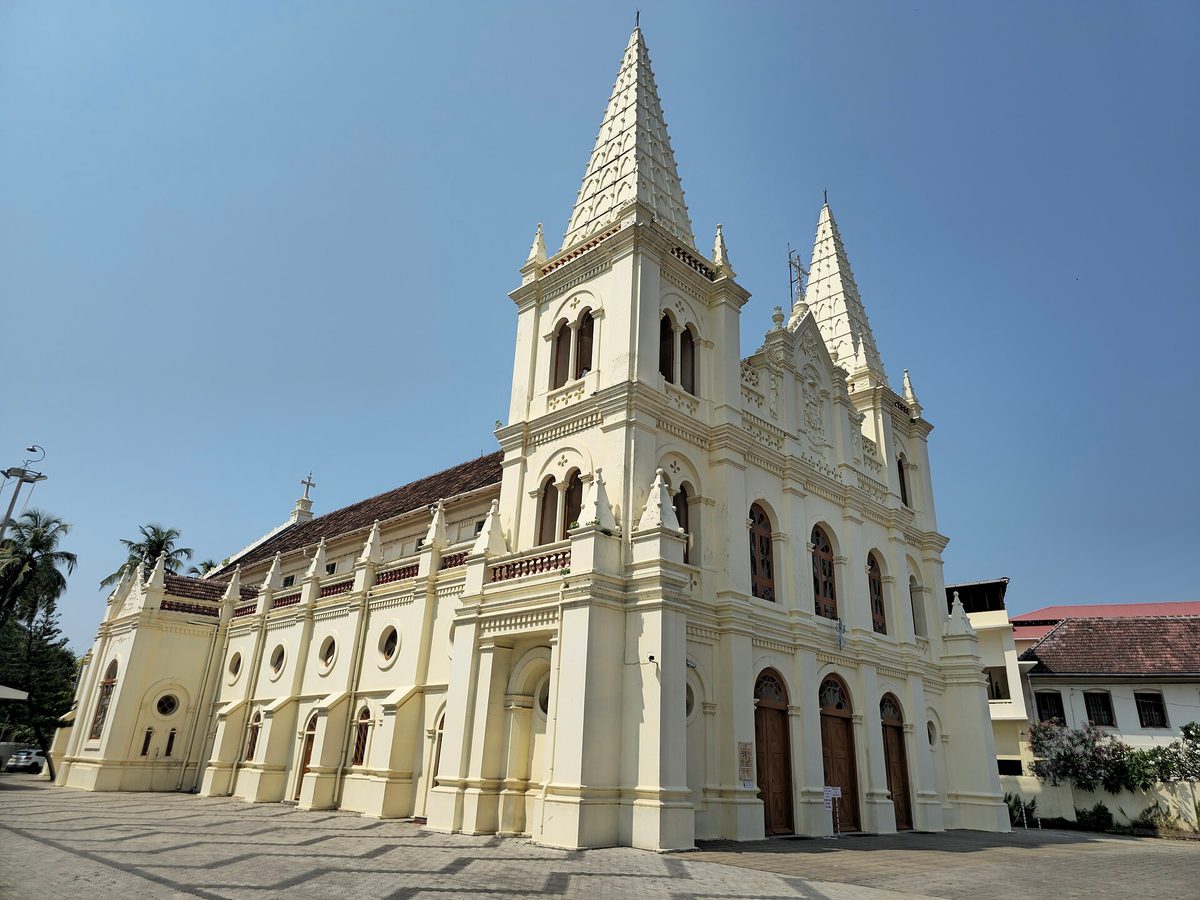
Santa Cruz Cathedral Basilica in Fort Kochi is a different kind of sacred architecture entirely. First built by the Portuguese in 1505 — the same year as Vasco da Gama's second Indian voyage — it was one of the first churches erected in India by Europeans. Demolished by the British and rebuilt in the early 19th century, the present neo-Gothic church is known for its colourful Dutch-tile interior and its association with the beginning of European Christianity in India. Fort Kochi itself is a palimpsest: Chinese fishing nets on the waterfront, a synagogue in Jew Town, a Jama Masjid near the harbour, and the Basilica on the hill — all within walking distance.
San Thome Basilica, Chennai: The Tomb of the Apostle
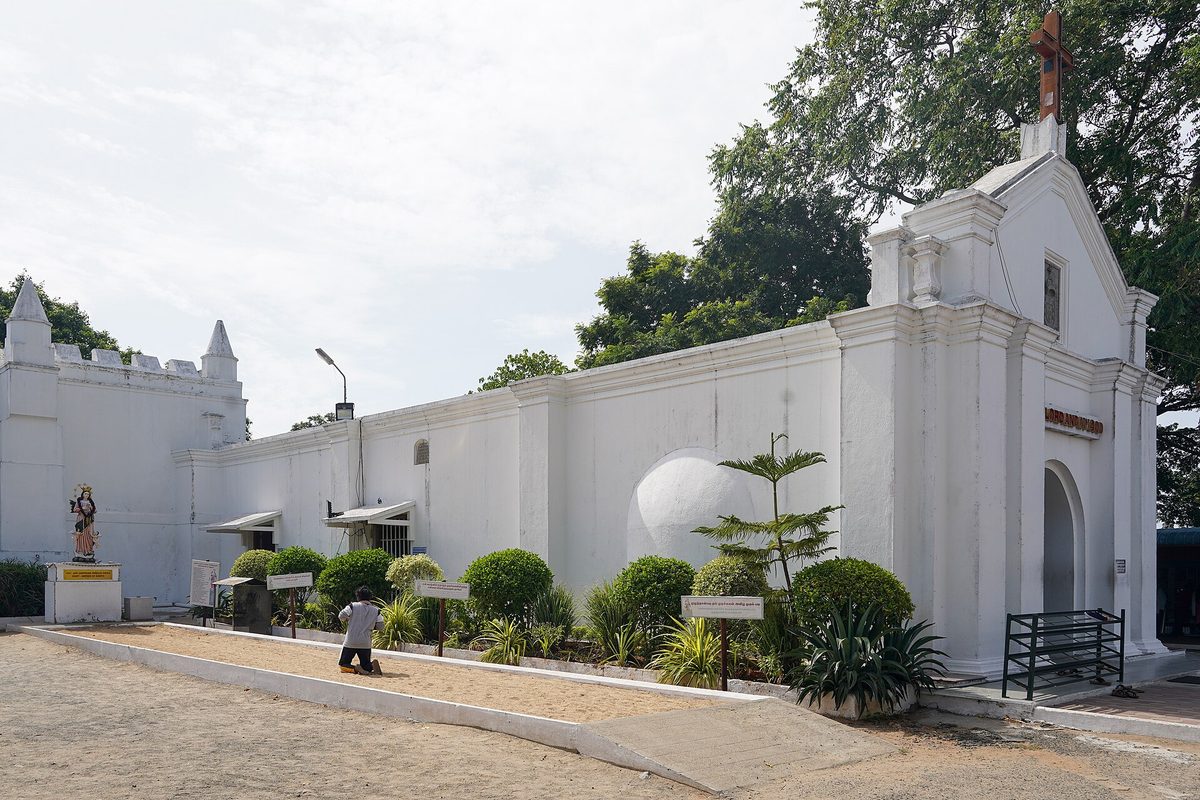
The Thomas pilgrimage ends, as Thomas's own journey ended, in Chennai — Mylapore, to use the ancient name. The Cathedral Basilica of San Thome sits on the Marina seafront, a white neo-Gothic structure rebuilt by the British in 1893 over a much older church that the Portuguese had constructed in 1523 above what they identified as the apostle's tomb.
The tomb itself is in a crypt beneath the high altar. A small reliquary contains what are traditionally identified as a bone fragment and a portion of the lance with which Thomas was martyred — killed, tradition says, by a Brahmin who felt threatened by his growing influence. The exact manner and date of his martyrdom is disputed by scholars, but the Acts of Thomas (3rd century) and the Syriac tradition agree on Mylapore as the site.
San Thome is one of only three basilicas in the world built over the tomb of an apostle: the others are St Peter's in Rome and the Cathedral of Santiago de Compostela in Spain. This is not a minor claim. It places Chennai — Mylapore, Madras — in the same category as Rome and Compostela for Christian pilgrimage.
The church also houses a small museum with relics, artifacts, and documentation of the Thomas tradition. Pilgrims descend into the crypt, pray at the tomb, and surface into the bright Chennai sunlight. Nearby, St Thomas Mount — a low hill a few kilometres inland — is where Thomas is said to have lived and been martyred. The Little Mount shrine (Santhome) is the cave where he sheltered. Both are part of the full Chennai pilgrimage.
Planning Your Pilgrimage: Kerala and Chennai
A St Thomas pilgrimage in South India divides naturally into a Kerala leg and a Tamil Nadu leg. The Kerala churches are spread along the coast and inland, best covered in three to four days. Chennai's Thomas sites — San Thome Basilica, St Thomas Mount, and the Little Mount — can be done in a day.
**Kerala — The Seven Churches Circuit:** Base yourself in Kochi (Ernakulam) for the central and northern churches. Fort Kochi's Santa Cruz Cathedral Basilica, Kottakkavu's St Thomas Church (North Paravur, 30 km north), and Kodungalloor (Cranganore, the landing site, 35 km north) form a natural loop. For Malayattoor, it is 46 km from Ernakulam into the hills above the Periyar River. The southern churches — Niranam, Kokkamangalam, and Nilackal — are best accessed from Kottayam. Allow a full day for the Niranam-Kokkamangalam-Nilackal route; Nilackal (near Sabarimala) is remote but beautiful.
**Kodungalloor (Cranganore):** The Cheraman Juma Mosque here, built in 629 AD, is claimed as the first mosque in India — a reminder that Islam also reached Kerala by sea, in Mohammed's own lifetime, just as Thomas had arrived six centuries earlier. The Kodungalloor Bhagavathy Temple nearby adds a further layer: this has always been a land where religions arrive by sea and learn to coexist.
**Malayattoor:** The climb to Kurisumudi takes about 45–60 minutes on a well-maintained stone pathway. Wear sturdy footwear. The view of the Periyar valley from the summit is extraordinary. Come early to beat the heat; very early if visiting in Holy Week.
**Chennai — Mylapore:** San Thome Basilica is open from 6 AM to 8 PM. The museum is open during church hours. St Thomas Mount (Parangimalai) is 13 km southwest of the Basilica; the climb is 135 steps, with a small chapel at the top containing a painting of the Virgin Mary said to have been painted by St Luke and brought to India by Thomas. Little Mount is 4 km from St Thomas Mount.
**Best time:** October to March. The Kerala monsoon (June–September) is intense and can make the Malayattoor climb treacherous. July 3, the Feast of St Thomas, is celebrated at all sites. Holy Week is the peak pilgrimage time at Malayattoor — powerful, but very crowded.
Two thousand years after Thomas stepped ashore at Muziris, his presence in India is not archaeology but living memory. The churches are full. The pilgrims climb the mountain. The water still flows from the rock on the hillside above the Periyar. Whatever the historical questions, the faith he is said to have planted here has endured longer than almost any other Christian community on earth — and it shows no sign of diminishing.