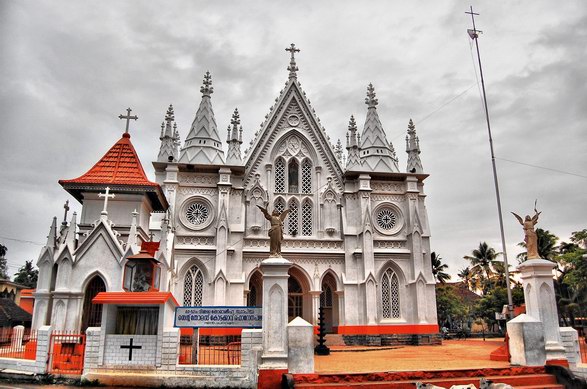
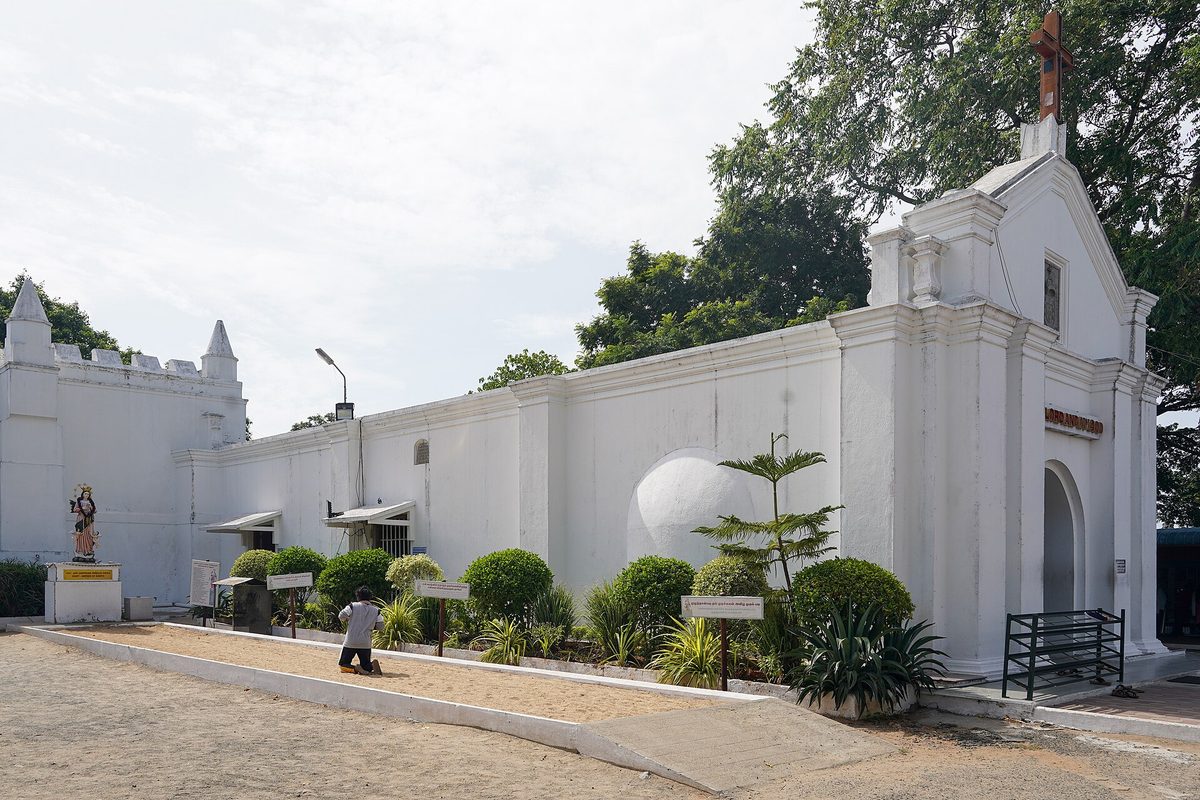
The monsoon does not arrive gently on the Malabar coast. It arrives the way tradition says the apostle did — from the sea, without warning, changing everything it touched. As churches across Kerala mark the July 3rd feast of St Thomas with brass bands, incense, and processions of the Mar Thoma sleeva — the ornate granite cross that is the community's oldest surviving symbol — it is worth asking a question the West rarely thinks to ask: what if the doubter went east, and stayed?
The story Western pilgrims know ends in an upper room in Jerusalem, with a hand reaching for a wound. The story Kerala tells begins there and keeps going — across the Arabian Sea, into a spice port that no longer exists, and into the lives of a Christian community that has now worshipped, married, and buried its dead on the Indian subcontinent for nearly two thousand years, older by some centuries than Christianity in most of Europe.
The Port That Vanished
Tradition holds that Thomas landed in 52 AD at Muziris, the legendary emporium near present-day Kodungallur, a somnolent riverside town about an hour north of Kochi. It sounds implausible until you remember what Muziris actually was: not a backwater but one of the ancient world's great trading crossroads, where Roman ships rode the monsoon winds to load pepper, pearls, and ivory, and where Jewish merchants — some tracing their own arrival here to the time of Solomon — had already built a diaspora community centuries deep. A first-century apostle following trade routes to a cosmopolitan port with an existing Jewish population is not a stretch of geography; it is exactly how the ancient world moved. Muziris itself silted into the Periyar's floodwaters sometime in the fourteenth century and was rediscovered only through the ongoing Pattanam excavations, but its memory survives in the churches, synagogue ruins, and the ninth-century Cheraman mosque — all clustered within walking distance of one another in Kodungallur, a small, remarkable knot of Judaeo-Christian-Islamic memory on one riverbank.
Seven and a Half Churches
What Thomas is said to have left behind, according to the tradition carried down through generations of Kerala's Nasrani families, are seven and a half churches — Ezharappallikal — planted along the coast and the backwaters as he made his way south. Kodungallur came first. Then Kollam (Quilon), Niranam, Nilackal, Kokkamangalam, Kottakkavu near Paravur, and Palayoor, a hilltop church near Guruvayur so old that locals still call the surrounding neighbourhood the "Jews' town" — a memory of the community that worshipped there before it was, tradition says, converted by the apostle himself. The half-church is usually identified as Thiruvithamcode Arappally, just across the modern border in Tamil Nadu's Kanyakumari district — counted as a fraction either because it lay outside the traditional Malabar heartland or because, in the oldest telling, it was left unfinished.
None of the buildings standing today are the originals; wood and thatch do not survive two millennia of monsoons. What survives is something more interesting — a continuous thread of worship on the same ground, rebuilt again and again in stone, each reconstruction absorbing a little more of the surrounding culture. Kerala's old churches do not look like the churches of Rome or Ravenna. They borrow the sloping tiled roofs, oil lamps, and processional deportment of the Hindu temples beside which they have always stood, while granite crosses inside — carved with Persian Pahlavi script and set without a corpus, the cross alone triumphant — mark a Christianity that grew up not Latin but Syriac, shaped centuries later by contact with the Church of the East in Persia.
The Nasranis
The Christians who trace themselves to this founding — the Saint Thomas Christians, or Nasranis, from the Syriac word for Nazarene — did not remain one people forever. Portuguese colonisation brought the Synod of Diamper in 1599, which forced Kerala's ancient East Syriac-rite Christians into union with Rome and burned what Syriac manuscripts it could find; the resulting fractures produced the Syro-Malabar and Syro-Malankara Catholic churches, the Orthodox and Jacobite communities, and the Mar Thoma Church, among others — a family of denominations all pointing back to the same apostolic root. To sit in a Syro-Malabar Qurbana today, with its Syriac chant lines still audible beneath the Malayalam, is to hear an echo of Edessa and Nineveh carried, improbably, into a Kerala nave scented with jasmine and frankincense.
The Long Road South, and the Tomb
The tradition does not let Thomas rest in Kerala. It sends him east across the peninsula to Mylapore, now a crowded, temple-dense quarter of Chennai on the Coromandel coast, where, around 72 AD, he is said to have been killed with a lance on a small hill — St Thomas Mount, or Parangimalai — while at prayer before a cross he had carved into the rock himself, a cross that pilgrims still venerate for its faint, reddish sweating said to appear each feast day. His body, tradition holds, was buried nearby at the site that is now San Thome Basilica.
This is the detail that ought to stop any pilgrim in their tracks: San Thome, rebuilt in dignified neo-Gothic style by the British in 1893 over earlier Portuguese and, before that, purportedly far older structures, is one of only three churches on earth built directly over the tomb of an apostle of Christ — a rare company that includes St Peter's Basilica in Rome and the Basilica of St James in Santiago de Compostela. It recasts Chennai, of all places, as one of Christendom's ultimate destinations — the terminus of a story that, for most Western pilgrims, never seemed to have an Indian chapter at all.
If You Go
Best time to visit: December through February, when Kerala and Chennai are cool and dry. Time a trip around the July 3rd Feast of St Thomas (the community's principal feast, called Dukrana) for full liturgical splendour, or the smaller December 21 commemoration kept in some older calendars.
Start in Kerala: Kodungallur (ancient Muziris), Palayoor, and Malayattoor — a dramatic hill-shrine near Kochi with a major pilgrimage festival each March — give the clearest sense of the seven-and-a-half-church tradition.
Don't skip Niranam or Kollam: quieter, less touristed, and closer to what a fifth-century pilgrim would have actually seen.
End in Chennai: San Thome Basilica in Mylapore holds the tomb crypt (open to visitors, with relics on view); climb nearby St Thomas Mount for the cross and the view the apostle is said to have died facing.
Go respectfully: these are living parish communities, not museums — dress modestly, keep voices low during Qurbana or Mass, and ask before photographing the crypt.
“I have seen the Lord”