
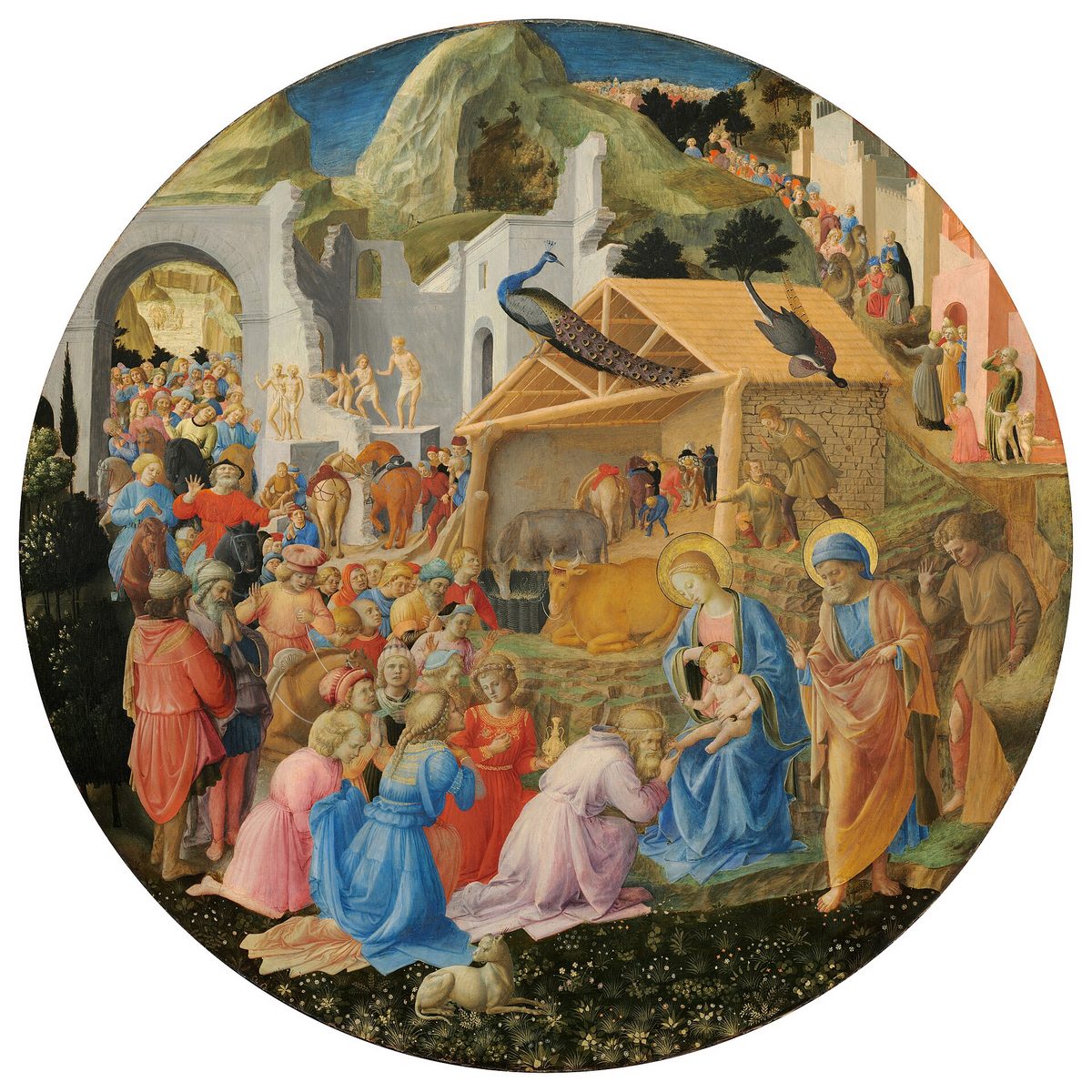
Adoration of the Magi
Adoration of the Magi — Botticelli, c.1475-1476
Sandro Botticelli, Public domain, via Wikimedia Commons
Botticelli's Adoration of the Magi is the painting that established his reputation in Florence — a complex multi-figure composition in which Botticelli included portraits of the Medici family as the Magi and their court. Cosimo de' Medici (the founder, already dead) kneels as the eldest Mage at Christ's feet; his sons Giovanni and Piero appear elsewhere in the crowd; Lorenzo and Giuliano de' Medici (the current generation) stand prominently on the right.
Botticelli himself is believed to appear in the right corner, looking directly out at the viewer. The painting was commissioned by Gaspare di Zanobi del Lama as an altarpiece and hung in Santa Maria Novella; it demonstrates Botticelli's mastery of the complex perspectival and figural challenges of large-group narrative.
The Adoration of the Magi was a popular subject for Florentine patrons partly because it allowed portraiture under religious cover — the Magi's courts, by convention, could include contemporary figures. Botticelli used the convention with particular richness: the Medici portraits give the painting an extraordinary documentary interest, and the quality of individual characterisation within the crowd rivals Ghirlandaio's contemporary portrait frescos. The Portinari Altarpiece by Hugo van der Goes arrived in Florence in 1483 and subsequently transformed Florentine painting's approach to Flemish naturalism; but Botticelli's Adoration predates it and operates in a different tradition of Florentine idealization.
The composition centres on the Holy Family at upper left, with the crowd arranged in a large triangular group descending to the lower right. The ruin behind the Holy Family is a conventional symbol of the Old Covenant giving way to the New.
The three Magi at the foot of the throne are individually characterized portraits: the kneeling figure (Cosimo de' Medici) is elderly and reverent; the two behind him are younger men of different temperaments. In the right-hand group, a young man in yellow-orange (possibly Giuliano de' Medici) stands out. Botticelli himself — young, in a yellow-brown cloak, looking at the viewer — stands at the far right edge.
When standing before this work, look carefully: Adoration of the Magi — Botticelli, c.1475-1476. Give it time — what seems decorative often carries the central meaning.
When standing before this work, look carefully: Cosimo de' Medici kneeling as eldest Mage. Give it time — what seems decorative often carries the central meaning.
When standing before this work, look carefully: Botticelli's self-portrait at the far right. Give it time — what seems decorative often carries the central meaning.
When standing before this work, look carefully: The Medici family as the Magi's court. Give it time — what seems decorative often carries the central meaning.
Uffizi Gallery, Room 41. Often less crowded than the Birth of Venus and Primavera in the adjacent room; well worth extended attention for the portrait content.