
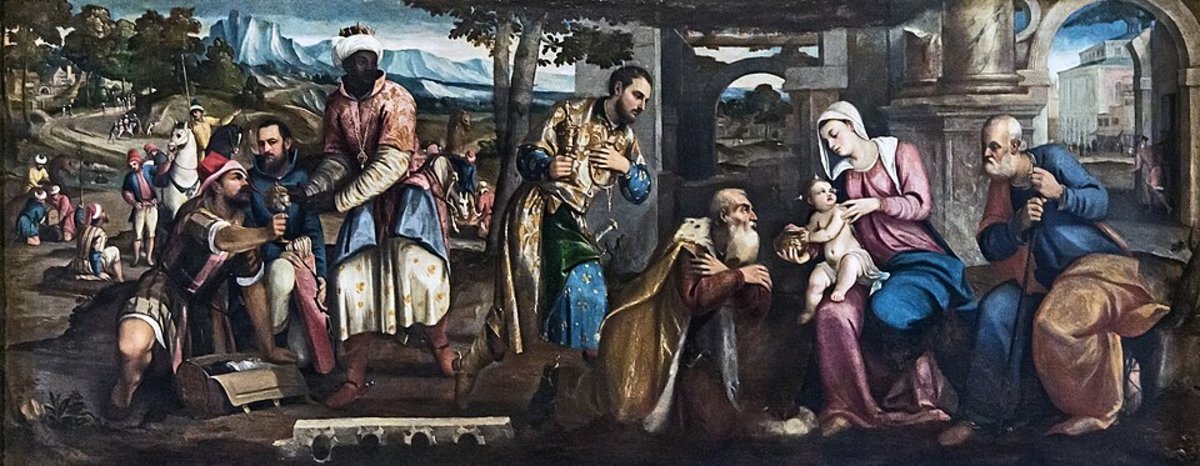
Adoration of the Magi
Adoration of the Magi — Dürer, 1504
Albrecht Dürer, Public domain, via Wikimedia Commons
Dürer's Adoration of the Magi in the Uffizi is his finest surviving altarpiece — a large panel (approximately 100 by 114 cm) painted in 1504, the year he began his second Italian journey and immediately before he left for Venice. The composition shows the three Magi adoring the Christ Child in the ruins of a classical building, the Holy Family at the left, the three Magi kneeling before them.
Behind the figures, a ruined arch and tower dissolve into a detailed landscape with a lake and distant mountains — characteristically German in its precision but Italianate in its spatial depth. The quality of the individual portraits — the oldest Magus (Melchior, the European king) is a portrait study of extraordinary character; the youngest Magus (Balthasar, the African king) is depicted with specific African facial features — demonstrates Dürer's systematic approach to portraiture even in a devotional context.
The Uffizi Adoration was painted just before Dürer's second Italian journey (1505-1507) — the journey during which he painted the Feast of the Rosary (entry 168) in Venice and deepened his engagement with the Italian tradition. The panel shows him on the threshold between his early German style and his Italian-influenced mature style: the Gothic precision is present in the detail of the foreground figure's costume; the Italian Renaissance is present in the spatial depth of the landscape and the unified perspective construction. For Dürer's biographical context, see entry 169.
Dürer includes his own portrait in the composition: the young man standing on the extreme right of the background landscape, looking directly at the viewer. This is one of his several self-portrait insertions into devotional paintings (compare the Landauer Altar, entry 221). The figure's direct gaze — aware of being seen — creates a different level of temporal reality from the sacred event in the foreground.
When standing before this work, look carefully: Adoration of the Magi — Dürer, 1504. Give it time — what seems decorative often carries the central meaning.
When standing before this work, look carefully: Melchior (oldest Magus) — portrait of extraordinary character. Give it time — what seems decorative often carries the central meaning.
When standing before this work, look carefully: The landscape — German precision, Italian depth. Give it time — what seems decorative often carries the central meaning.
When standing before this work, look carefully: Dürer's self-portrait looking out from the background. Give it time — what seems decorative often carries the central meaning.
Uffizi Gallery, Room 21-23 (Northern European masters), Florence.