
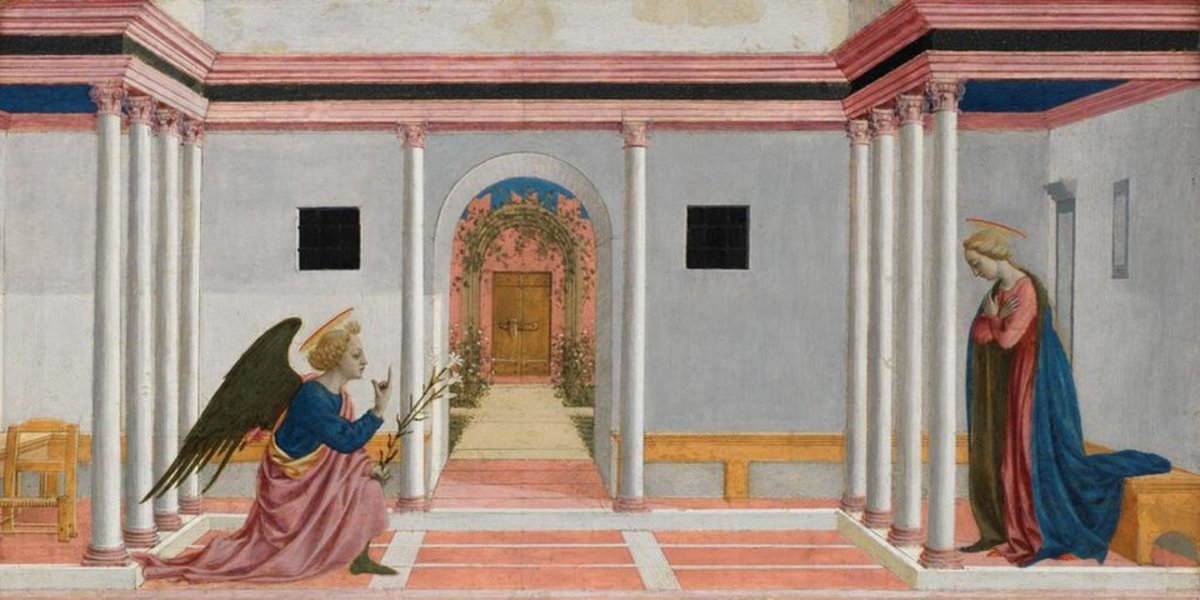
Annunciation (San Martino della Scala Altarpiece)
Annunciation predella — Domenico Veneziano, c.1442-1448
Domenico Veneziano, Public domain, via Wikimedia Commons
Domenico Veneziano's Annunciation (the predella panel of the Santa Lucia dei Magnoli Altarpiece) is a small panel (approximately 27.3 by 54 cm) of extraordinary compositional innovation — showing the Annunciation in a loggia with a closed garden (hortus conclusus) visible through the arches behind the figures. The perspective recession of the loggia's colonnade, the deep spatial relationship between Gabriel and the Virgin (separated by the full width of the panel with a closed door between them — the door of the garden is shut, symbolising Mary's virginity), and the quality of the light (a late afternoon Florentine light that casts long warm shadows across the floor tiles) are all characteristic of Veneziano's approach. This small predella panel is among the most spatially innovative works in the history of Italian painting: the spatial distance between Gabriel and the Virgin, created by the perspective recession, gives the Annunciation a new spatial and psychological meaning.
Domenico Veneziano (c.1410-1461) was a Venetian-trained painter who worked primarily in Florence — he is credited with introducing the Venetian tradition of coloured light (sfumato atmosphere, warm tonal colour) into the Florentine tradition of clear spatial construction. The Santa Lucia dei Magnoli Altarpiece (the main panel is also in the Uffizi) was his most important commission in Florence; the predella panels survive in various collections (Cambridge, Washington) and the Uffizi. For Piero della Francesca's biographical context — Piero was Veneziano's assistant on a documented commission in Perugia — see entry 129.
The closed garden door in the centre of the Annunciation panel is the key iconographic element: the hortus conclusus (Song of Songs 4:12, 'a garden enclosed is my sister, my spouse') was a symbol of Mary's perpetual virginity — the garden is locked and cannot be entered, yet the Angel's announcement has already entered Mary's soul. The door is shut; the Incarnation is accomplished. The specific quality of the afternoon light — warm, long-shadowed, saturating the floor tiles with colour — is Veneziano's contribution to the Florentine tradition.
When standing before this work, look carefully: Annunciation predella — Domenico Veneziano, c.1442-1448. Give it time — what seems decorative often carries the central meaning.
When standing before this work, look carefully: The spatial distance between Gabriel and the Virgin. Give it time — what seems decorative often carries the central meaning.
When standing before this work, look carefully: The closed door — hortus conclusus symbolism. Give it time — what seems decorative often carries the central meaning.
When standing before this work, look carefully: The floor tiles in afternoon light — Venetian colour. Give it time — what seems decorative often carries the central meaning.
Uffizi Gallery, Rooms 7 (Veneziano), Florence. Advance booking essential.