
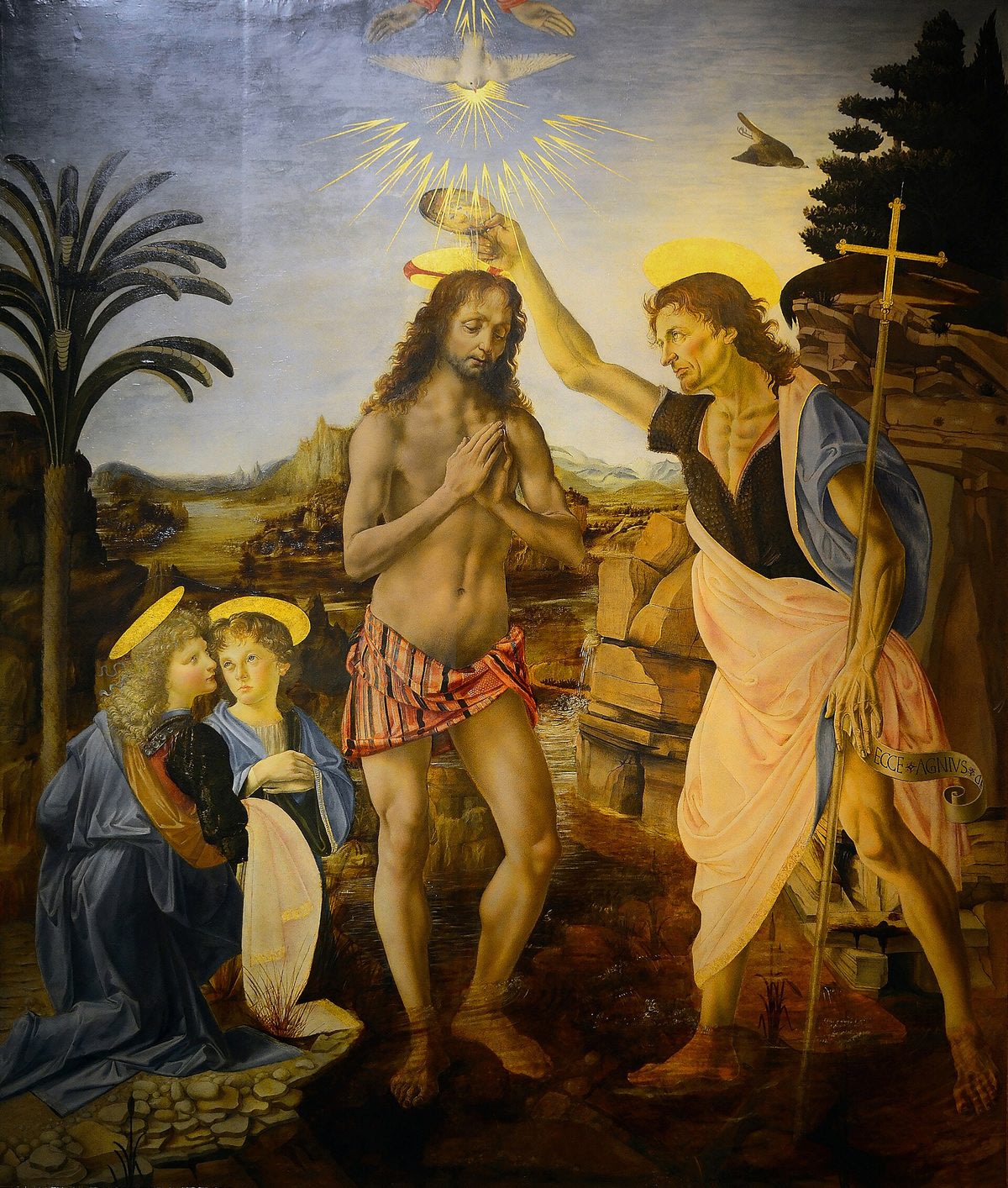
Baptism of Christ (Verrocchio and Leonardo)
Baptism of Christ — Verrocchio and Leonardo, c.1475-1478
Andrea del Verrocchio / Leonardo da Vinci, Public domain, via Wikimedia Commons
The Baptism of Christ by Verrocchio and Leonardo is one of the founding documents of Leonardo's genius — the painting in which the young apprentice's contribution reportedly so surpassed that of his master that Verrocchio, according to Vasari, laid down his brushes and never painted again. The left-hand angel in the Baptism — clearly distinguishable from the right-hand angel and from the figures of Christ and John in its smoky atmospheric quality — is the work Leonardo added to Verrocchio's composition.
The contrast is instructive: Verrocchio's figures are precise, linear, slightly stiff; Leonardo's angel is softer, the contours dissolved in atmospheric haze, the expression inward and contemplative. The moment when one artist's hand yields to another is visible to the naked eye.
Verrocchio (c.1435–1488) ran the most important workshop in Florence in the 1460s-80s; Leonardo entered it as an apprentice around 1466 and remained until about 1476. The Baptism was probably executed between 1475 and 1478, with Leonardo contributing the left angel and apparently some of the landscape background (the hazy mountain landscape behind the angel contrasts with the more conventional rocks on the right). The documentation of Leonardo's contribution to this specific painting comes from Vasari's Lives (1550, 1568), which is not always reliable — but the visible evidence of different hands in the painting confirms collaborative authorship, and the left angel is universally accepted as Leonardo's.
Look first at the two angels: the right angel (Verrocchio's) has a clear, defined profile with sharp contours; the left angel (Leonardo's) has softer edges, a more complex three-quarter turn, and an expression of inward spiritual attention. Then look at the landscape: behind Leonardo's angel, a hazy atmospheric landscape; behind Verrocchio's, conventional rocky terrain.
Christ's figure is Verrocchio's — strong and solid; John the Baptist is similarly clear-cut. The dove of the Holy Spirit descends from above, and God the Father's hands extend from the top. The painting demonstrates, in a single frame, the transition from Early Renaissance to High Renaissance.*
When standing before this work, look carefully: Baptism of Christ — Verrocchio and Leonardo, c.1475-1478. Give it time — what seems decorative often carries the central meaning.
When standing before this work, look carefully: Leonardo's left angel — the atmospheric difference. Give it time — what seems decorative often carries the central meaning.
When standing before this work, look carefully: Verrocchio's right angel — for comparison. Give it time — what seems decorative often carries the central meaning.
When standing before this work, look carefully: Full painting in the Uffizi Gallery. Give it time — what seems decorative often carries the central meaning.
Uffizi Gallery, Florence. Room 35. The Uffizi houses one of the most important collections of Florentine Renaissance painting; the Verrocchio-Leonardo Baptism is in proximity to Botticelli's major works and Raphael's Portrait of Leo X.