
Birth of Venus
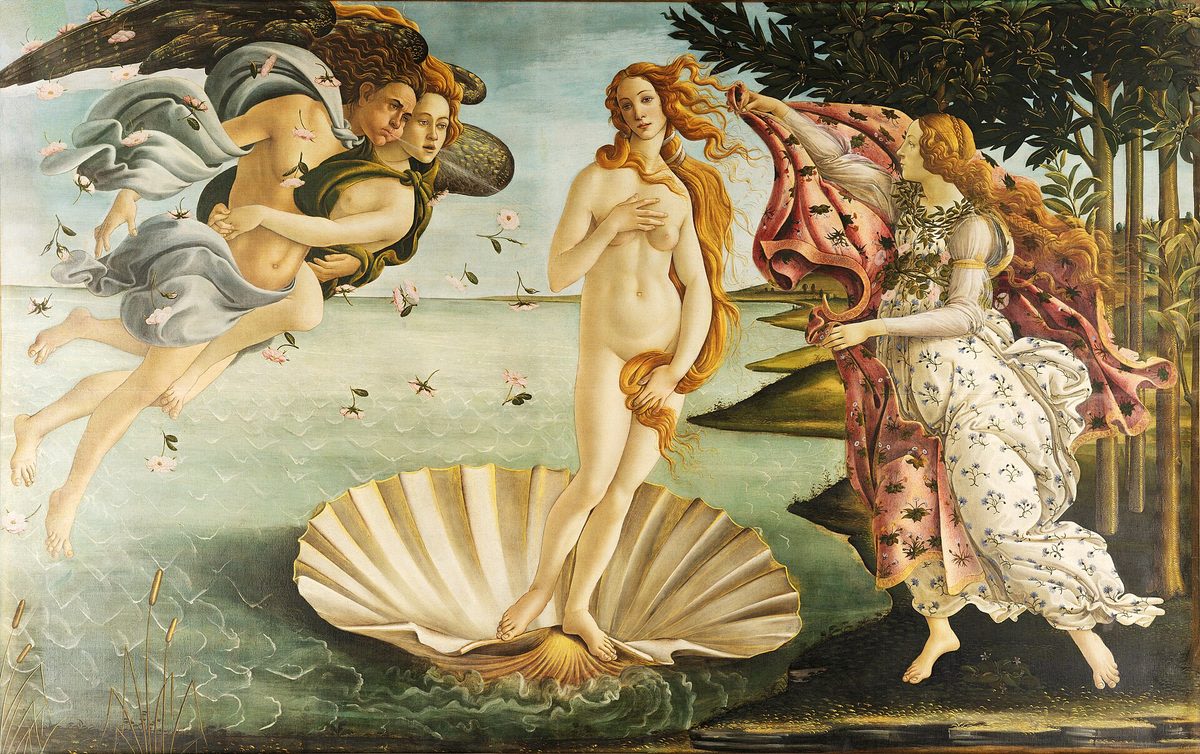
Birth of Venus — Botticelli, c.1484-1486
Sandro Botticelli, Public domain, via Wikimedia Commons
Botticelli's Birth of Venus is the most famous mythological painting of the Italian Renaissance and, alongside the Mona Lisa, the most reproduced painting in the history of European art. It depicts Venus emerging from the sea fully formed, standing on a scallop shell, propelled by the wind gods Zephyr and Aura toward the shore, where a Hora (one of the goddesses of the seasons) waits to clothe her in a flower-embroidered mantle.
The theological and Neoplatonic significance is that Venus Caelestis (celestial beauty, divine love) is born from the sea of matter and comes to earth — a mythological analogue to theological ideas about the soul's incarnation. In the Medici Neoplatonic framework, the beautiful nude goddess is a pagan figura of the generation of divine beauty.
The Birth of Venus was probably commissioned by Lorenzo di Pierfrancesco de' Medici (the Primavera's patron) around 1484, after Botticelli's return from Rome where he had painted frescoes in the Sistine Chapel. It is unusual in Renaissance painting as a large-scale mythological nude — a category of painting that would only become common in Venice in the next generation.
The iconographic source may be Poliziano's Stanze per la Giostra, which describes Venus's birth from the sea in a passage closely related to what Botticelli painted. The model for Venus's face was likely Simonetta Vespucci, the great beauty of the Medici circle who died young in 1476 and was celebrated in verse by Lorenzo de' Medici and Poliziano.
The Venus figure is painted in Botticelli's characteristic elongated style — her neck is longer than anatomically possible, her shoulders slope at an angle that is structurally impossible but aesthetically perfect, her hair is impossibly abundant and falls in the precise S-curves of Botticelli's line. This deliberate deviation from anatomical accuracy is a statement about the nature of ideal beauty: it transcends the natural.
The wind figures to the left are intertwined in complex drapery; the Hora to the right is dressed in a gown embroidered with spring flowers (cornflowers, daisies, etc.) of botanical precision. The sea surface and the sky are flattened to near-abstraction — the painting is not realistic space but ideal space.
When standing before this work, look carefully: Birth of Venus — Botticelli, c.1484-1486. Give it time — what seems decorative often carries the central meaning.
When standing before this work, look carefully: Venus's face — the Simonetta ideal. Give it time — what seems decorative often carries the central meaning.
When standing before this work, look carefully: Zephyr and Aura — the wind gods. Give it time — what seems decorative often carries the central meaning.
When standing before this work, look carefully: The Hora with the flower-embroidered mantle. Give it time — what seems decorative often carries the central meaning.
Uffizi Gallery, Room 41. One of the two or three most photographed objects in Italy — plan for crowds. The best time to visit is when the museum opens or in the final hour before closing.